When most .NET developers hear Redis, they think of caching. That is the most common use, but since Redis is a fast in-memory store that all your servers can share, it can solve a lot more problems. Here are 10 use cases worth knowing.
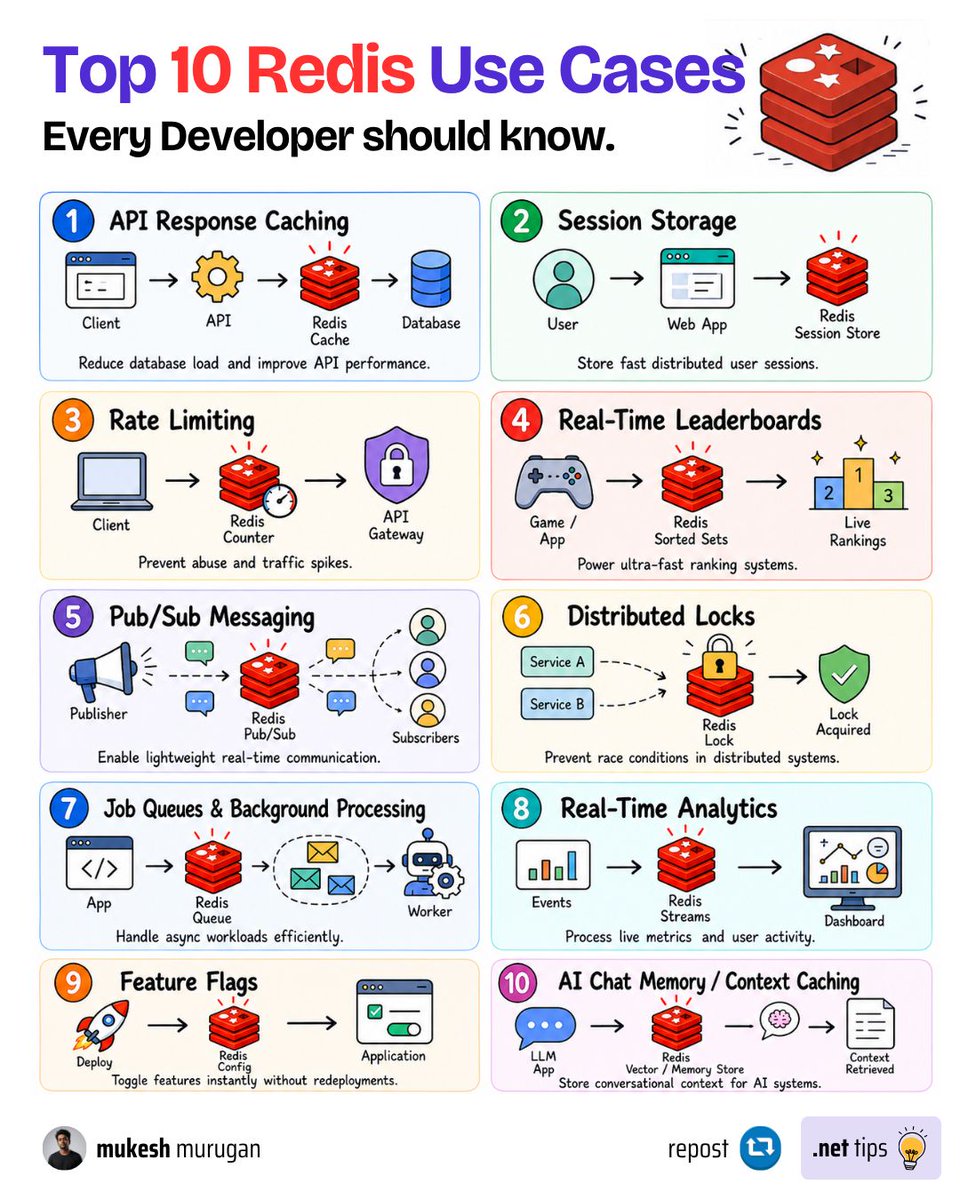
1. API response caching - Reduce database load and speed up your API.
2. Session storage - Share user sessions across multiple servers.
3. Rate limiting - Count requests per client with a short expiry.
4. Real-time leaderboards - Sorted sets keep scores in order for you.
5. Pub/Sub messaging - Send lightweight real-time messages between services.
6. Distributed locks - Make sure only one instance runs a job at a time. Always set an expiry on the lock.
7. Job queues - Push work to a queue and let a background worker process it.
8. Real-time analytics - Redis Streams can collect live events for dashboards.
9. Feature flags - Turn features on or off without redeploying.
10. AI chat memory - Store conversation context for LLM apps.
In general, Redis is a good fit whenever several servers need to share fast, short-lived data.
I have covered distributed caching with Redis in my free .NET Web API Zero to Hero course, with complete source code on GitHub. Link is in the first comment.
Save this for later, and follow me for more posts like this on .NET and Redis.
What are the best practices for API error handling in .NET?
I always start with this: API errors need to be presented in a consistent way.
- Provide a clear and consistent structure for your error response
- Implement logging and monitoring
- Use descriptive error messages
- Document common errors
- Don’t leak sensitive data
Wouldn’t it be great to have a standard for returning API errors?
Surprise... There is!
It’s called Problem Details.
You can learn more about API error handling best practices here: https://t.co/dEwBMMRCAX
Scaling from “handles normal traffic” to “handles the storm.”
Rebuilding our event processing to scale out automatically when load spikes — queue partitions, containers, and KEDA doing the work so nobody has to be awake for it.
https://t.co/nt7beGWv8V
#Azure#CloudArchitect
New Peacock for @code Release - v4.3
Highlights:
- one‑time Modern UI detection & in‑product guidance for workbench.experimental.modernUI (colors may be invisible when enabled)
- new settings & commands (window border coloring, SideBar darkness command, active-tab background option, improved @Cursor support)
- several fixes for status bar, activity bar, remote fallbacks, and more.
Full details: https://t.co/rEOpaS3OfW
Claude Code 2.1.91 has been released.
13 CLI changes
Highlights:
• disableSkillShellExecution disables inline shells in skills and plugin/slash commands, improving safety
• MCP accepts _meta["anthropic/maxResultSizeChars"]=500K to allow large outputs like DB schemas untruncated
• Fixed --resume transcript chain break that dropped history on async write failures, preserving resumed history
Full details are in thread ↓
Scaled our API to serve thousands of clients with zero manual work using Azure API Management
One endpoint. Multiple tenants. Automatic parameter injection. Self-service signup.
Full breakdown: https://t.co/IhkVkRH4Yh
Built an event-driven architecture 2 years ago as an experiment and still running strong!
New post with lessons learned and tips for Azure + Redis.
https://t.co/8kQFOs9F0o
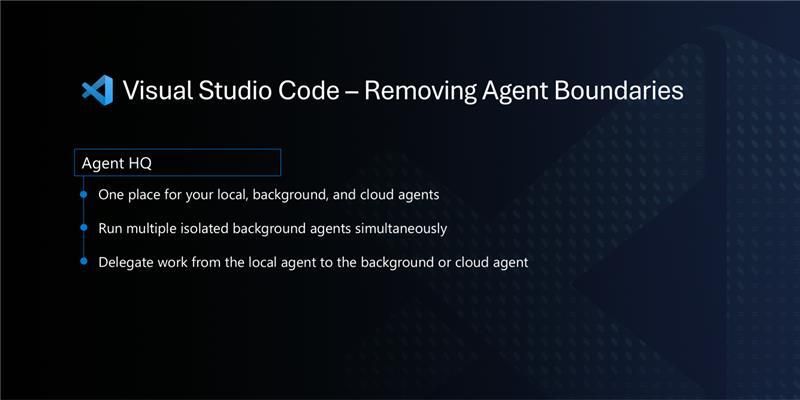
The agent experience in @code just got a major upgrade.
With today's release, you'll see:
✨ Agent sessions integrated into the chat view for a unified experience
✨ Support for isolated background agents powered by Git worktrees
✨ Seamless delegation across agents
🧵
A simple, fluent, extensible, and fully customizable library for throwing exceptions using .NET 6+.
https://t.co/Ehl20baNGK by @amichaiman #dotnet#dotnet6