Before you give a coding agent write access to GitHub, push a test branch yourself and see what CI runs. If that push can deploy to prod or read prod secrets, give the agent a sandbox repo first.
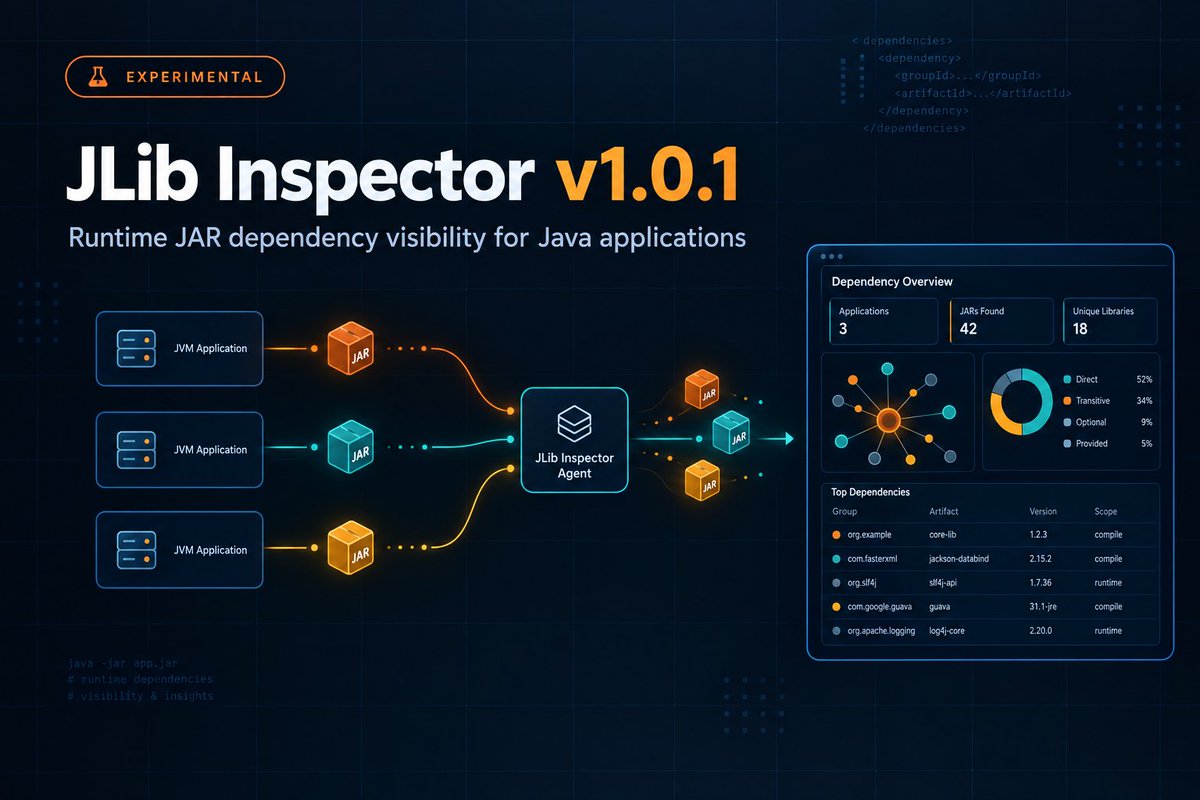
JLib Inspector v1.0.1 is out! 🚀
It’s a Java agent, server, and dashboard that shows which JARs applications actually load at runtime, helpful when investigating dependency and vulnerability exposure.
This release improves dependencies, security, Maven 4 support, and CI.
https://t.co/mwqxOcedub
#Java #OpenSource #DevSecOps
A good design system makes it harder for both humans and AI agents to make bad decisions.
In this ideal setup, tokens come in two layers:
- *Primitives* are the raw values without meaning: sand.1000 is rgb(130, 130, 124).
- *Semantic tokens* define roles: content-tertiary points to sand.1000 in light mode and ink.1000 in dark mode.
This has two benefits:
1. Your agent refers to roles, not arbitrary values.
2. Theme switching happens automatically by changing the primitives behind the semantic tokens.
Both of these benefit agents and humans because they reduce the margin for error.
You, and your agent, are less likely to use content-tertiary for a heading than an arbitrary hex value like #432154. The token communicates its purpose, a raw hex value has no real meaning to it.
And when theming is handled through semantic tokens, you don't have to rely on manually adding Tailwind's dark: modifier everywhere.
This is nothing new fwiw, this approached has worked for years. What works well for humans, will likely work well for agents as well.
If an agent adds relationships between notes, mark those edges as inferred and keep the supporting passage. The next agent needs to see where the connection came from.
Two new agent skills! @obsdmd-@excalidraw CLI creates drawings, mind maps and Automation Scripts.
👉 https://t.co/oMokRunI96
K-Plex CLI explores note relationships, edits ontology, and exports maps to markdown.
👉 https://t.co/UWPkdsWvDt
if you want to actually understand how a production backend works, i put together a free learning path for it
backend engineering fundamentals, 9 articles in order:
- HTTP & routing
- serialization, auth & authz
- validation, controllers, middlewares
- REST API design
- Databases in depth (3 parts)
- Caching, task queues, logging
- Security, scaling & concurrency
Long form, no fluff, no signup. You can mark articles as done as you go
https://t.co/tSbhsvdodk
(bookmark it for your next interview prep)
18 months ago, I started building a tool to unlock the creative potential of open models.
12 months ago, I thought it was ready for testers.
1 whole year of struggle later, it finally is!
Story in video, jump to 1:24 to see a demo. Beta link below. https://t.co/LziD0SNFLI
I use my custom fields package for my relaticle open source CRM and I just added a date attribute 'last contacted' to people in a test workspace. No migrations ran. It just showed up as a column in the people table and on the record. This is why I built the package.
What if one prompt gave you a rigged, animated 3D character? 🤔
@tanstack/ai-meshy chains @MeshyAI jobs by jobId:
mesh → textures → skeleton → motion.
You can even prompt the motion: "raise the sword, slam it down." ⚔️
Check it out below 👇
Vercel Board has been lighting my brain on fire for the last few days
It's a genius idea, but I think most teams should build it from scratch
Basically just a private Slack workspace for your agents AND developers (which can even sync to Slack channels for better observability)
The idea (not necessarily Vercel's implementation of it) makes so many things simple:
1. Collaborative grilling
Each locally running agent has its own identity on the board. As does every human!
That means if you're grilling with an agent, and you need to ask someone a question, you just get your agent to ping them (or, ping their agent!)
2. Locally running agents
This setup feels awesome for connecting locally running agents to the rest of the organisation.
"Unread messages" could form a queue (Vercel board doesn't do this AFAIK) which would allow remote agents to ping messages to local agents, which would get picked up when they wake up.
This would allow seamless communication between remote and local, and aid companies looking to make the leap to remote agents.
3. Schedules
Want to schedule a cron? Just trigger a repeating message to an agent. I love how simple it makes the mental model.
4. Multi-vendor setups
Creating a vendor-agnostic version of this would be sweet - a seamless collaboration environment for all of your vendor-locked servers/harnesses.
5. Deterministic workflows as commands
One opportunity I see for Vercel Board is to allow for registering deterministic workflows as `/commands` - i.e. running review agents or implementer agents.
This would allow you to mix and match agents and workflows in a really lovely way, and agents could themselves trigger workflows which report back via the board.
Overall my brain is on fire, just wanted to share
https://t.co/RnbGsFyqAM