Moverte también es cuidar cómo envejeces. El ejercicio ayuda al VO2 max, la fuerza y la salud articular. La inactividad pesa más de lo que pensamos.
#Ejercicio#VO2Max#Salud#Aprendemosjuntos
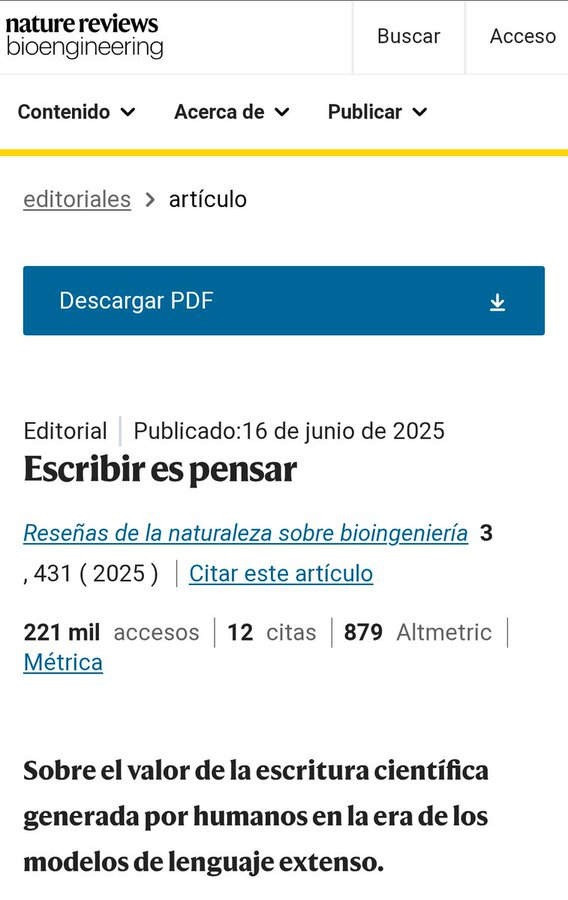
En la era de la IA, este artículo de Nature recuerda algo clave
Escribir es la forma más sofisticada de pensar te permite descubrir y construir ideas
No es solo registrar ideas: es obligarte a ordenarlas, descubrir contradicciones y generar nuevas https://t.co/ypq8rOuUEW
Un reto educativo que ha intensificado la IA es la evaluación.
¿Y si en lugar de intentar "erradicarla" de los exámenes, la integrásemos para mejorar todo el proceso?
Los exámenes socráticos son un instrumento que propone usar esta tecnología para conversar, adaptar y medir el razonamiento real del estudiante.
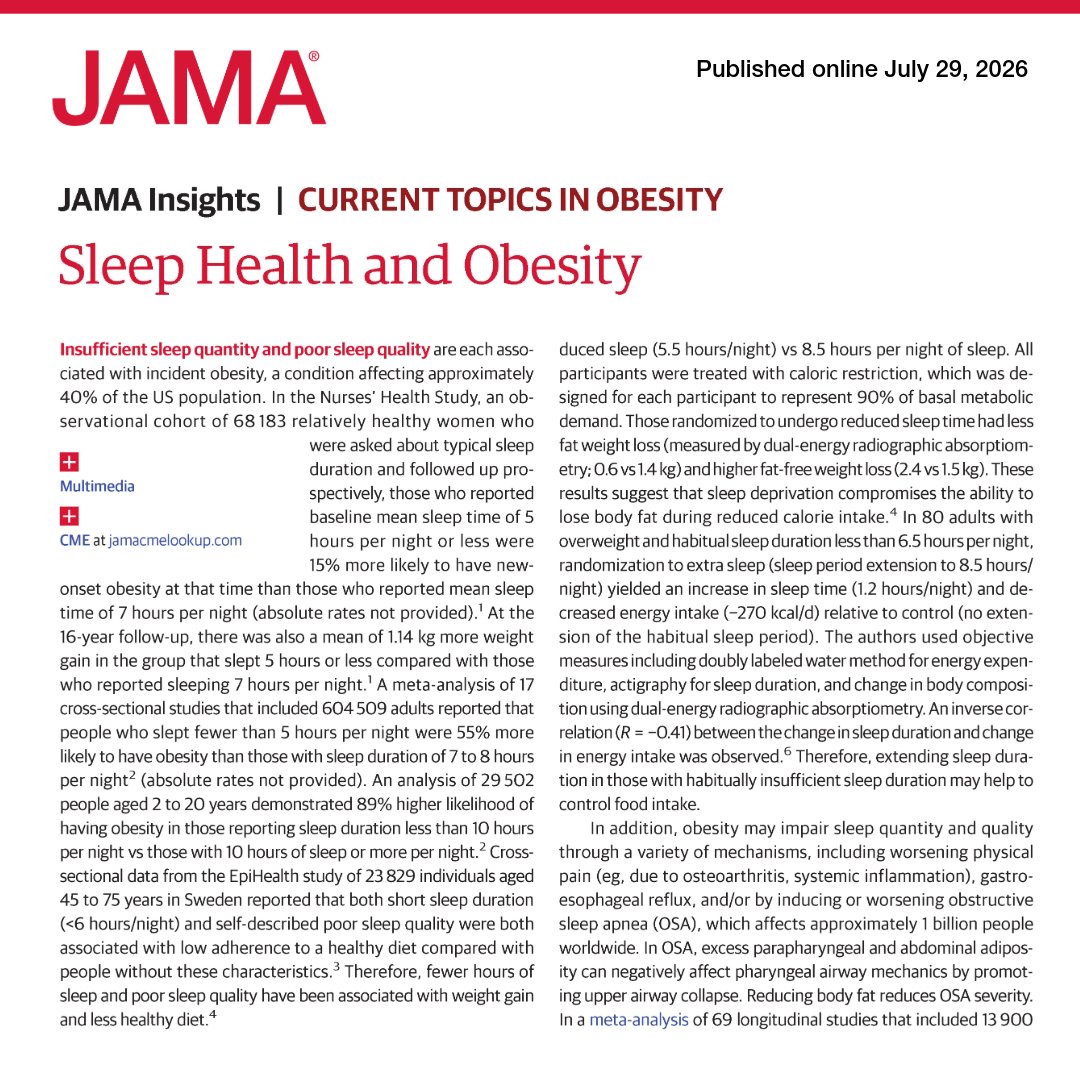
💡 JAMA Insights: #SleepHealth and #obesity are linked, with insufficient sleep quantity and poor sleep quality associated with weight gain, less healthy diet, and incident obesity.
https://t.co/SEj9dwNHiW
This review examines the evidence for continuous #glucose monitoring use beyond type 1 #diabetes or #pregnancy, explores its usefulness as a behavior change aid, and critically assesses its expanding role in the care of people with dysglycemia. https://t.co/IueFPPzWjl
✅ Editor's Choice: Age-related macular degeneration (AMD) is a progressive #retinal disorder and a leading cause of severe vision impairment in older adults.
Late-stage disease presents as geographic atrophy or exudative neovascular AMD, and intravitreally administered anti-vascular endothelial growth factor treatment is the first-line therapy for exudative neovascular AMD.
💾 Save it for your bibliography: https://t.co/ciDG7HdMwu
This paper is f*cking brilliant
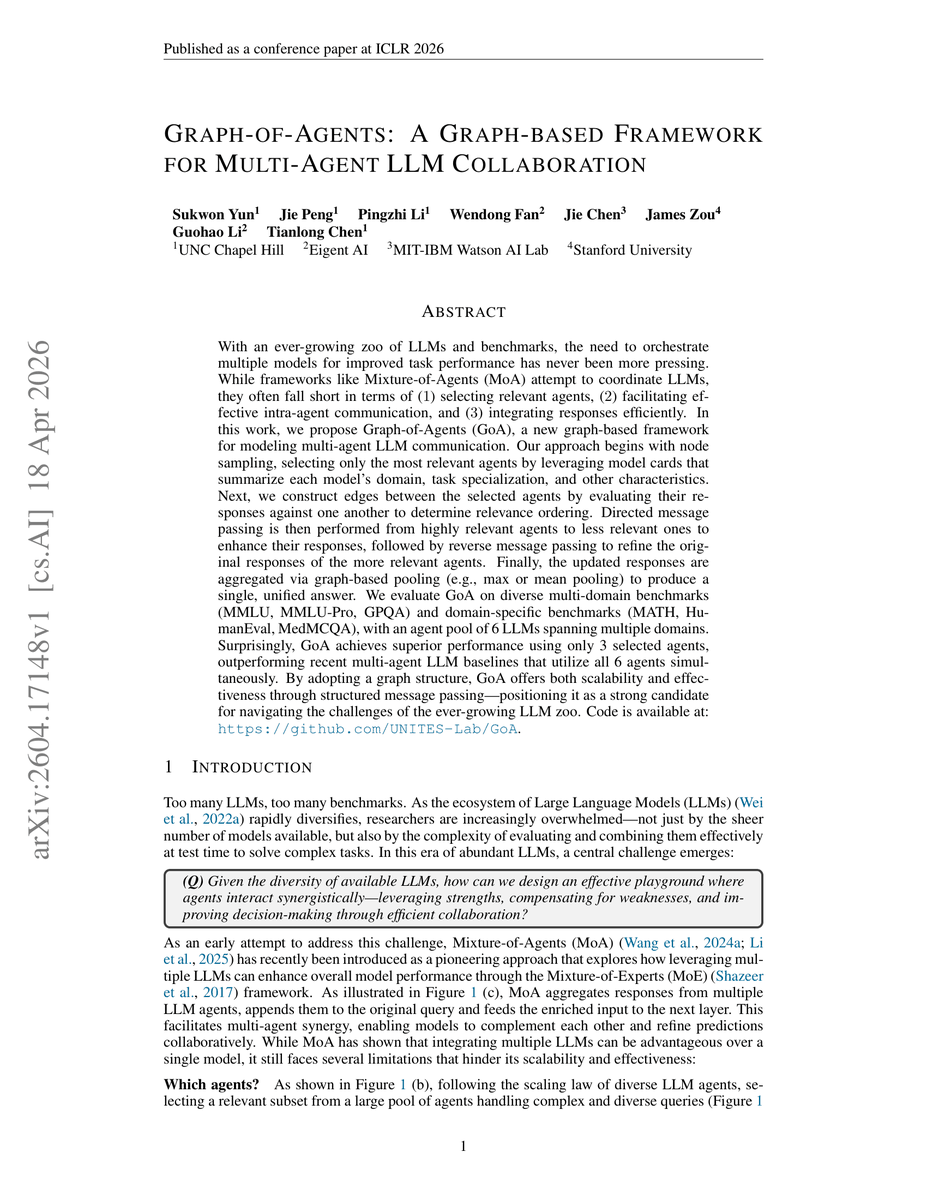
A computer science paper replaces Mixture-of-Agents with Graph-of-Agents for multi-LLM collaboration
The result: structured node sampling, directed message passing, and graph pooling deliver state-of-the-art benchmark scores using only 3 active agents instead of 6
The crazy part is how graph engineering cuts multi-agent inference cost while improving decision accuracy
Relevant model nodes are sampled via domain cards, directed edges pass responses from expert to generalist models, and graph pooling aggregates final consensus
Most multi-agent architectures blindly feed every query to every model in the pool
This framework converts multi-agent collaboration into an optimized communication graph
Read the complete paper + article below
Bookmark it for future reference
IBM just dropped a 100% free 1-hour course on mastering Graph Engineering from scratch.
this is the clearest breakdown of graph memory and multi-agent orchestration you'll find anywhere :
• 00:00 - Introduction to knowledge graphs
• 05:35 - Building your first agentic graph
• 19:59 - Agentic memory powered by graphs
• 30:39 - Graphs for multi-agent orchestration
it replaces 10 paid courses on agentic engineering.
watch it today, then read the article below on how to become a knowledge graph engineer ↓
Un neurocientífico de Stanford afirma que el cortisol crónico reduce la memoria, hace crecer el centro del miedo y deja al cerebro con la sensación de haber sido secuestrado.
Aquí tienes 8 cosas que yo haría a diario para reducirlo de forma natural:
1. Caminar descalzo sobre el césped durante 5 a 7 minutos.
Somebody uploaded a phone recording of a Harvard algebra class from 2003, and it teaches one idea better than any polished course I've paid for.
The camera barely moves. A chalkboard, bad lighting, an instructor who clearly isn't performing for a camera. It's Benedict Gross, a real Harvard math professor, opening a course called Abstract Algebra. The kind of title that makes most people click away.
But watch what he actually does. He draws a little box of four numbers, a and b on top, c and d underneath. A two by two matrix. Nothing scary. Just four numbers in a square. Then he asks one question: can you undo it? Can you run this thing backwards and land exactly where you started?
Instead of hand-waving, he gives you a single test. Multiply a by d. Multiply b by c. Subtract. If that number, ad minus bc, is anything other than zero, the box can be reversed. If it comes out to zero, it can't. The whole thing collapses, folds the plane onto a line, and you can never get back what you started with. One subtraction decides everything.
Then the quiet payoff. He points out that all the boxes that pass this test fit together. Combine two of them, you get another one. Every one has a partner that undoes it. That neat little club has a name, a group, and the whole rest of the course grows out of that one word.
Four numbers in a square quietly became the reason your phone can rotate a photo and rotate it back. No music, no thumbnail bait. Just the moment where a box of numbers turns into something you can actually point at.
The math is free and public. So is the lecture. What nobody can hand you in one video is the feel for when a system is about to quietly break, right before the numbers blow up. That feel is the real edge, and it's built over a semester of doing it by hand, not one clip.
Why do some companies have customers... while others have fans?
I used to think I knew the answer. Then I watched a founder pitch a genuinely better product than his competitor's, in front of investors who clearly agreed... and still lose the deal.
He led with what he built.
His competitor led with why he built it.
Apple never sold computers. Nike never sold shoes. They sold a belief first, and let the product prove it.
"People don't buy what you do. They buy why you do it." — Simon Sinek
That's the core idea behind his Golden Circle.
Most companies communicate from the outside in.
What → How → Why
"We build software."
"We offer consulting."
"We sell courses."
That's not a pitch. That's a receipt. It tells people what happened, not why it matters.
Inspiring companies do the opposite.
Why → How → What
They start with the belief, move to the principles that protect it, and let the product show up last, as proof.
Here's why the order matters so much.
Your brain doesn't process Why and What in the same place.
The neocortex handles facts and figures. It's rational, but it doesn't drive decisions on its own.
The limbic system handles feeling and trust. It has no capacity for language, which is why "I don't know, it just feels right" is a real sensation, not an excuse.
When you lead with What, you're talking to the part of the brain that analyzes.
When you lead with Why, you're talking to the part of the brain that decides.
That's the whole game.
When people understand why you exist:
→ Your message becomes memorable instead of forgettable
→ Your brand earns trust before the sales pitch even starts
→ Customers become advocates instead of one-time buyers
→ Employees show up committed instead of just compliant
Your What explains your product.
Your How explains your process.
Your Why explains why anyone should care in the first place.
And here's the part most people miss.
If your What ever contradicts your Why, people feel it immediately, even if they can't articulate what's off. That's the moment trust quietly breaks.
That's what separates companies people buy from...
...from companies people believe in.
I've summarized the core ideas from Start With Why into the infographic below.
Question: can you describe your company's Why in one sentence?
—
@natan_mohart
Programa Ejecutivo de Certificación Internacional en Servicio al Cliente:
4 días de inmersión total, o 10 sesiones en línea, para certificarse en una metodología estructurada para construir una Cultura de Servicio, y TRANSFORMAR la experiencia del cliente.
Solicite el temario:
Gilbert Strang, a quiet MIT professor, picked up a piece of chalk and explained the one skill standing between you and every account you have ever blown.
MIT put the entire course online. it has been free for over twenty years. almost nobody finishes it.
His point: the market never pays in certainties. it pays in probabilities, and a human gut can barely hold one straight. the math that holds ten thousand at once, weighs them, and collapses them into a single call is linear algebra. it is the branch Citadel and OpenAI both pay $400K to hire for.
he is not a trading guru. his 18.06 lectures are the most watched math class on the planet.
Skip to where he turns a wall of numbers into one vector. a single object carrying a thousand odds at once, in notation a beginner can follow.
No slides. no jargon. one piece of chalk.
a quant I know rewatches lecture one every year before he sizes a single position.
You do not have a strategy problem. you have a math problem. the fix has been free for two decades, and you are still guessing.
In 2008, Malcolm Gladwell explained why some people succeed and some don't in a single 1-hour talk.
This will permanently change the way you think about talent, effort, and success.
Bookmark & watch today, no matter what.
INSTEAD OF WATCHING AN HOUR OF NETFLIX TONIGHT.
This 1 hour Stanford lecture by Joel Peterson will teach you more about negotiation and getting what you want than most people learn in years.
Bookmark it and give it an hour, no matter what.