🧵1/ Our first meta-science paper (with 350+ coauthors) is published today in Nature. It presents one of the largest-ever reproducibility projects in economics & political science.
Here’s what we found 👇
@nickcammarata i'd love to know if it would replicate in the general population. maybe there are a bunch of lay person arhats out there centred in their heart and experiencing joy
@nickcammarata it's interesting to think about what an academic study of suffering mechanics looks like though? we probably need much better measurement...
@nickcammarata if we're right, academics will get there, and hopefully bring some segment of society with them. we're in the willow bark stage of happiness science, folk experts know what works, but it will take a while for scientists to isolate salicylic acid
The McGill-UofT Wellbeing Seminar is back! Join us monthly for online talks with researchers on key well-being topics. Each 3-month mini-series features two perspectives, followed by a panel discussion. Talks are at noon EST on select Tuesdays. 📷
@phyllis_lun@pwb_lab Thanks Phyllis! Let the record show that the report could not have happened without Phyllis. I learned a lot from you about getting things done and out the door.
Oh, finally, we put up all our code and data (except the Gallup World Poll stuff, sorry) to replicate the report on OSF: https://t.co/wsO82wtpzA. If you want all the Canadian well-being data in one place, to play with, or for student projects, etc., it might be helpful!
11/10
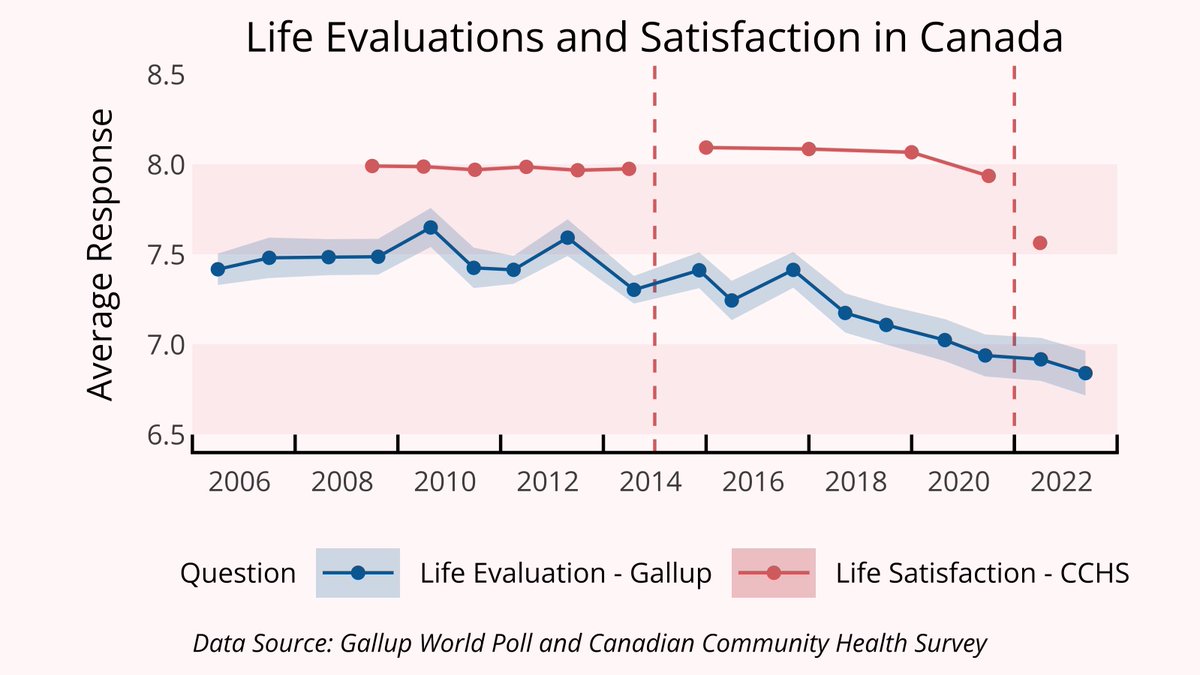
Today the @pwb_lab and I publish the 2024 Canadian Happiness Report! Confirming the findings of @HappinessRpt, Canadians do feel that the quality of their lives are declining, however they remain very satisfied with these lives (especially before the pandemic)! 🧵
1/10
This project has inspired the @pwb_lab to think about how we can do data collection well, how much subjective well-being data is being impacted by context, and to think again about what questions we ask and when they’re equivalent. I will follow up with a thread soon.
10/10
@alz_zyd_ I also wonder if the systems you're trying to manage are public markets, governments, institutions if you do not have a responsibility to make your intuitions and predictions formal and legible. Is that what economists are up to?
@alz_zyd_ Just because complex systems are typically managed with poor prediction doesn't seem like a reason that economics (or whatever social science is trying to improve social systems) should not try to do it better.