Your future isn’t being stolen from you.
You’re handing it away…
One comfortable decision at a time.
The hardest prison to escape
is the one that feels comfortable.
The cage was never locked.
You just got comfortable inside it.
No. 19 overall pick @allengraves_5 did a little bit of everything for the @Raptors tonight...
▪️ 23 PTS (team-high)
▪️ 6 REB
▪️ 4 AST
▪️ 1 STL
▪️ 2 BLK
▪️ 4 3PM
Toronto moves to 3-1 in NBA Summer League play!
Allen Graves was one of the first prospects the Spurs brought into the facility for a private workout. At pick #20, I wouldn’t be surprised if his name was called. Sign me up for a poised, play-making PF that can stretch the floor and is a dog defensively.
This isn’t remotely true, Rachel. It’s not 2020 any more either. The people who took your NBA job because you were a white woman aren’t ever going to give it back to you no matter what you say about Trump.
Things you can do as an athlete:
- beat your wife
- abuse your kids
- run from the cops
- do insane amounts of drugs
- go to strip clubs
- bet on games
Things you can’t do as an athlete:
- Support the current President
“Let’s be honest. Who you supported in 2008, 2012 is nowhere near as polarizing as who you support today”
Jaxson Dart seems to be a good young man. He can support whoever he pleases, but that support affirms certain things to his locker room. Abdul Carter should have handled things differently, but his disappointment is understandable.
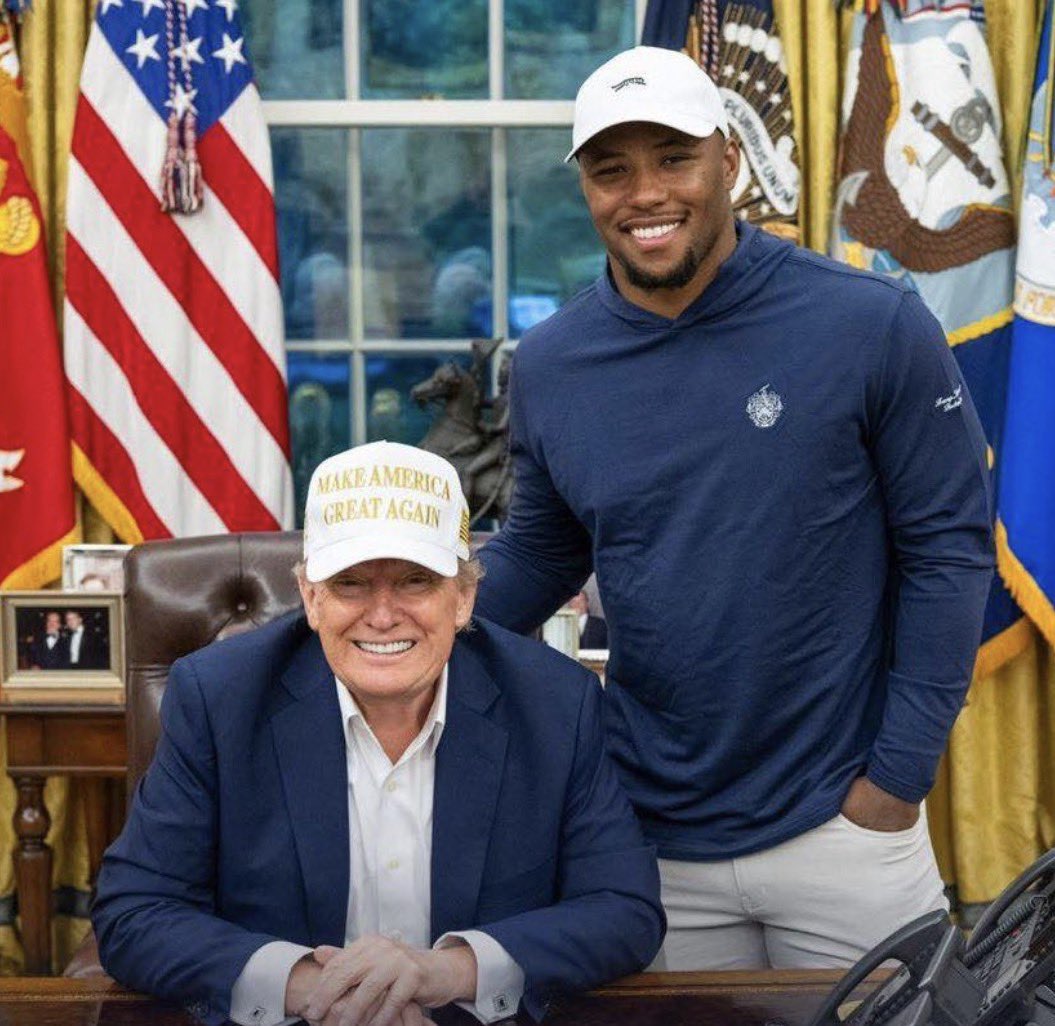
The President has clearly picked a side, & standing next to him gives the impression that you have to. Which means you stand in direct opposition of the majority of your teammates. It’s a conversation to be had behind closed doors, but it is an important conversation.
@thepivot clips on @youtube.
#ThePivot #JaxsonDart #AbdulCarter #NYGiants
https://t.co/OPayDlPS5E
Green Bay Packers running back Josh Jacobs has been arrested for allegedly strangling and suffocating a woman. Which sounds bad. But it could be worse per sports media — he could have introduced President Trump at a rally.
Won’t ever forget this and the season from Allen Graves man
So long partner 🫡
Any NBA team will be fortunate to have him, another NBA Santa Clara Bronco on the doorstep
For the record.
Jamie Dimon says he wants a “level playing field” for stablecoins. What he really wants is to make sure nobody can offer you a better deal on your own money than tradtional banks can. The president is right to call the banks out on this.
We’ve seen this before. In the 1970s, money market funds started paying real yields while banks were locked under deposit caps. Banks cried “unfair” and “unsafe,” lobbied furiously, and lost. Policymakers chose competition over protection; savers got paid, and banks had to adapt instead of suffocating the threat.
Today’s script is the same, just with better technology. Stablecoin issuers now operate under licensing, 1:1 high‑quality reserves, liquidity and risk rules, audits and strict AML standards. This is not the Wild West. Yet Dimon still talks as if they exist with “no reserves, no compliance, no oversight.” He’s not describing reality; he’s describing a story that justifies shutting down a rival funding system.
The Clarity Act is the real battlefield. On paper, it’s about integrating crypto into U.S. market structure. In practice, the big banks are fighting to ensure that anything that looks like a deposit with yield must either become a bank product or be regulated into irrelevance. “Level playing field” in their vocabulary means: everyone wears the bank straitjacket, or no one plays.
Why? Because yield‑bearing stablecoins blow up the quiet cartel behind record profits. Banks live on deposits that pay close to nothing even when risk‑free rates are high. They earn a clean spread and interest on balances parked at the Fed, while passing little of it through. Savers get crumbs; banks get the margin; inertia does the rest. A credible, regulated stablecoin that passes through money‑market yields detonates that racket: with a few clicks, your cash can leave the cartel.
The president’s critique goes straight at this arrangement: Americans should “earn more money on their money,” and banks should not be allowed to undermine laws designed to make that possible or to stall a market‑structure bill so the whole “powerful Crypto Agenda” decamps overseas. He’s not attacking banking; he’s attacking a model that treats low‑yield deposits as an entitlement and regulation as a weapon.
Crypto‑native firms, for all their flaws, behave like they live in a real market: they build new instruments, disclose, and pay up to attract capital. The banks build talking points and hire lobbyists. Stablecoins don’t just threaten their funding; they threaten their chokehold on payment rails and transaction data.
Call this debate what it is: not a fight over “safety,” but a fight over whether a protected deposit cartel gets veto power over technologies that finally let savers earn something closer to the risk‑free rate. In the 1970s, policymakers chose competition.
In the 1970s, banks were forced to stop hiding behind regulation and compete. If Jamie Dimon wants a level playing field, he should stop complaining and start doing the same.