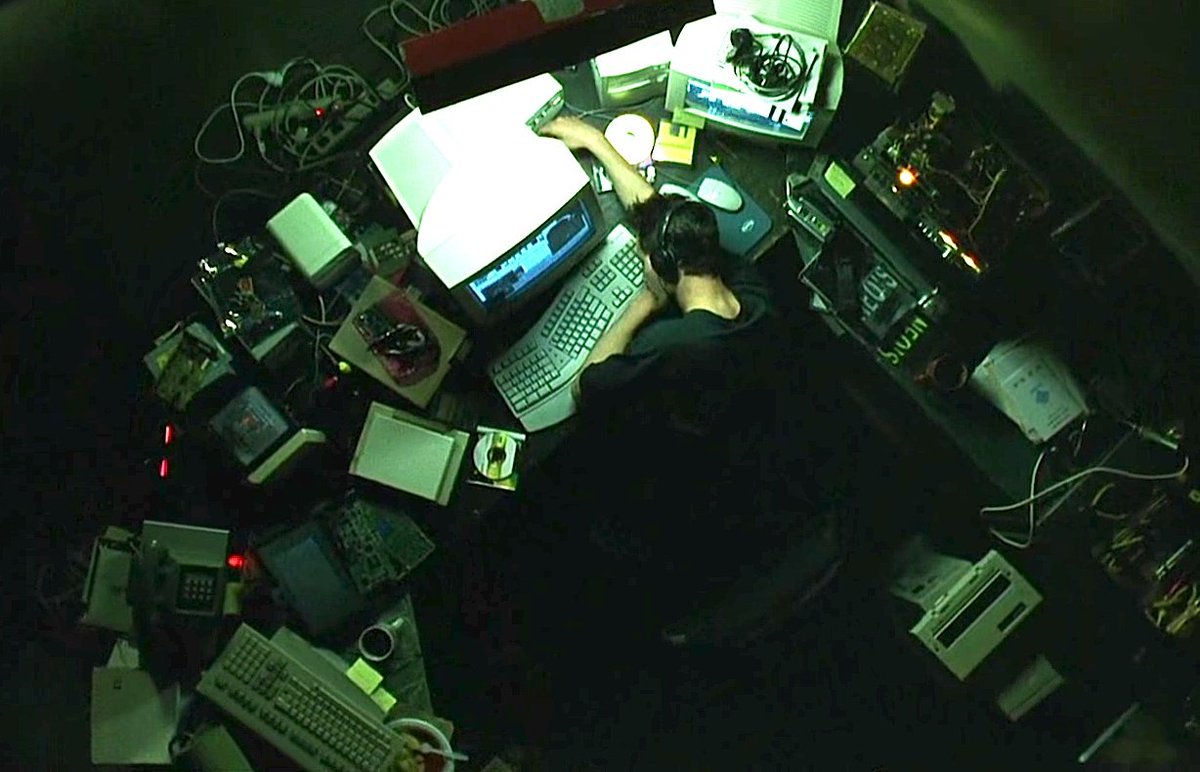
#VR Design Manifesto
AKA holodeck program guidelines
[a work in progress]
- no fail states
- minimize user frustration
- maximize user empowerment
- maximize user awe
- allow user to set their own goals
- don't put words in user's mouth
- don't push the user around
@azrathetical You did indeed miss it, but you're forgiven. It feels like they happen all the time.
Is it possible for things to be too interesting? I feel like that's where I've been at. Haha
🔴 New Holodeck Program Guidelines is Live:
Awe & the Cathedral of the Mind 👇
https://t.co/KkHz5Ly0Re
The holiday season is upon us. ❄️
What better time to talk about awe, wonder, and clutter as they relate to designing immersive worlds?
How can we evoke the feeling of looking out across a sea of stars in the night sky, stepping into an ancient cathedral, or being moved by music as waves of sound from a massive pipe organ or subwoofer wash over you?
In this edition of Holodeck Program Guidelines, I take a deep dive into:
- Scale: How to make the user feel small, in a good way.
- Depth: Leveraging volumetrics, particles, and stereoscopy.
- 3D audio: How awe can be achieved without any visuals at all.
- Clutter: How overwhelming complexity helps sell reality.
'Tis the season to feel deeply, and to help others in any way we can.
Taking a trip to the UK soon. I decided to learn how to drive in Grand Theft Auto London 1969. Shout out to @Anticleric for the map and sound design. I played using the @XREAL_Global 1S with built in Real 3D AI 2D to 3D conversion https://t.co/e1e5VPYTS0
I agree with the store front, but "all the user money" might be a bit of a stretch. I mean, I don't have any sales figures , but Asgard's Wrath 2 was bundled, and I think we can safely assume the other titles didn't so well. Not enough to keep paying the teams anyway. I hope you're right for what it's worth, but even looking at smaller studios like Cloudhead who have seen "success" or the guys that made shooty canoe (can't remember the real name), I can't say I'm not worried.
🔴 New Holodeck Program Guidelines is live.
https://t.co/WwxKRyW8KU
Writing the player's character and putting a voice in their head is the number one way to break immersion in a holodeck experience. In this edition, I talk about alternatives, and how to build rich worlds, full of lore and interesting characters, while maximizing player agency without telling the user who they are and what they should be doing.
Nobody ever needed a walkthrough for the Holodeck.
Step through the door and the world takes it from there. No quest log. No “GAME OVER” screen. Just atmosphere, agency, and vibes.
https://t.co/192yPaqfez
I’ve started a weekly newsletter, 'Holodeck Program Guidelines', to dig into ideas like:
• Removing fail states and puzzles from VR
• Reducing user frustration without killing tension
• What a “cozy dystopia” means in practice
• Building worlds people want to live in, not just beat
🔴 New Holodeck Program Guidelines is live.
https://t.co/KEJfCytlRV
Main Quest Guilt:
That feeling when the world is ending, but you’d rather be fishing, picking flowers, or just vibing at a noodle stand.
In VR, guilt hits the user, not their avatar.
So this edition is we talk about designing holodeck-like experiences where:
+ Calm is the default
+ Drama is opt-in
+ The world reacts, but doesn’t judge
And how ignoring the dragon is 100% valid.



![Anticleric's tweet photo. #VR Design Manifesto
AKA holodeck program guidelines
[a work in progress]
- no fail states
- minimize user frustration
- maximize user empowerment
- maximize user awe
- allow user to set their own goals
- don't put words in user's mouth
- don't push the user around https://t.co/y5XKh6mRf4](https://pbs.twimg.com/media/Eee3cE3XsAAm9A7.jpg)