A shift in the way people move in the Roman Empire - traveling, but not settling down. We analyzed hundreds of ancient human genomes, discovered high migration, & showed how the results fit with present-day population structure. Check out our new paper! 🧵https://t.co/cBNGX2RwDa
Researchers at @StanfordMed led by @jkpritch, Clemens Weiss and Margaret Antonio used #ancientDNA to map migration during the #RomanEmpire. Their work was published today in @eLife. https://t.co/LKuGpDkHlN
In the Pinhasi lab: thank you Susanna, Vicki, Brina, Olivia and others for collecting & processing samples (even driving to museums on weekends!). Our work heavily relied on published aDNA data and tools - we are grateful for the road paved before us by colleagues in the field.
Our local collaborators - thank you for allowing us to share the story of these precious samples, and for providing local historical & archaeological contexts which have been invaluable in interpreting the data.
Thank you @jkpritch for supervision and guidance. Thanks to Clemens @clw_gg, who co-led data analysis and interpretation, as well as @ziyue_gao, @mootspoints, and @spence_jeffrey_ in the Pritchard Lab. Thanks to @WalterScheidel for insightful context on the Roman Empire.
It has been a privilege to work on this project and learn from our colleagues across multiple disciplines, time zones, institutions. It's exciting to see insights from genetic data alongside the historical and archaeological records.
This expands the way I think about ancestry & the past. We may trace our ancestry to some particular group, but that doesn’t mean our ancestors were confined geographically. They moved much in the same way as people do today. The past was dynamic!
A shift in the way people move in the Roman Empire - traveling, but not settling down. We analyzed hundreds of ancient human genomes, discovered high migration, & showed how the results fit with present-day population structure. Check out our new paper! 🧵https://t.co/cBNGX2RwDa
Faster travel leads to a stronger decoupling of “migration” and “reproduction”, which are assumed to occur together in simulations. In the Empire, people had both a means and reason to move - for military service, trade, labor, forced displacement - but they didn’t settle.
So how do we reconcile high mobility with stable population structure? We think the key is in HOW people moved. By historical times, distances that used to take generations to travel, now took less than a month!
With spatial Wright-Fisher simulations, we show that 8% migration is enough to collapse population structure by present-day. This is perplexing as we don’t observe collapsed structure today. The PCA in (C) doesn't look like the present-day PCA of real genomes we just saw!
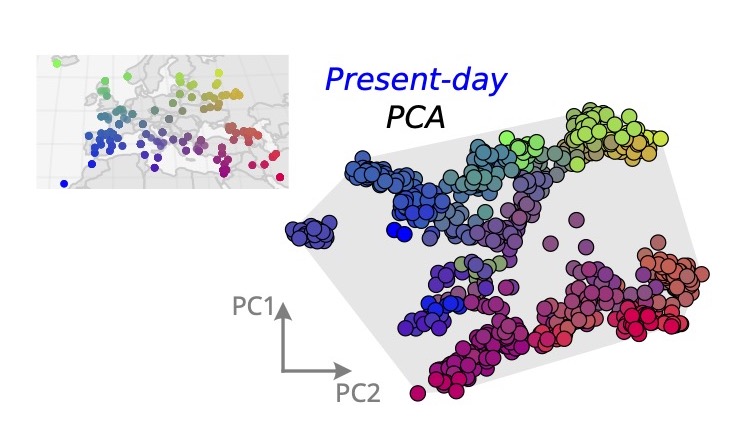
Today, the structure is also very distinct. The closer people live to each other, the more similar their ancestries. We use PCA to visually show how genetic distance corresponds to geographic distance.
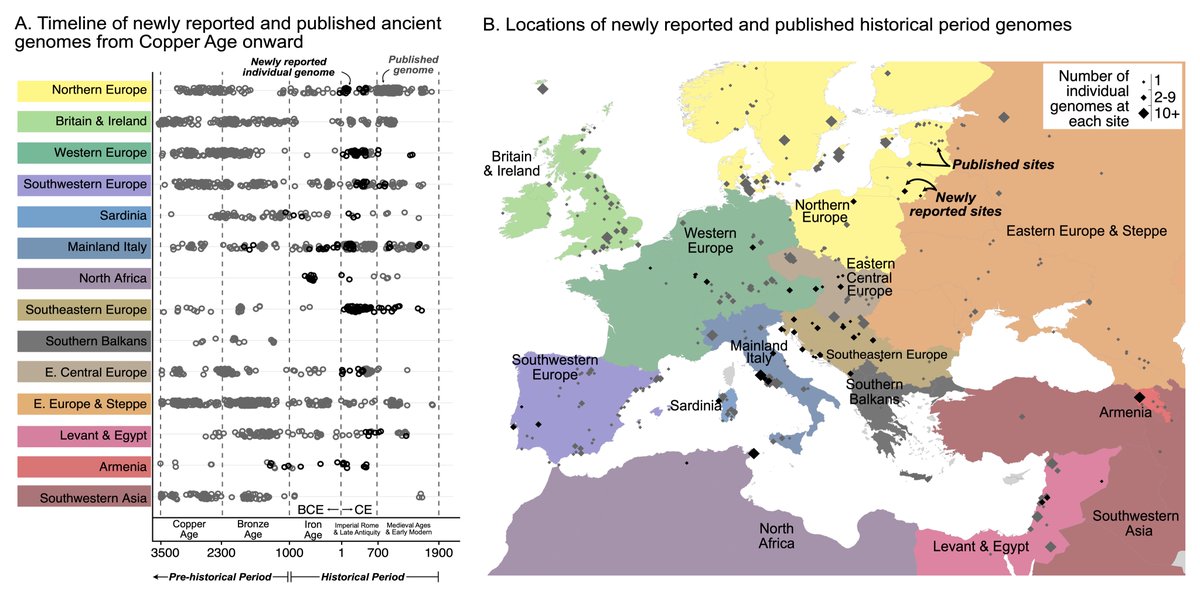
In Europe, there was a large decrease in how genetically different people were following the major prehistoric migrations (people from far away started interacting). However, population structure has been stable across the historical periods (since the Iron Age).
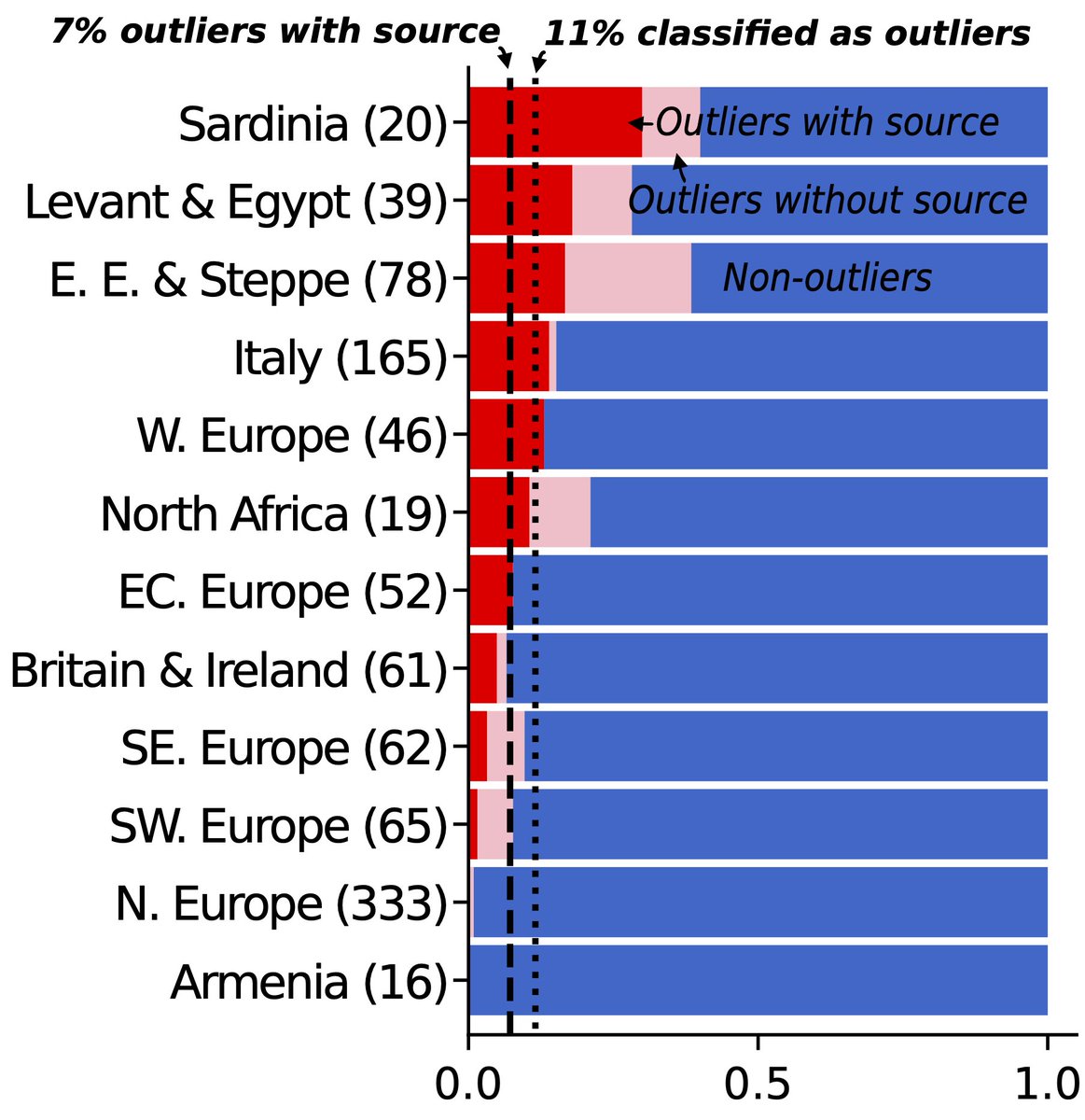
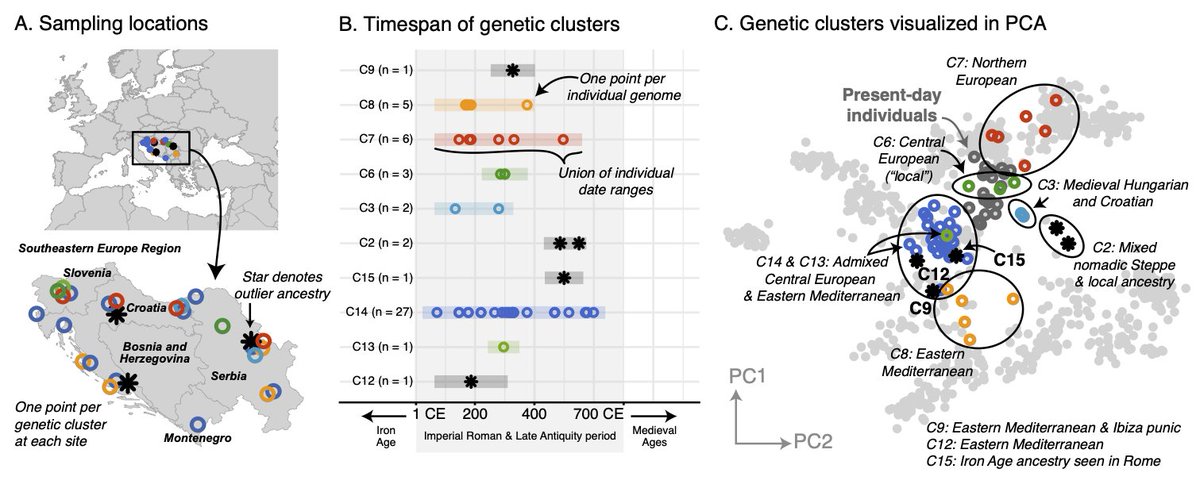
Based on individuals we studied, we estimate 7-11% are outliers (people moving long distances). Most outliers can be modeled using real individuals from other regions as their source ancestry. We'll see in a second, 7% is not a small number!
This could result from "urban-military complexes", and idea introduced by historians. As military forces established themselves along the frontier, local individuals would seek protection or economic benefit, drawing in resources (trade, labor) to otherwise remote areas.
Even regions that were homogeneous, like Armenia, showed evidence of movement to hubs like Rome. On the frontier of the Empire (e.g. Western Europe) we see a lot of influx of ancestries.
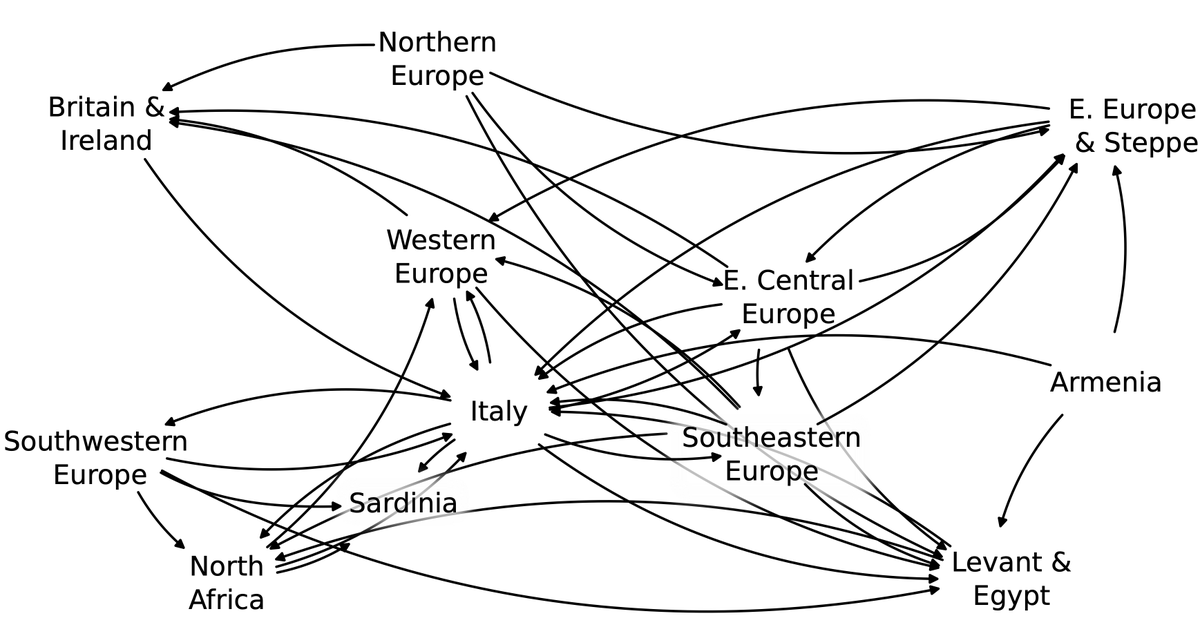
To draw a network, we determined a “local” population to be the majority ancestry in a region. We identified “outliers” as people who had similar ancestries to the “local” population elsewhere. The result reminds me of the maps of Roman travel networks many have shared!
First, we found other regions that have ancestry heterogeneity similar to Rome's: Serbia, Croatia, Austria, Germany, for example. Across these regional vignettes, we started noticing similarities in ancestries….maybe we could connect these regions using ancestry.
We looked beyond Rome and collected over 200 ancient genomes from Europe and the Mediterranean with the help of local museum directors and archaeologists. @PinhasiL processed the specimens. We analyzed these new genomes alongside published data.
In 2019, we used aDNA to characterize the people's ancestries in Rome across 10k yrs. At the peak of the Empire, we saw evidence of people from all around the Mediterranean and Europe in Rome alone. What about the rest of the Empire?
https://t.co/WtWSMdIm06
Immensely proud of former lab mates and mentors @ziyue_gao and @hjpimentel for getting Sloan Fellowships. 2/10 in computational biology! Potential to revolutionize their fields? Sure. Potential to embolden and mentor students while they do it? Not a doubt.