“To navigate the oil markets without understanding international relations is to track the cargo while ignoring the ocean. Policy dictates the rule, diplomacy opens the door” #oott#oil
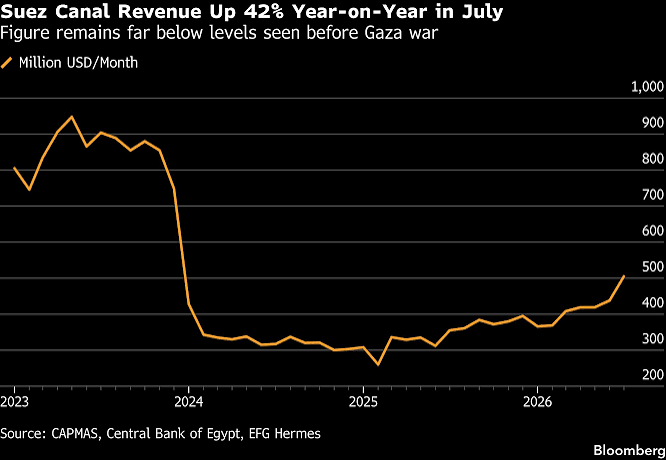
💰📈Suez Canal revenue jumps 42% as Hormuz crisis reroutes ships.
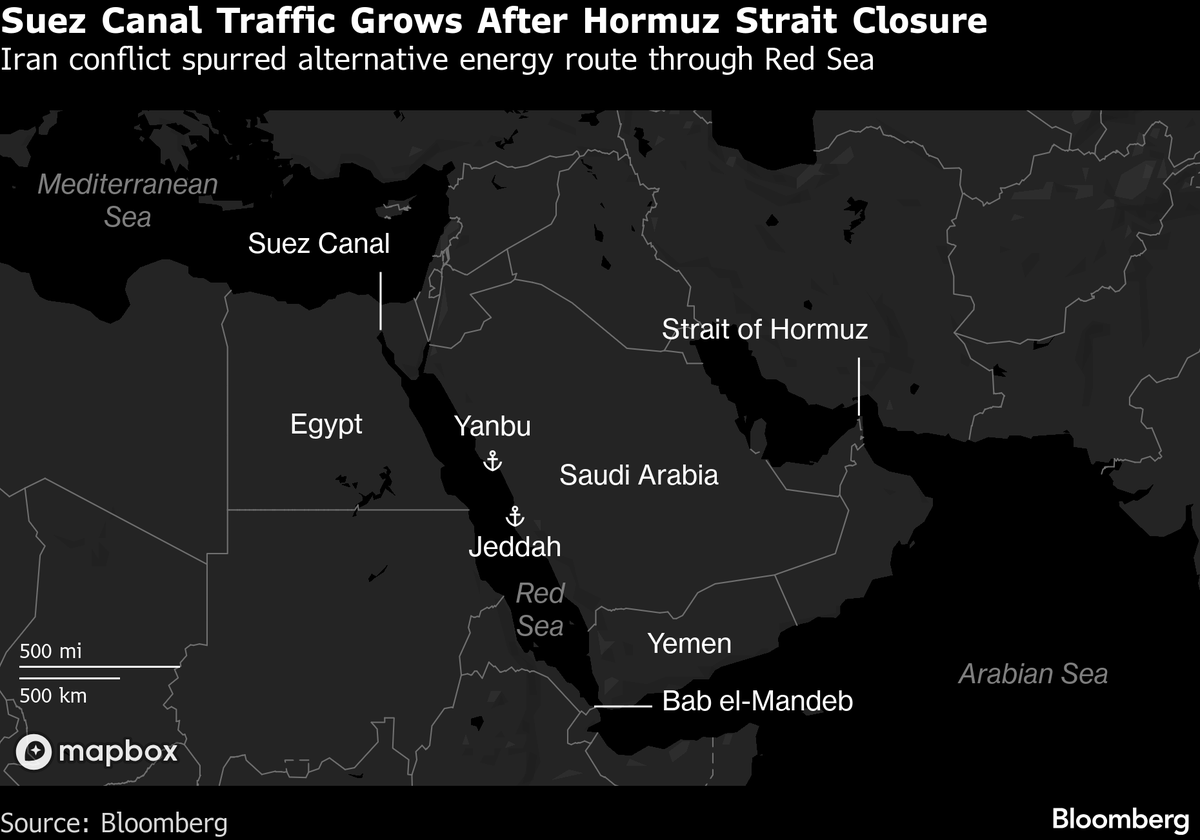
Egypt's canal earned roughly $500 million in July, its best month since December 2023, as the effective closure of the Strait of Hormuz pushed Gulf oil exports toward the Red Sea.
Traffic is following the money.
About 1,340 vessels transited in July, up 27% from a year earlier, with oil tankers rising to 526 from 485 in June as Saudi barrels loading at Yanbu head north instead of through Hormuz.
The recovery still has a long way to go.
Monthly revenue ran near $900 million before the Gaza war, and 2023 was a record year at $10.2 billion.
Transits were closer to 2,300 a month back then.
The Suez Canal Authority now expects $5.8 to $6 billion for 2026, up from $4.1 billion last year.
Houthi threats around Bab el-Mandeb remain the swing factor, which is the same risk that emptied the canal in the first place.
source: Bloomberg
Brent futures trade at $98.73. But if you cannot wait for delivery and want the oil today, the price is $106.78.
That is backwardation. And it signals serious scarcity in the oil market.
Companies do not pay more than $8 extra per barrel if they can simply wait a few weeks.
El petróleo vuelve a acercarse a los US$100 por barril. Detrás no está solo la tensión entre Estados Unidos e Irán: los inventarios fuera de China han caído con fuerza y las restricciones en el estrecho de Ormuz mantienen bajo presión la oferta global.
Para Venezuela, precios más altos significan más ingresos por exportaciones y una mayor relevancia estratégica. Pero conviene evitar conclusiones fáciles: tener enormes reservas no significa poder aumentar rápidamente la producción.
La oportunidad existe, pero aprovecharla requiere inversión, infraestructura, capacidad operacional y reglas claras que permitan convertir una coyuntura favorable en crecimiento sostenible.
🟥WOOOOOW!
A VLCC carrying more than 2 million barrels of Saudi crude is heading to South Korea the long way — around Africa.
That voyage is roughly twice as far as the usual Red Sea/Bab Al Mandab route, adding about 30 days.
The tanker was only partly loaded, apparently by ship-to-ship transfer off Saudi Arabia’s western ports. It then sailed north and transited the Suez Canal. A fully loaded VLCC cannot cross Suez. It finished loading Saudi crude at Sidi Kerir (Egypt, see red arrow) then set course for South Korea.
Map from @kpler. I added the white line, the two red arrows and the red circle.
Oman crude is trading at $109.44. The chart shows the spread between Dated Brent and Oman crude.
When Middle Eastern crude starts outperforming Brent like this, it usually means Asian demand is strengthening.
Everything points to China returning to the oil market as a buyer.
A major structural shift in Venezuela’s Energy Sector today:
The signing of new Production Participation Agreements (CPPH) in Caracas marks a fundamental transition from the traditional Joint Venture model toward direct private operatorship. 🧵👇 #oott 🛢️🇻🇪
⚡ Power Grid: Strategic alliances with GE Vernova to restore power infrastructure across operational hubs.
4/4 Building on the current ~1.25M bpd national baseline, these deals target 1.5M+ bpd over the medium term.
Signed alongside top Venezuelan & U.S. energy officials, this transition toward direct operatorship reinforces Eni’s longstanding position in 🇻🇪 (joining its Cardón IV/Perla gas footprint) while boosting global crude availability.
Big structural shift in Venezuela’s energy sector: @Eni officializes a 25-year Production Participation Agreement (CPPH) with PDVSA, becoming exclusive Operator of the Junín 5 heavy oil block. 🧵 #oott
Key takeaways from the deal:
-Full Autonomy: Eni moves from a 40% JV partner to managing technical, financial & commercial operations.
-Asset Scale: Junín 5 holds ~35B bbls in place (Orinoco Belt).
-Strategic Goal: Deploy capital rapidly to scale output from ~12k bpd baseline.