MICROWAVE-PYROLOSIS CREATES PLASTOLINE, A PETROL MADE FROM PLASTIC WASTE. THIS SHOULD RID THE EARTH FROM THE SCOURGE OF DISCARDED PLASTIC. SO, WHY ISN'T THIS BEING HERALDED AND SUPPORTED BY GLOBAL GOVERNMENTS. NOW, GO AWAY AND SERIOUSLY MEDITATE ON THIS.
https://t.co/knj3egajjQ
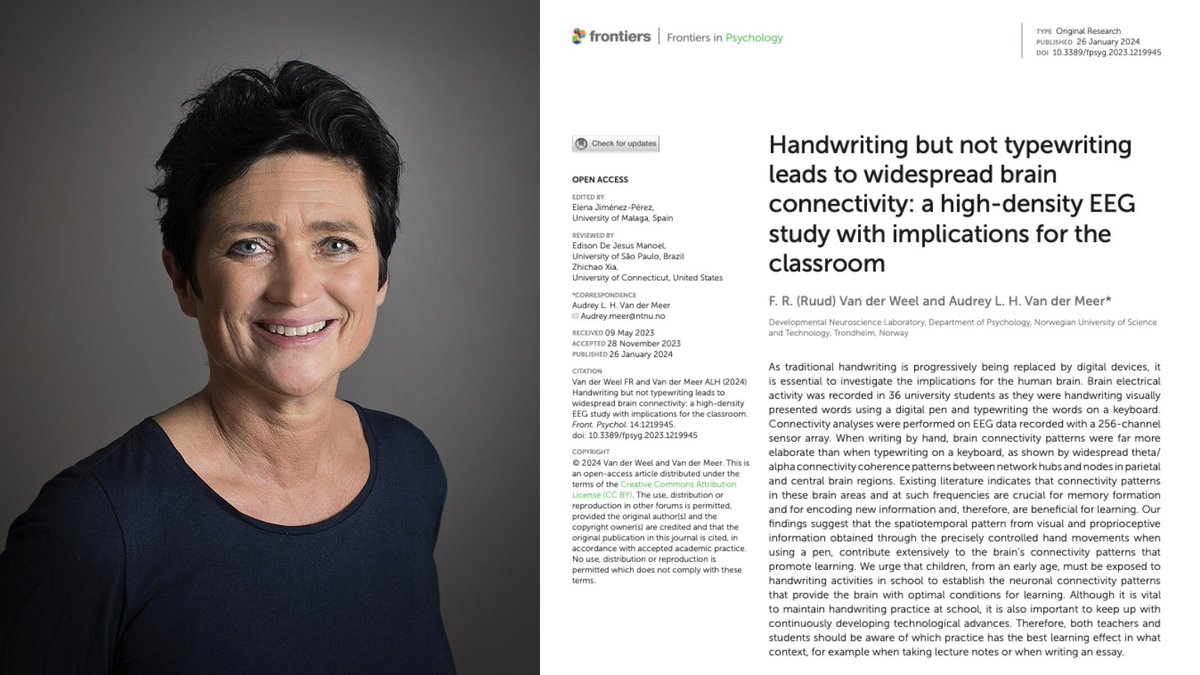
A Norwegian neuroscientist spent 20 years proving that the act of writing by hand changes the human brain in ways typing physically cannot, and almost nobody outside her field has read the paper.
Her name is Audrey van der Meer.
She runs a brain research lab in Trondheim, and the paper that closed the argument was published in 2024 in a journal called Frontiers in Psychology. The finding is brutal enough that it should have changed every classroom on Earth.
The experiment was simple. She recruited 36 university students and put each one in a cap with 256 sensors pressed against their scalp to record brain activity. Words flashed on a screen one at a time.
Sometimes the students wrote the word by hand on a touchscreen using a digital pen, and sometimes they typed the same word on a keyboard. Every neural response was recorded for the full five seconds the word stayed on screen.
Then her team looked at the part of the data most researchers had ignored for years, which is how different parts of the brain were communicating with each other during the task.
When the students wrote by hand, the brain lit up everywhere at once.
The regions responsible for memory, sensory integration, and the encoding of new information were all firing together in a coordinated pattern that spread across the entire cortex. The whole network was awake and connected.
When the same students typed the same word, that pattern collapsed almost completely.
Most of the brain went quiet, and the connections between regions that had been alive seconds earlier were nowhere to be found on the EEG.
Same word, same brain, same person, and two completely different neurological events.
The reason turned out to be something nobody had really paid attention to before her work. Writing by hand is not one motion but a sequence of thousands of tiny micro-movements coordinated with your eyes in real time, where each letter is a different shape that requires the brain to solve a slightly different spatial problem.
Your fingers, wrist, vision, and the parts of your brain that track position in space are all working together to produce one letter, then the next, then the next.
Typing throws all of that away. Every key on a keyboard requires the exact same finger motion regardless of which letter you are pressing, which means the brain has almost nothing to integrate and almost no problem to solve.
Van der Meer said it plainly in her interviews.
Pressing the same key with the same finger over and over does not stimulate the brain in any meaningful way, and she pointed out something that should scare every parent who handed their kid an iPad.
Children who learn to read and write on tablets often cannot tell letters like b and d apart, because they have never physically felt with their bodies what it takes to actually produce those letters on a page.
A decade before her, two researchers at Princeton ran the same fight using a completely different method and ended up at the same answer. Pam Mueller and Daniel Oppenheimer tested 327 students across three experiments, where half took notes on laptops with the internet disabled and half took notes by hand, before testing everyone on what they actually understood from the lectures they had watched.
The handwriting group won by a wide margin on every question that required real understanding rather than surface recall.
The reason was hiding in the transcripts of what the two groups had actually written down.
The laptop students typed almost word for word, capturing more total content but processing almost none of it as they went, while the handwriting students physically could not write fast enough to transcribe a lecture in real time, which forced them to listen carefully, decide what actually mattered, and put it in their own words on the page.
That single act of choosing what to keep was the learning itself, and the keyboard had quietly skipped the choosing and skipped the learning along with it.
Two studies. Two countries. Same answer.
Handwriting makes the brain work. Typing lets it coast.
Every note you have ever typed instead of written went into your brain through a thinner pipe. Every meeting, every book highlight, every idea you captured on your phone instead of on paper was processed at half depth.
You did not forget those things because your memory is bad. You forgot them because typing never woke the part of the brain that would have made them stick.
The fix is the thing your grandmother already knew.
Pick up a pen. Write the thing down. The slower road is the faster one.
It's such a shame. We lose master carpentry skillset, essential knowledge, history, hand-me-down refinery, legacy and the natural beauty of real wood. For what? Imitation plastic, adverse profit gain and loss of Art and respect. Such a pity. My guess is, we lost it all long ago.
Atomic veterans describe what nukes feel like
“When the flash hit you, you could see the X-rays of your hand through your closed eyes.”
“If I was looking at you now I would see all your bones, the blood vessels and everything.”
Ok, so AI is here, and I used it to ask if synthetic folic acid is bad for you. Do you own research and make your own decision. What I learnt made me consider making my own bread.
“In 2026, it will be a legal requirement, for pizza bases, bread and dough to contain synthetic folic acid”
“It’s a new study but they believe it’s causing gene manipulation”
This story out of the UK has received little to zero attention - but is absolutely insane what they are doing to spread based products.
Introducing the lead characters of our showcase Best Friends at the Park Theatre. They will be joined by an ensemble of other award nominees & winners. To claim your FREE seat, click the link below.
https://t.co/mXDGi8V6Jd
Artwork: Martha Hegarty
Photography: Sarah Hickson
This is our new marketing campaign for Best Friends at Park Theatre on the 17th of October. The showcase skilfully blends humour & sensitivity into the themes of friendship & assisted dying.
4 details
https://t.co/mXDGi8V6Jd
Photo: Sarah Hickson,
Artwork: Martha Hegarty
Introducing our 3 African American actresses, Johnnie Fiori, Victoria Alexis Williams and Naheema Shafau who will be performing in our showcase reading of Best Friends at the Park Theatre in October.
Click link for details of our FREE showcase.
https://t.co/d3ZeuscMKT
Best Friends touches on friendship not only as a personal phenomenon but as an ideology. By aligning the personal & the collective phenomena through the lens of friendship, we realise that our friendships are the basis upon which our societies are based. https://t.co/ydNclRMohc
Yep. We're on. The human condition gets to be explored by us once more, with eloquence and depth. Performance creativity goes up a notch...or seven. It's been a long time coming. And even then we 'ain't finished!' Thanks to the Arts Council England for funding our research.
Crying in the Wilderness Productions presents at the Park Theatre, Best Friends, a new play about lifelong friends, Martin Preston and Tyrone Jameson, who have checked into an assisted dying centre to spend their last 24 hours together. Click link below. https://t.co/ydNclRMohc
"You A Gum Chewer?...You May Want To Rethink Your Gum Chewing Habit."
Layne Kilpatrick
"You Are Chewing The Exact Ingredients In Tires & Glue With A Hefty Dose Of Plastic."
"The US FDA Allows Gum Manufacturers To Hide 100s Of Chemicals Within 'Gum Base' On Ingredient Labels."
Some of the substances used in common chewing gums include styrene-butadiene, polyethylene & polyvinyl acetate—compounds found in tires, plastic bags & wood glue, respectively.
Most chewing gum today contains synthetic chemicals & plastics as part of its "gum base".
Modern synthetic gum bases include:
Polyethylene: A common type of plastic used to make items like plastic bags & milk jugs.
Polyvinyl acetate: A plastic used in wood glue.
Styrene-butadiene rubber: A synthetic rubber used to manufacture car tires.
Paraffin wax: A petroleum byproduct.
Major gum manufacturers like Wrigley don’t disclose these chemicals, instead choosing to hide them behind the vague term “gum base.”
But now you’ll know that whenever you see the term “gum base” on a pack of Doublemint, you might as well be chewing on a set of Michelin tires & washing it down with a thick glass of Elmer’s glue.
The FDA allows manufacturers to list "gum base" as a single ingredient rather than disclosing each of its individual components, which includes synthetic plastics & rubbers. The specific formula for a brand's gum base is typically a trade secret.
FDA regulations on gum base is basically no regulation at all:
A "food additive" category: The FDA classifies "chewing gum base" as a food additive that may contain any number of individual substances.
Undisclosed formula: A manufacturer can use any ingredient they coin as GRAS, Generally Recognized As Safe. It is 100% legal to have hidden materials in their proprietary gum base formula without listing them individually on the chewing gum's ingredient label, as long as they are generally recognized as safe (GRAS) or approved food additives.
Consumer advocacy: This practice has drawn criticism from consumer advocates who argue that the GRAS designation is overly vague & allows companies to hide potentially harmful chemical additives from the public.
Natural Chewing Gum Alternatives:
SIMPLY GUM: A widely available and well-known brand of natural, plastic-free gum. It is made with natural chicle, organic cane sugar & natural flavors. Simply Gum is also free of aspartame & other artificial sweeteners.
THE HUMBLE CO: This brand offers a sugar-free, biodegradable gum made from natural ingredients.
NATHAN & SONS UNDERBRUSH CHEWING GUM: This gum is handcrafted from natural tree saps like acacia, chicle & spruce. The company emphasizes that its gum has a different, sap-based texture compared to conventional plastic gums.
CHEWSY: A plant-based, plastic-free & sugar-free chewing gum. Chewsy uses a biodegradable, natural gum base & is sweetened with xylitol.
WELDENTAL: This brand is noted for both its plastic-free gum formula & its packaging. The gum comes in plastic-free packaging, such as cardboard tubes & uses a plant-material eco-bag for refills.
👇UCLA Finds Plastics In Chewing Gum👇
https://t.co/y1wbcsPari
👇What Chewing Gum Is Actually Made From👇
https://t.co/nc8oGTAbCi
👇Microplastics Are Plaquing Up Your Arteries👇
https://t.co/nBuQ6WjxQu
Speaker: @hormonespecialist
How and when did we become complacent with our food, our necessary daily nutrition, being labelled 'organic'? How is it that we've somehow ignored the value of what we're eating? What reality are we living in................?
"You A Gum Chewer?...You May Want To Rethink Your Gum Chewing Habit."
Layne Kilpatrick
"You Are Chewing The Exact Ingredients In Tires & Glue With A Hefty Dose Of Plastic."
"The US FDA Allows Gum Manufacturers To Hide 100s Of Chemicals Within 'Gum Base' On Ingredient Labels."
Some of the substances used in common chewing gums include styrene-butadiene, polyethylene & polyvinyl acetate—compounds found in tires, plastic bags & wood glue, respectively.
Most chewing gum today contains synthetic chemicals & plastics as part of its "gum base".
Modern synthetic gum bases include:
Polyethylene: A common type of plastic used to make items like plastic bags & milk jugs.
Polyvinyl acetate: A plastic used in wood glue.
Styrene-butadiene rubber: A synthetic rubber used to manufacture car tires.
Paraffin wax: A petroleum byproduct.
Major gum manufacturers like Wrigley don’t disclose these chemicals, instead choosing to hide them behind the vague term “gum base.”
But now you’ll know that whenever you see the term “gum base” on a pack of Doublemint, you might as well be chewing on a set of Michelin tires & washing it down with a thick glass of Elmer’s glue.
The FDA allows manufacturers to list "gum base" as a single ingredient rather than disclosing each of its individual components, which includes synthetic plastics & rubbers. The specific formula for a brand's gum base is typically a trade secret.
FDA regulations on gum base is basically no regulation at all:
A "food additive" category: The FDA classifies "chewing gum base" as a food additive that may contain any number of individual substances.
Undisclosed formula: A manufacturer can use any ingredient they coin as GRAS, Generally Recognized As Safe. It is 100% legal to have hidden materials in their proprietary gum base formula without listing them individually on the chewing gum's ingredient label, as long as they are generally recognized as safe (GRAS) or approved food additives.
Consumer advocacy: This practice has drawn criticism from consumer advocates who argue that the GRAS designation is overly vague & allows companies to hide potentially harmful chemical additives from the public.
Natural Chewing Gum Alternatives:
SIMPLY GUM: A widely available and well-known brand of natural, plastic-free gum. It is made with natural chicle, organic cane sugar & natural flavors. Simply Gum is also free of aspartame & other artificial sweeteners.
THE HUMBLE CO: This brand offers a sugar-free, biodegradable gum made from natural ingredients.
NATHAN & SONS UNDERBRUSH CHEWING GUM: This gum is handcrafted from natural tree saps like acacia, chicle & spruce. The company emphasizes that its gum has a different, sap-based texture compared to conventional plastic gums.
CHEWSY: A plant-based, plastic-free & sugar-free chewing gum. Chewsy uses a biodegradable, natural gum base & is sweetened with xylitol.
WELDENTAL: This brand is noted for both its plastic-free gum formula & its packaging. The gum comes in plastic-free packaging, such as cardboard tubes & uses a plant-material eco-bag for refills.
👇UCLA Finds Plastics In Chewing Gum👇
https://t.co/y1wbcsPari
👇What Chewing Gum Is Actually Made From👇
https://t.co/nc8oGTAbCi
👇Microplastics Are Plaquing Up Your Arteries👇
https://t.co/nBuQ6WjxQu
Speaker: @hormonespecialist
And that sticker is going to slowly loosen/peel away around its edging by human movement to look/feel atrocious, gunky and blackened by clothing fibres, skin cells, food particles and supposed cleaning chemical remnants. What a cheap cosmetic solution to a grand dining table!
Leng Jun's 2004 oil painting is considered by many experts to be 'the painting that surpassed the Mona Lisa' and one of the most hyperrealistic works ever created!
NATURE UNLOCKED GOD MODE ON PLASTIC WASTE
Scientists found a fungus in the Amazon called Pestalotiopsis microspora that literally snacks on plastic like it’s lunch.
It doesn’t even need oxygen. Just throw it in a landfill, and it gets to work while everything else just vibes.
Polyurethane? One of the hardest plastics to break down. The fungus? It said: "Yummy!"
Nature might’ve just dropped an update for saving the planet.
Source: @wealth