Thread on the Most Dangerous Jobs in the World🧵
1. Ironworker during the construction of the Columbia Tower, Seattle, 1984.
Don`t open if you are soft hearted
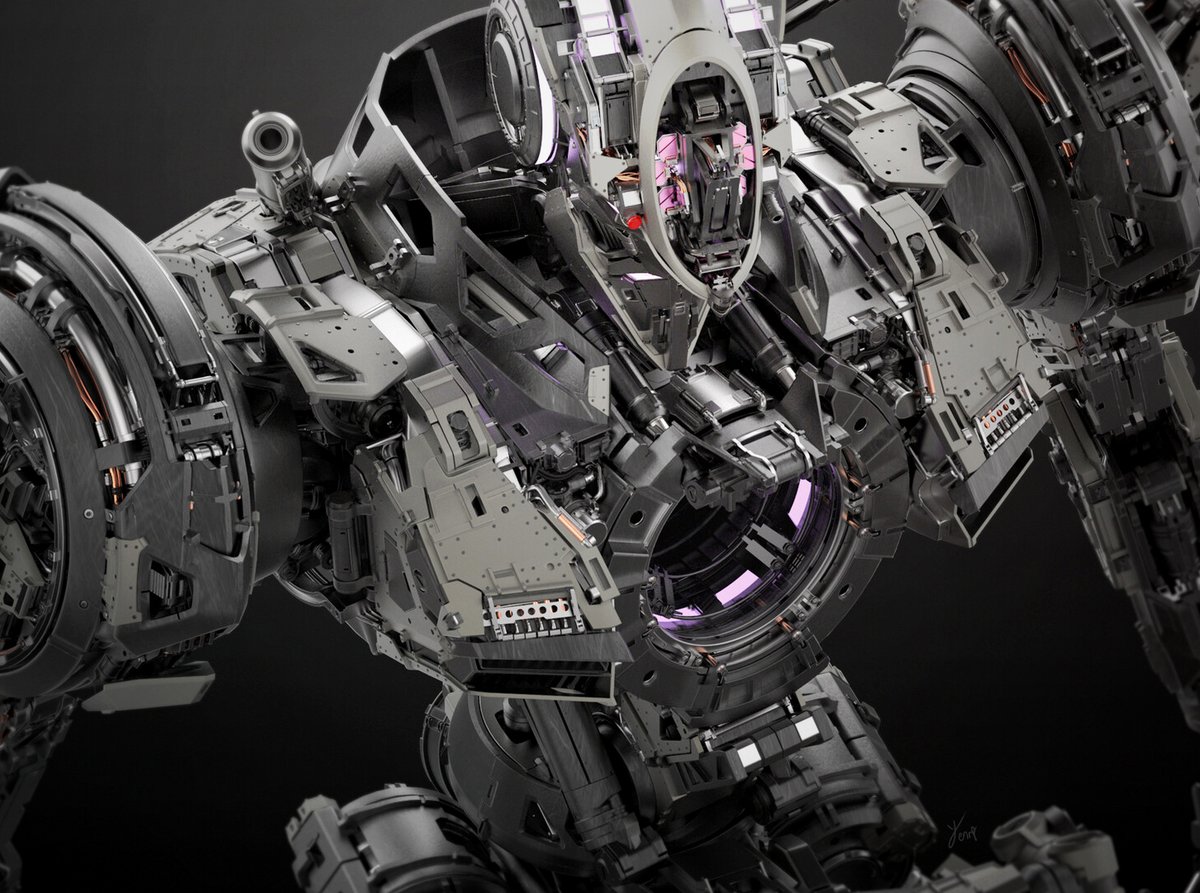
Stratosphere was our biggest and heaviest character on #Transformers ROTB. He was a real challenge to deal with on the Modeling, Texturing, and Rendering side.
He had 1434 UDIMs due to his immense scale and was made up of tens of thousands of objects. His level of detail was truly something else. His vehicle form was also a behemoth.
We had also built a mortar for his robot form and a cannon for his vehicle form but neither of these made it into the film as his part in the final battle was cut out.
He was originally supposed to help out in the final battle, using both of these weapons against the Sweepers and Predacons. The decision to cut him from the final act came very late as all of his assets were final at that point. We were never told the reason why his role was cut from the film.
I had to re-design my texturing system in Mari when working on him to ensure that it could handle such a complex and large character. I had to simplify a lot of the procedural systems and even had to branch off some of them into their own files to ensure that artists could work with somewhat decent performance.
We ran into a lot of issues pushing him through our pipeline, both as a model as well as rendering him due to the sheer amount of objects and textures that had to be processed.
For shots, it was requested by Lighting that we reduce his memory footprint as Google had complained he was taking up too much memory and their I/O for rendering on the cloud was being affected.
The leadership team and I decided that the best way to do this was to half the texel density on the parts that wouldn't be visible in our approved shots and to also half the resolution of the textures in the parts not visible to camera. This allowed us to optimize his memory footprint both in shots as well as storage and I/O.
It was massive technical undertaking working on Stratosphere, so much so that we had to delay getting him into shots as we simply couldn't push him through with our normal tooling. I really enjoyed the challenge that he posed for us as a team.
CREDITS:
Primary Modeling by Oscar Lowe
Support Modeling by Arthur Grandjean and his team
Final Texturing & Lookdev by Yaz Raji
Video credits:
Breakdown shot by MPC
Film footage by Paramount
@StavrosFyl@RassoulEdji PS: It’s part of a bigger project to recreate a shot from the movie with Saber Athena instead of Gipsy Avenger: (the link should have the right time code)
https://t.co/G3BqLjzFig
@StavrosFyl@RassoulEdji Absolutely, thank you! It’s been quite a lot of work hahah. I think I’ve gotten the modeling and UVs to a pretty solid place that I can consider them mostly complete. Where would be best to send some screenshots or turns?
Mechanical feet are always a challenge to design and develop as they need to support near omni-directional movement. For organic creatures this isn't a problem, but for mechanical designs you need to figure out ways the pieces can slide over each other and move in a realistic manner.
For Hyperion, I designed the feet with three primary pistons which handle most of the movement, almost like a ball joint. The rest of the mechanisms are hinges and overlapping panels which slide on top of one another when the feet moves.
Because of his massive size and weight, I also added a toe spread feature so we could spread his toes when he walks, further selling the weight of the character.
Overall I'm very happy with how the feet turned out. The feet are the second most difficult joint to work out mechanically. Second only to the shoulder joints. The hips are a close third place.
#mecha #3d #vfx #cgi #rigging #animation #characterdesign #hardsurface
@StavrosFyl@RassoulEdji oh you’re that person! I absolutely loved this jaeger watching the movie, you and the team did a fantastic job!
I’m currently building my own saber athena - modeling is almost done, currently working on the UVs. also having nightmares hahah. I for sure understand the struggle 🫡
Due to their immense scale and required level of detail, the Jaegers in Pacific Rim Uprising (and the first film) had an average UDIM count of 1000+ at 4K resolution.
DNEG used Clarisse to bake out their data maps for them because of the sheer amount of computation needed.
We ran into this same issue with our larger characters in Transformers ROTB. Graphics cards simply didn't have enough VRAM to be able to bake down that amount of 4K data.
I designed a custom baker with RenderMan which could run on the render farm to bake down our heavier assets.
Working on shows that have huge singular assets like Pacific Rim and Transformers requires a lot of data management and optimization for I/O through the pipeline.
Je crois sincèrement qu’il existe une proportionnalité entre votre épanouissement dans la vie et les personnes que vous laissez entrer dans votre tête.
Si vous laissez les gens de Twitter entrer dans votre tête, vous n’aurez plus de respect pour l’ambition, la différence, le challenge. Vous n’aurez de tolérance que pour le confort de l’intolérance, et la consolation du cynisme.
Ça atteindra peut-être temporairement les gens que vous visez, mais vous, vous enterrez définitivement qui vous auriez pu avoir envie de devenir.
Vous pouvez considérer qu’un travail est imparfait, même vous en offusquer parfois, mais si ça devient un réflexe, demandez vous pourquoi.
Vous n’avez pas besoin d’être un fan pour apprendre de quelqu’un.
Prenez ce que vous avez à prendre.
Je crois qu’il y a beaucoup à apprendre de ce gars.
Moi j’ai beaucoup appris, merci @Inoxtag ♥️
en parlant de ça j’ai eu un entretien avec fortiche (le studio qui fait arcane) aujourd’hui mais vu que j’ai que du réaliste dans ma demoreel ils étaient en mode kestufou là 💀