Now I'm working on AI for APIs: discover data structures, visualize entities and their relationships, and let you define synchronization rules.
It then generates an integration script you can download, own, and run on your own server.
https://t.co/Ld4V3NaHrd
I’m thinking about what RealStats should focus on first.
What would be most interesting to you?
• Improve + AI goal plan
• Find races and competitions that match you
• Activity invitations
• Ask for advice
• Activity Replay — turn your workout into a shareable story
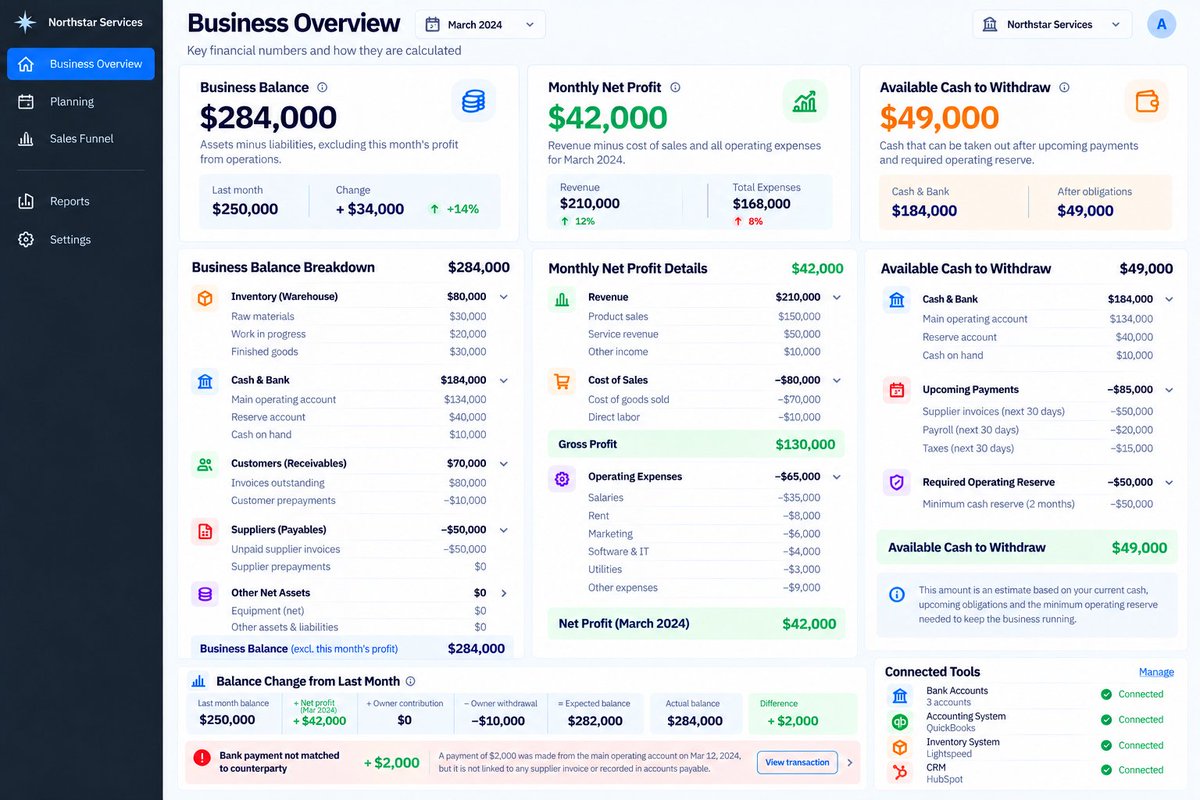
Working on a new Business Planning Dashboard
The idea is simple: connect your business tools and plan the next 12 months .
Change any number and instantly see how it affects your future profit.
No more complicated Excel spreadsheets or switching between different apps.
I’m building LevelOne — an app that turns your real-life stats, skills and progress into a digital character.
I’ve just made a first character generator. Try it here: https://t.co/uhOfiL6q3l
Post your result in the replies and tell me: does it actually look like you?
I've run businesses before, and one thing that always frustrated me was having financial data scattered across accounting software, CRM, bank accounts, and spreadsheets.
Here's my first UI mockup. Still figuring out whether this is a problem worth solving.
I've been thinking about building a tool that pulls together financial data from the different systems a business already uses.
I put together a rough mockup.
Do you have everything in one place, or are you still using spreadsheets to figure it out?
Tip #9: Set financial goals that are at least double your monthly variable expenses. This way, even if spending rises, you’ll still have a clear target that pushes you to save and grow beyond your comfort zone.
Tip #7: Track your expenses regularly.
This helps you see if they fit your budget and adjust your income-dividing system (50/30/20, FIRE, or your own).
Tip #6: Now that you know your income and expenses, set up a system to divide your income. For example, you can use the 50/30/20 rule (needs/wants/savings) or customize categories that match your lifestyle. This helps you stay on track automatically.
Tip #5: Okay, now it’s time to take your bank statements and calculate your fixed vs. variable expenses. This will help you see and understand the numbers clearly.
Tip #2: Define pocket money for your kids
A simple guideline could be:
•Age 6–8: $20–40 per month
•Age 9–11: $40–60 per month
•Age 12–14: $60–100 per month
•Age 15–17: $100–200 per month
🐦🔥How much do you give your kids?
Tip #1: Calculate your family’s total income and list all your assets.
Knowing your exact numbers is the first step toward financial clarity.
Do you already keep track of yours?
The biggest debt I’ve ever had (not counting mortgage or car loans) was $100,000.
It happened during a financial crisis.
I had to cut almost every expense, downgrade my lifestyle, and even sell my car just to stay afloat.
Have you ever faced a financial low point?