I am not convinced that general intelligence is "the ability to perform most economically valuable tasks."
My 3-year old can perform *no* economically valuable task, but he's one of the smartest guys I've ever interacted with.
Meanwhile, control theory has automated millions of highly valuable industrial jobs, but no one would call a PID controller intelligent.
Yes, I've made this point many times.
The beginning of a sigmoid looks like an exponential.
Not only can we "never be fully certain that what we are observing isn't in fact following a logistic trend before the inflection point", we can always be fully certain that *every* *single* *exponential* *trend* eventually passes an inflection point and saturates into a sigmoid.
Continuing an exponential trend beyond that inflection point requires a paradigm shift.
No physical process can grow indefinitely.
There are always friction terms in the dynamics equation that eventually become dominant (energy consumption, heat dissipation, quantum effects, thermal fluctuations, communication bandwidth, mass/energy density....).
Even processes that *appear* exponential on a long time scale are actually a succession of sigmoids, in which each new sigmoid is caused by a paradigm shift.
A good example is Moore's Law. It is saturating right now. But the exponential progress of the last 7 decades is due to a succession of technological paradigm shifts that weren't pre-ordained.
Each paradigm behaved like a sigmoid. Each new sigmoid overtook the previous one. The envelope turned out to be exponential.
We haven't seen similar paradigm shifts in, say, airplane speed or space travel.
Technological paradigm shifts require scientific breakthroughs.
General intelligence is *precisely* learning -- the ability to efficiently learn new things, beyond what your genes and past experiences prepared you for.
Current ML has near zero intelligence because static inference with a curve only yields local generalization, with zero ability to adapt/learn, and meanwhile fitting a curve via gradient descent is an extremely data-inefficient process (compared to e.g. discrete program search which can pick up complex, novel tasks from 1-2 examples). It requires a dense sampling of its operational space in order to generalize -- because it is limited to local generalization.
These are all true simultaneously:
1. Scaling up deep learning will keep paying off (unlock more applications, or higher performance on existing ones).
2. Scaling up deep learning isn't the path to AGI.
3. We aren't particularly close to AGI, and LLMs did not represent a step closer.
4. We're not anywhere near full deployment of existing deep learning techniques. A huge amount of value remains to be created with the tech we already have.
🎮💥 Participa en una #investigación de la US sobre #videojuegos y sube al siguiente nivel
🕹️Colabora con investigadores de la US en este estudio sobre videojuegos y ayuda a entender su impacto
➡ https://t.co/ly05CbftCY
Writing and being read is a tool of disproportionate power, a magical lever that can move the world at the touch of your fingers. Code is the only other thing that comes close to it.
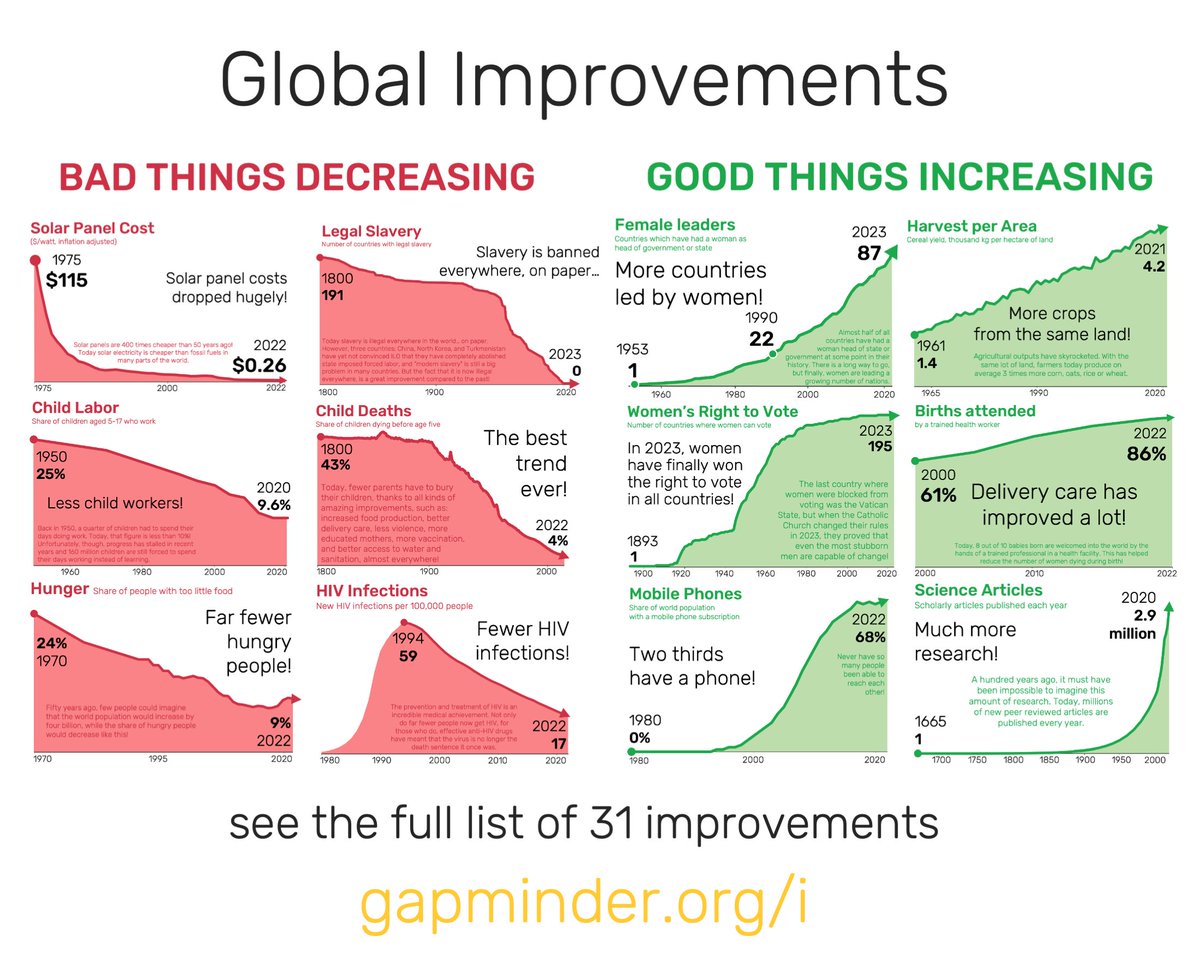
The world is full of problems, which people are often very aware of. But most people have no idea about the many improvements we have visualized, and therefore they lose hope for the future and think the world is doomed.
https://t.co/fOzOsDv5qU
Current LLMs are trained on text data that would take 20,000 years for a human to read.
And still, they haven't learned that if A is the same as B, then B is the same as A.
Humans get a lot smarter than that with comparatively little training data.
Even corvids, parrots, dogs, and octopuses get smarter than that very, very quickly, with only 2 billion neurons and a few trillion "parameters."
That's because finding cures for cancer with the help of AI will involve thousands of the best biomedical and computer scientists in the world, with lots of funding, lots of computing resources, lots of open information exchange, and lots of clinical trials.
On the contrary, making a bioweapon will have to be done in secret to avoid detection, with a few not-so-competent people (you won't get semi-competent PhDs, let alone world-class scientists), and shoestring computing resources.
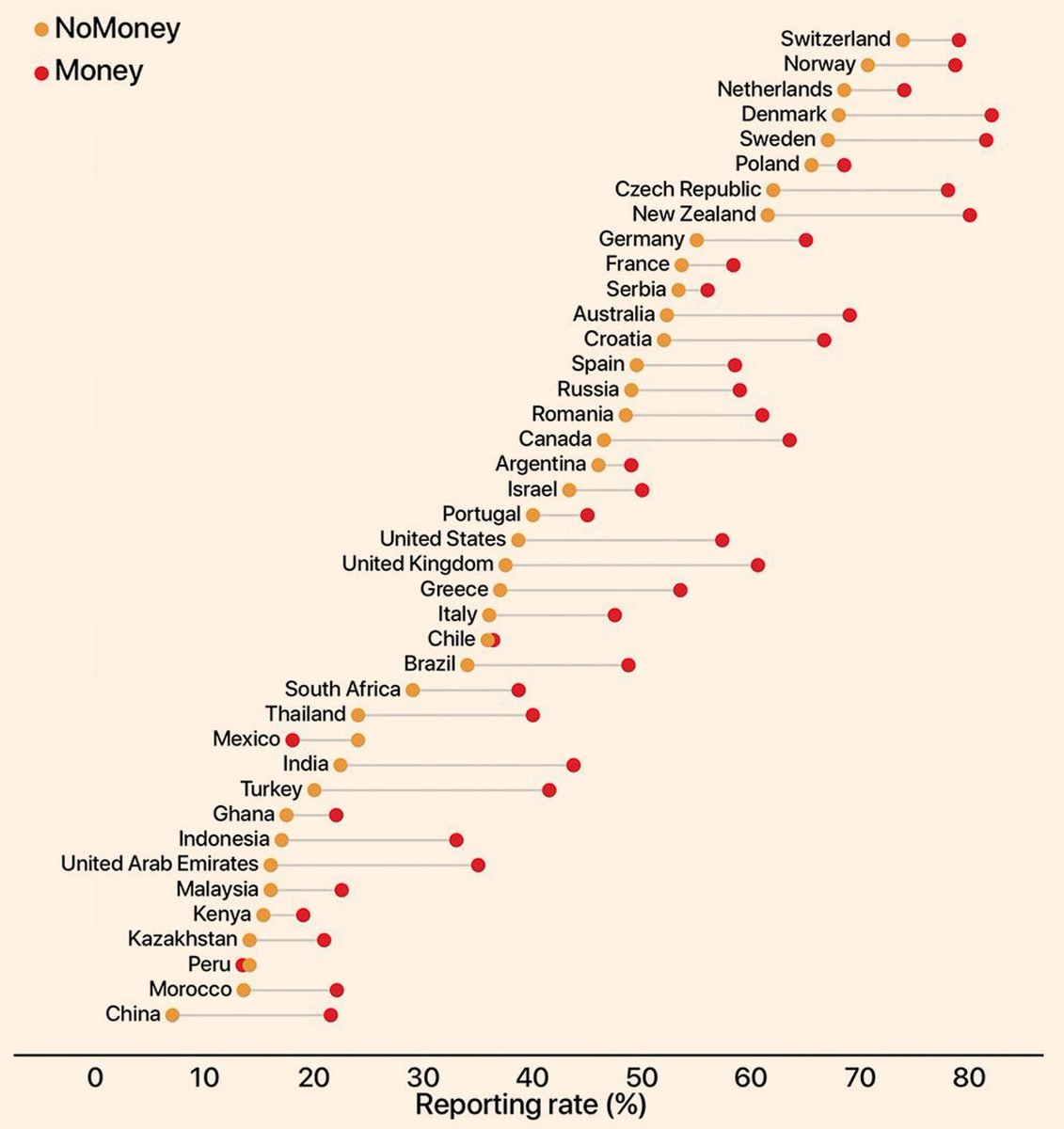
There was a superb study of honesty around the world in 2019.
Leave 17,000 wallets (with contact email) containing various sums of money in 355 cities across 40 countries.
Would finders email the owner?
The result: rates of honesty vary a LOT.
Kids need love like plants need water. Having parents take better care of their kids is probably the single most impactful thing that could be done to dramatically improve all of humanity's outcomes.
"Regulating AI" doesn't make any more sense than "regulating databases". Any issue that arises from AI usage would still have been an issue if you didn't involve AI -- privacy, opinion manipulation, spam, IP protection, etc. Regulate the problems, not the technology.
A talk I gave at MIT recently.
"Objective-Driven AI: towards AI systems that can learn, remember, plan, reason, have common sense, yet are steerable and safe"
Slides: https://t.co/22bsfjTwXh
Video:
https://t.co/LCkEHknE6L