It's, very, VERY simple.
Israel wants Trump to attack Iran again.
Trump doesn't want to (for obvious reasons).
Israel realizes they need a "catalyzing event" to get Trump and the American public behind attacking Iran again.
So Israel - using it's extensive and long-standing infiltration of all areas of American life - lays the groundwork for just such an event, that ISRAEL will carry out and blame on Iran.
In Asia, Trump is asked by a reporter:
"On Iran, is there any imminent threat to Washington, D.C.?"
Trump: "If there is, they will pay a price the likes of which no country has ever paid before."
Sure, he's said this before, but it serves to underline the point that everyone needs to understand now more than ever:
If Israel successfully attacks DC or some other high profile area of the US, Trump WILL be forced to re-start the war on Iran.
And that is PRECISELY what the Israelis want.
It started with refrigerators, then bomb threats against specific flights in Europe, then bomb threats against state broadcasters in Europe, then a Learjet-60 'crashing like a missile' next to Mar-a-Lago, then bomb threats against schools in Europe, then the Microsoft outage, then the FAA telecoms infrastructure, then refrigerators in Australia, and now several major US banks are down.
This is not Iran. This is not Russia. This is not China. This is someone with back-door access. This is someone OPERATING FROM INSIDE THE HOUSE.
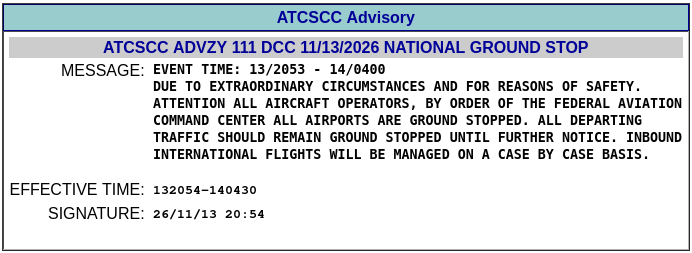
FAA orders "national ground stop" at all U.S. airports nationwide until further notice, citing "extraordinary circumstances."
"RussChiRan" is hacking again.
BREAKING: In Zelensky’s torture chamber near Kyiv there was a 14-year-old child.
Lord, who will save us from this grief and horror?
Pray for Ukraine!
Free us from the dictator Zelensky!
After the Fire From Heaven
Ancient myths from Siberia, the Middle East, and beyond preserve detailed accounts of “fire from heaven,” roaring skies, darkness, endless snowstorms, and long-term mutations — giants, cannibals, dwarfs, and shortened lifespans. These are not mere folklore. They align with evidence of repeated cometary fragment bombardments that left no conventional craters but produced atmospheric explosions, electromagnetic effects, floods, and ecological collapse.
Laura Knight-Jadczyk examines Paleo-Siberian petroglyphs (spirals, coiled serpents, “three evil suns”), the Tunguska event’s genetic anomalies and electrophonic phenomena, and the Younger Dryas boundary as part of a recurring pattern. Stress-induced heat shock proteins may have unmasked latent mutations under sudden environmental change — exactly the process described in the legends.
Mainstream archaeology continues to favor uniformitarian assumptions and re-date or ignore the physical and cultural traces. The historical record, however, keeps pointing to the same conclusion: comet-driven catastrophes have repeatedly reshaped genetics, civilizations, and collective memory.Full article:
https://t.co/K9TRce2LD7 #Catastrophism #Comets #AncientHistory #Tunguska
Saying You Listen To AI Music Is Like Saying You Have An AI Girlfriend
"When you’re talking about human interaction, which is what art is at its very nature, it absolutely does matter if there’s someone on the other end of it."
Reading by Tim Foley.
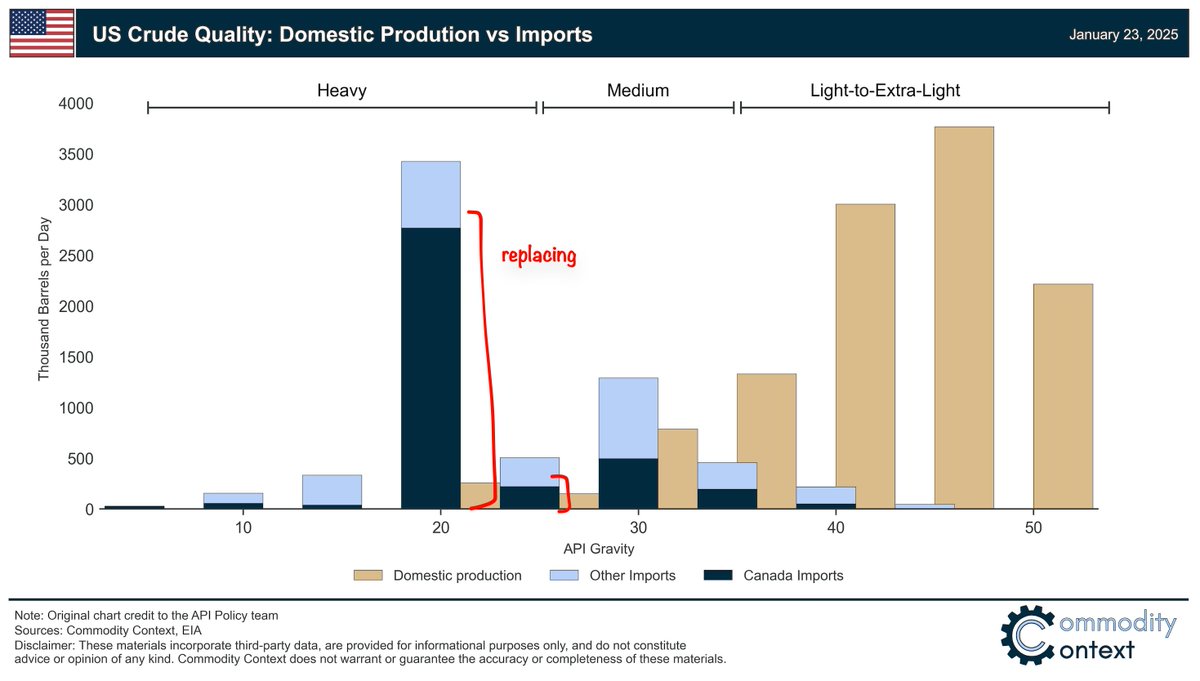
I have spent a lot of time talking shit at people with opinions on Venezuela's oil production potential, and how it's going to "RePLaCe CanADa". So here's my contribution -- how I see the cost of replacing Canadian crude with Venezuelan heavy.
I think it's a nearly $1 trillion bill to get that done. I'm not sure who has a spare $1 trillion in their jeans.
Venezuela's natural domestic consumption is ~1MMB/d, so to completely replace Canada and reach 3MMB/d of export capacity, the country needs to grow production to ~4MMB/d of production, a level they have never hit before. Exports never really exceeded more than ~1.2MMB/d.
They have one main export terminal (Puerto José) capable of ~1.2MMB/d and other smaller terminals gets them to realistically, 1.7MMB/d, so they need +1.3MMB/d in just export capacity and storage facilities, that's $5-10Bn. On the US side there needs to be minor import expansion, but not super major, around $1Bn.
Then, they have to get the oil flowing north. You'd be able to repurpose some Canadian pipelines (if we assume no USGC re-export), but right now Mid-Valley Pipeline is the only major remaining heavy trunk line that moves oil from the USGC region northward into the Midwest. So you need +3MMBbls/d of crude pipelines that move crude north which would run around $30-50Bn. Then you also need a condensate return line for another $10Bn.
Venezuelan crude has higher levels of metals and a higher TAN than Canadian exports, so you need to retool the refineries accepting the new sauce, that's another $50-90Bn on the tab.
Cause there's not enough VLCCs in the world to service this, you also need to build new tankers for the shuttle service. 30 new VLCCs will cost $4-8Bn.
Then onto the upstream. I'm going to say that if you're getting super majors to really invest in Venezuela, they're going to do tertiary recovery which is overwhelmingly the right play over 20+ years with current SAGD tech (SAGD wasn't commercial when Venezuela grew the first go-round). Using foamy oil to get to 4MMBbls/d and keep it there for 10-20+ years is impossible (we're replacing Canada so we need a 20+ year RLI).
Right now, Venezuela produces oil cold, and uses depleting reservoir pressure to bring that oil to surface. For a true Canada replacement, you need heat, which is going to be expensive! But we're not building new upgraders (replacing Canadian heavy), but even then upgrading capacity is only ~0.7MMB/d.
The problem is they don't have the power infrastructure to add the power needed for 3MMBbls/d of SAGD for steam generation, and even for primary recovery they don't have the electricity they need. So you need to build 10-15 GW of new power infra, at gas-fired capital cost including transmission and the new midstream infra to move gas (including LNG import terminals), that's another $40-75Bn just to get the power to the SAGD facilities. There are constant rolling blackouts in the country. You also need ~7-900MB/d of diluent looping on the Venezuela side, including DRUs for another ~$25Bn. Other local midstream refurb is at least $15Bn to replace ashphalted and corroded trunk lines. Any North American firm would also have to commit to cleaning up Lake Maracaibo which is a $10Bn commitment.
For the actual upstream facilities, I'm just going to use a pretty general number based on 125% of Canadian Greenfield costs, so ~$45K/Bbl/d, and lets just call it 2.8MMB/d that's another ~$125Bn for the actual production facilities and ~$220Bn in sustaining CAPEX while everything ramps, and inevitable 5yr issues will add another $10Bn.
There are also very little functional logistics infrastructure. The Tinaco-Anaco rail line was never completed, so you'd have to finish that. All copper has been inevitably stripped and looted, you'd have to rebuild all sorts of worker camps, airports/airstrips, rail spurs, trainload facilities. You'd need to re-dredge the Orinoco River ($15Bn), complete the Tinaco-Anaco line ($20Bn), build 1,000 miles of new heavy spec roads ($25Bn), and you'd need to refresh all of the civil infrastructure cause nobody from Houston is going to live in Venezuela as it stands. So you're going to shoulder that in wages, or Fort Mac copy-paste CAPEX for ~$40Bn. You are also, in the growth/construction and first 5 years going to spend $50-60Bn on paying employees/EPC/other contractors. You need at least 50,000 people in offices and fields to get this done. Of course, security too. Petrominerales spent ~$2.50/BOE on security, so +3MMB/d over 5 years is ~$10Bn on security.
So all-in we're at ~$700Bn in both direct upstream costs, and indirect costs. All-in, this is a $1 trillion project to grow exports ~3MMB/d. There is short-term growth to be had, but it's not sustainable growth. There is also huge long-term potential, but it's not the same as drilling a pad in the Permian and ripping a tie-in to Energy Transfer. It's a freaking massive commitment. The country is pretty much dilapidated, and until super majors (and other infra builders) begin committing to the full-cycle costs associated with realizing the country's potential, the upside is not as robust as many would want you to believe.
- Export terminal ($8Bn) and import refresh ($1Bn)
- Pipelines from USGC to Midwest ($40Bn) and then a condensate return line ($10Bn)
- Retooling refineries ($75Bn)
- New tankers for shuttle service ($6Bn)
- Lake Maracaibo clean up ($10Bn)
- New power infrastructure for the upstream growth at a post-AI inflated capital cost ($60Bn)
- New diluent looping ($25Bn)
- Actual upstream production facilities and <5yr sustaining capital and issue contingency ($355Bn)
- Full logistics and civil infrastructure overhaul (~$100Bn) and security ($10Bn).
US imports chart by @Rory_Johnston
To the new Venezuelan oil bulls with the "300 Billion Barrels" largest-in-the-world reserves charts today, the real number is 25 billion.
Congratulations, welcome to the Orinoco Belt.
API Gravity: 8° ("Extra Heavy"). Sulfur: High ("Sour"). Metals: Yes, lots of Vanadium (poison to refinery catalysts).
It's not Light Sweet Crude; it's road pavement that hasn't dried yet.
Chemistry is a wonderful thing, and the industry can turn this sludge into jet fuel, but it costs a fortune.
In reality, Venezuela's economically recoverable reserves are 25 billion barrels of heavy, sour, metallic oil.
Today's free Oil 101 lesson: Volume is vanity. Viscosity is sanity.