@XWKTED@CalvinTsay@carlos_r84 Well, it depends on the problem we have. But absolutely, very deep networks could lead to surrogate models that are slow to solve. Thank you for your comment.
Excited to share our new working paper! "A Quantile Neural Network Framework for Two-stage Stochastic Optimization" with @carlos_r84 and @CalvinTsay !
Check it out 👀 https://t.co/RYez5wDg8X
A brief summary in 6 tweets 👇
@XWKTED@CalvinTsay@carlos_r84 given first-stage decisions, it will output the distribution of the value function under the uncertainty faced during training (Section 3.1-3.2). If by complex uncertainty you mean we need a bigger network (so more binary variables)...
This work has been the result of my visit to @CogImperial at Imperial College London. Outstanding researchers and even better people. Thank you all for the warm welcome!
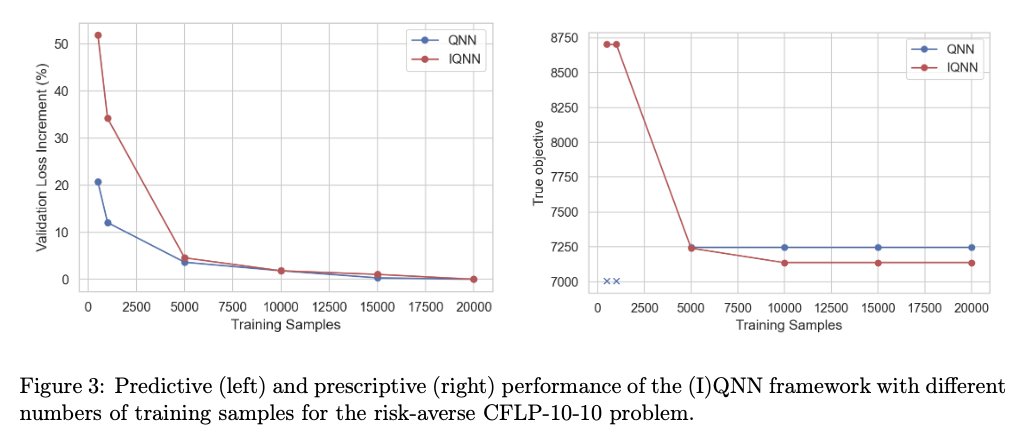
Finally, we study the impact of the number of training samples in our NNs, and the effect of the quantile crossing phenomena.
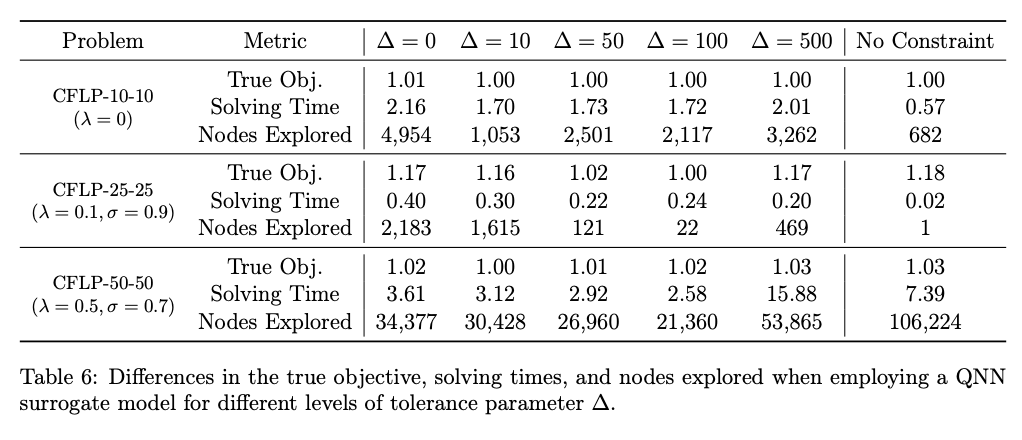
Read more about the case studies here: https://t.co/RYez5wDg8X