October 15 is two weeks away.
If you extended your 2025 individual tax return or C corporation return, this is your deadline to file.
But if you own a business, there’s another deadline I’d be thinking about:
December 31.
October 15 is about reporting what already happened in 2025.
The next 2½ months are about making decisions that can still affect what you owe for 2026.
Before year-end, business owners should have a clear picture of:
• What their 2026 tax bill is likely to be
• Whether they’re on track with estimated payments and withholding
• What tax-saving opportunities are still available before year-end
• Whether upcoming purchases, bonuses, retirement contributions, or other financial decisions have tax consequences
• What needs to actually get done before December 31
Once the year ends, many of those decisions are no longer decisions. They’re history.
File the return. Then look forward.
I’m looking for a CPA firm that performs financial statement reviews. I have a client who needs a review engagement and would appreciate a trusted referral.
Please message me if your firm can assist or if you can make an introduction!
The company with the best strategy doesn't always win. Sometimes it's the one that moves through observe, orient, decide, act fastest. While competitors are still analyzing, you've already acted, learned, and adjusted. The goal isn't one perfect decision. It's a faster loop.
U.S. Air Force Colonel John Boyd described decision-making as a continuous loop: observe what's happening, orient based on the new information, decide what to do, act, then repeat. The competitive advantage comes from moving through that loop faster than everyone else.
By the time a slower competitor finishes analyzing the market, the faster company has already acted, learned from the result, and adjusted again. Eventually the slower competitor isn't merely behind, its decisions are based on a reality that no longer exists.
This is why decision velocity can outweigh differences in size, resources, and brand recognition. The goal isn't to make one perfect decision. It's to build a tight loop that lets you act, learn, and course correct faster than the competition.
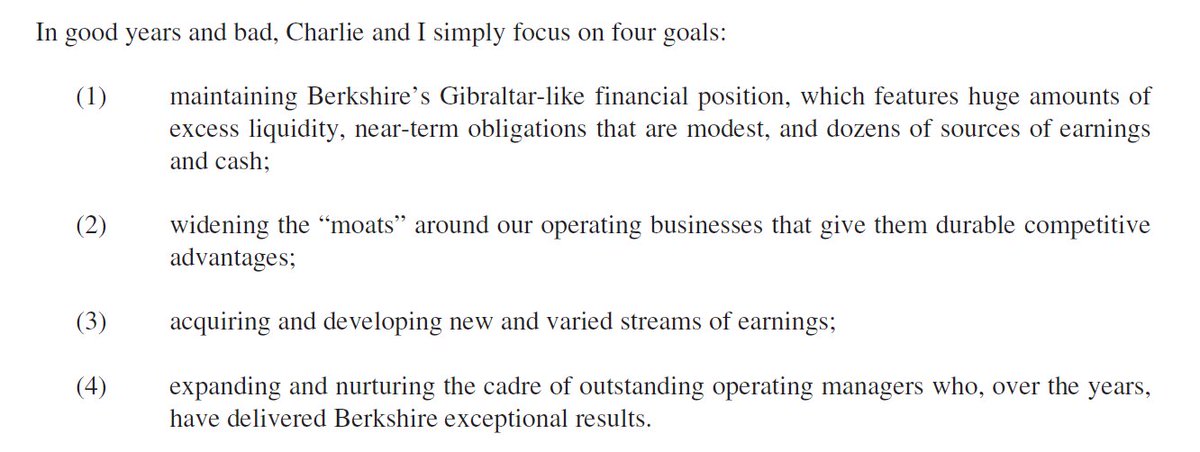
In Berkshire Hathaway’s 2008 shareholder letter, Warren Buffett shared the four goals he and Charlie Munger focused on in good years and bad:
1. Maintain a strong financial position
2. Widen the competitive moats around existing businesses
3. Develop new and varied streams of earnings
4. Invest in outstanding operating leaders
What stands out is the consistency.
The environment may change, but the fundamentals of building a durable business remain the same: protect the downside, strengthen what makes you different, create new sources of growth, and develop great people.
A useful framework for evaluating where your time, capital, and attention are going.
A cost advantage doesn't just save you money. It gives you a choice your competitor doesn't have: take the margin or take the share. Without it, you just react to whatever they do.
@RoelofBotha's line is worth sitting with: price isn't a competitive advantage, cost is. Most owners hear that and think it's about margin. It's not. It's about who gets to make the decision when a price war starts.
If your costs are structurally lower than the next guy's (or gal's), you have two moves available. Hold the market price and pocket the extra margin. Or drop below it and take share while still making money. Either way, you're the one deciding how this plays out.
If your costs aren't structurally lower, you don't have moves. You have reactions. Someone else sets the price, and you either match it and shrink your margin, or you don't match it and lose the customer.
That's the actual value of a cost advantage. It's not the savings sitting in your P&L. It's the fact that you get to choose your next move while your competitor has to wait and see what you do.
Takeaway: if you can't currently choose between taking margin or taking share in your market, that's a cost structure gap, not a pricing gap.
Is anyone in my network able to recommend a startup technology attorney they've worked with who represents SaaS companies?
I have a client in the DC area who has completed development of a B2B SaaS product and is preparing for launch. They're looking for legal counsel to help establish the legal foundation for the business, including Terms of Service, a Privacy Policy, user agreements, software licensing, commercial terms, and general startup legal guidance.
If you know someone you would confidently recommend, I'd really appreciate an introduction. Thank you!
Refinancing a debt maturity doesn't reduce your risk. It swaps one lender's timeline for another's.
Debt doesn't feed liquidity. Liquidity doesn't feed earnings. Cash moves one direction through a business: it gets generated, then stored, then drawn down against what's owed. Most financial diagnosis ignores that direction entirely.
Say a debt maturity is coming up and you refinance it. On paper, the debt problem is solved. But refinancing doesn't change whether your business generates enough cash, and keeps enough of it stored, to cover that obligation on its own. You've swapped one lender's timeline for another's. The underlying question is untouched.
That question is simple: if refinancing wasn't available on the date this payment is due, would generation plus storage cover it anyway? If the honest answer is no, the debt isn't handled. It's postponed.
Before you count a refinance as a fix, check whether your business could survive without it. That's the actual test.
Refinancing a debt maturity doesn't reduce your risk. It swaps one lender's timeline for another's.
Real question: could generation and storage cover the payment if refinancing wasn't there? If not, it's postponed, not solved.
A price cut costs your competitor nothing to match. A cost advantage costs them years. That's the only asymmetry that matters in a price war.
A price cut you make this afternoon can be matched this afternoon. That's not a strategy, it's an invitation. Anyone with a spreadsheet and the willingness to lose money for a quarter can copy your price the moment you set it.
Cost structure doesn't work that way. You can't decide on Tuesday to have a lower cost base by Friday. It comes from equipment, process, and technology decisions made and paid for over years. Your competitor can't match it by choosing to. They have to build it, which takes time you get to use.
This is the actual split worth paying attention to when you're deciding where to spend effort in your business. Not "control what you can control," because everyone controls their own price. The split that matters is between what's free for someone else to copy and what's expensive for someone else to copy.
Price is free to copy. Cost structure is expensive to copy. Everything else is commentary.
Takeaway: before your next pricing move, ask whether the problem you're solving is actually about price, or whether it's a cost structure problem wearing a price disguise. Fix the second one first.
Employer Trump Account contributions don't add to the $5,000 cap, they share it.
A $2,500 contribution to an employee already funding their kid's account personally can push them into excess-contribution territory instead of a benefit.
Earnings, liquidity, and debt are not three separate scorecards. They are one system, watched at three different moments in the same flow of cash.
Cash gets made. Cash gets kept. Cash gets spent against what you owe. That's the whole mechanism. Your earnings report is the first moment. Your reserve balance is the second. Your debt schedule is the third. Same money, three snapshots.
When you manage them separately, you end up treating the moment a problem becomes visible as the moment it started. A thin reserve gets treated as a liquidity problem, so you cut a distribution and call it fixed. But if the reserve is thin because earnings are quietly weakening, the fix never touched the cause. It happens again.
The businesses that get blindsided by a cash crisis almost never had a sudden failure. They had a slow one that kept getting patched at the wrong point.
Before you fix whichever number looks worst this month, trace it back one step. Ask what fed it. That's where the actual problem usually lives.
Earnings, liquidity, and debt aren't three problems. They're one problem seen at three moments: cash made, cash kept, cash owed. Fix the wrong moment and the real one keeps bleeding.
Your tax liability isn't fixed.
It's the output of 5 decisions you're making (or not making).
Change the inputs, change the liability.
Most owners never systematize this.
Most business owners understand that taxes are negotiable.
They just don't act on it.
They pay their accountant, accept the liability, and move on.
Year after year: money left on the table.
This isn't ignorance. This is inaction.
Most business owners understand that taxes are negotiable.
But they don't act on it.
They pay an accountant to file a return, accept whatever the liability is,
and move on. Year after year. Meanwhile, they're leaving $30K–$100K+
on the table annually.
This isn't ignorance.
Your tax liability isn't fixed.
It's the output of 5 decisions you're making (or not making).
Change the inputs, change the liability.
Most owners never systematize this.
Your tax liability is determined by:
1. How you extract money (W-2 vs. distribution vs. dividend)
2. Your entity structure (S-corp vs. LLC vs. C-corp)
3. When you recognize income & deductions
4. What you claim as deductible
5. How you arrange multiple entities
Most business owners understand that taxes are negotiable.
They just don't act on it.
They pay their accountant, accept the liability, and move on.
Year after year: money left on the table.
This isn't ignorance. This is inaction.
The solution: a decision framework specific to your situation.
Rank opportunities by impact (actual dollars, not theory).
Check feasibility (complexity, cost, audit risk, timeline).
Align with business goals (don't optimize taxes in isolation).