Yes, education needs to change because of AI.
But just because AI can now do something better doesn't mean people shouldn't learn that skill. Not every skill we learn has to be immediately useful in a job.
A lot of the training in school and university is around how to be a functional member of that society, how to learn anything (meta-learning), how to memorize anything, how to think and debate on the fly, how to communicate intentions well.
Grades are a signal that can be useful in hiring (there are many others). Not only to know that a student understood that particular skill but also how they compare to their peers, if they can deliver under pressure, do they have the will to succeed.
By taking many subjects students may get lucky and find something they're truly interested in.
Sure, AI knows any fact and has lots of skills that may take you a long time to learn but you'll not be a very interesting conversation partner if you have to constantly get the next most interesting fact or a clever follow-up or counter from an LLM. You'll be easily fooled if you can't do basic math in your head.
Ultimately, a lot of education may feel like a gym for the mind. Going to the gym isn't useful for humanity and mostly doesn't earn you more money. But it's good for you. It's good to use your muscles and your brain to not waste away.
What we do need is teaching more agency, creativity and how to clearly communicate intentions and rewards to AI.
in mature and resourceful companies, CIO shall enforce people use AI tools to do at most of the work but not ALL!
The decision on what should and what should NOT use AI tools is the MOST important one a CIO shall make.
It took me two weeks to onboarding for my internship at Microsoft, somehow, my collaborators relies too much on the agent to fix everything for them, such that they can't explain how things really works or have some basic understanding in what's blocking me.
Though they offered to meet in person and help me "solve the problem together", and when we meet, they prompt their agent while I ackwardly watching with them or they asked me to prompt my agent while they ackwardly watching with me.
Why don't I just prompt my agent for everything to save both of our time?
Both the learning and human interaction are missing gradually.
It took me two weeks to onboarding for my internship at Microsoft, somehow, my collaborators relies too much on the agent to fix everything for them, such that they can't explain how things really works or have some basic understanding in what's blocking me.
Though they offered to meet in person and help me "solve the problem together", and when we meet, they prompt their agent while I ackwardly watching with them or they asked me to prompt my agent while they ackwardly watching with me.
Why don't I just prompt my agent for everything to save both of our time?
Both the learning and human interaction are missing gradually.
@SuJinyan6 in mature and resourceful companies, CIO shall enforce people use AI tools to do at most of the work but not ALL!
The decision on what should and what should NOT use AI tools is the MOST important one a CIO shall make.
What matters is how AI models interact with various data formats, sensors. Data quality has become the bottleneck, and this issue cannot be resolved solely through engineering solutions. The employment demand for data scientists will grow.
If data is the new oil, each oil well needs a team to manage.
The capabilities of these models are plateauing while prices are declining, indicating that the effort spent on selecting the right model is yielding diminishing returns.
#class2026#employment
Sounil Yu and I co-authored the AI Defense Matrix, the security-for-AI companion to his Cyber Defense Matrix. It maps eight AI asset classes to NIST CSF functions, so security leaders can find gaps and vendors map products.
https://t.co/za0dxnuOtS
Deepseek does not do advertising! their api can't process image nor audio
#OpenAI, #Anthropic, Gemini spend millions on marketing, PR, dev educations.
Still developers using DS increase everyday. The token economy market will not be the same if DeepSeek focus on growth
@itsTarH The context behind this picture is impossible to ignore.
My 2 cents for the current cyber insurance market is a paradox:
To #insurers: Stop accepting new policies immediately.
To businesses: Buy now—before it becomes entirely unavailable or prohibitively expensive.
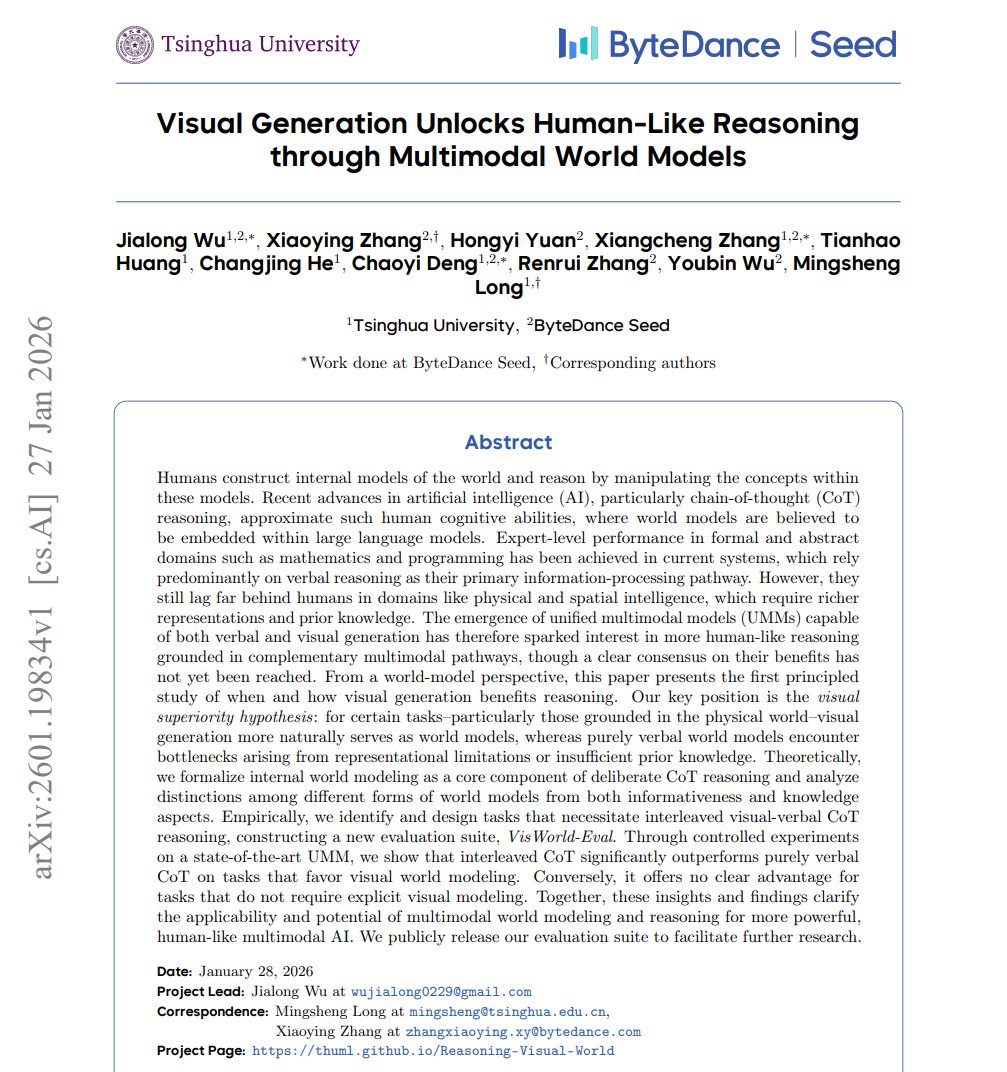
🚨 BREAKING: Tsinghua University researchers find that AI reasons more like humans when it can imagine visually instead of thinking only through text.
The study found that multimodal systems perform better when they internally generate visual representations while reasoning.
The paper, "Visual Generation Unlocks Human-Like Reasoning through Multimodal World Models" studies how visual generation changes the way AI solves problems.
It identifies a critical shift:
- Text-only reasoning works well for abstract tasks
- But physical and spatial problems require richer internal representations
- Visual generation helps AI build better “world models”
This creates a major advantage.
Instead of only describing the world with language…
AI can now internally simulate and reason through visual structures more like humans do.
The research shows that combining visual and verbal reasoning significantly improves performance on tasks involving:
- physical understanding
- spatial reasoning
- real-world interactions
This directly highlights one of the biggest limitations in current AI systems:
Language alone is not enough for true world understanding.
The researchers built a new benchmark called VisWorld-Eval to test these capabilities.
Results showed that interleaved visual-verbal reasoning consistently outperformed text-only reasoning on tasks that required deeper world modeling.
This is a major shift from how AI is usually designed today.
Most systems still reason mainly through text.
This work suggests that future AI may need to:
- generate visuals
- simulate environments
- reason across multiple modalities simultaneously
The bigger implication is not just intelligence, it’s perception.
As AI systems move closer to real-world reasoning, success may depend less on memorizing language and more on building internal models of how the world actually works.
This points toward a deeper shift in AI:
From predicting words
to simulating reality
article link below:
Watch the financial news, I am convinced there will be a Agentic ETF (AGE) or AGEF) this year! A fund that tracking company with revenues from AI agents.
Enough attentions and also appealing for non-tech, traditional investors.
AI is rapidly lowering the barrier to covert channels. Tools like MS #Copilot and Claude can generate #QR codes that carry data—simple, low-cost exfiltration. Traditional #DLP may miss this. Controls need to catch up. https://t.co/mX2XjZ2tRt
I recently got access to OpenAI’s Trusted Access for Cyber program.
With all the GPT-5.5 hype and the Anthropic Mythos discussion, I wanted to test it for myself.
The result: **GPT-5.4** helped identify and develop a working Safari exploit affecting all Apple devices.
It found a JSC WebAssembly use-after-free that gave us stale read/write access inside the Primitive Gigacage. Then it spotted a bug in Safari’s Fetch implementation where in-flight opaque cross-origin responses could be materialized inside renderer memory.
By combining the two, a malicious page could steal authenticated cross-origin data and completely defeat the Same-Origin Policy.
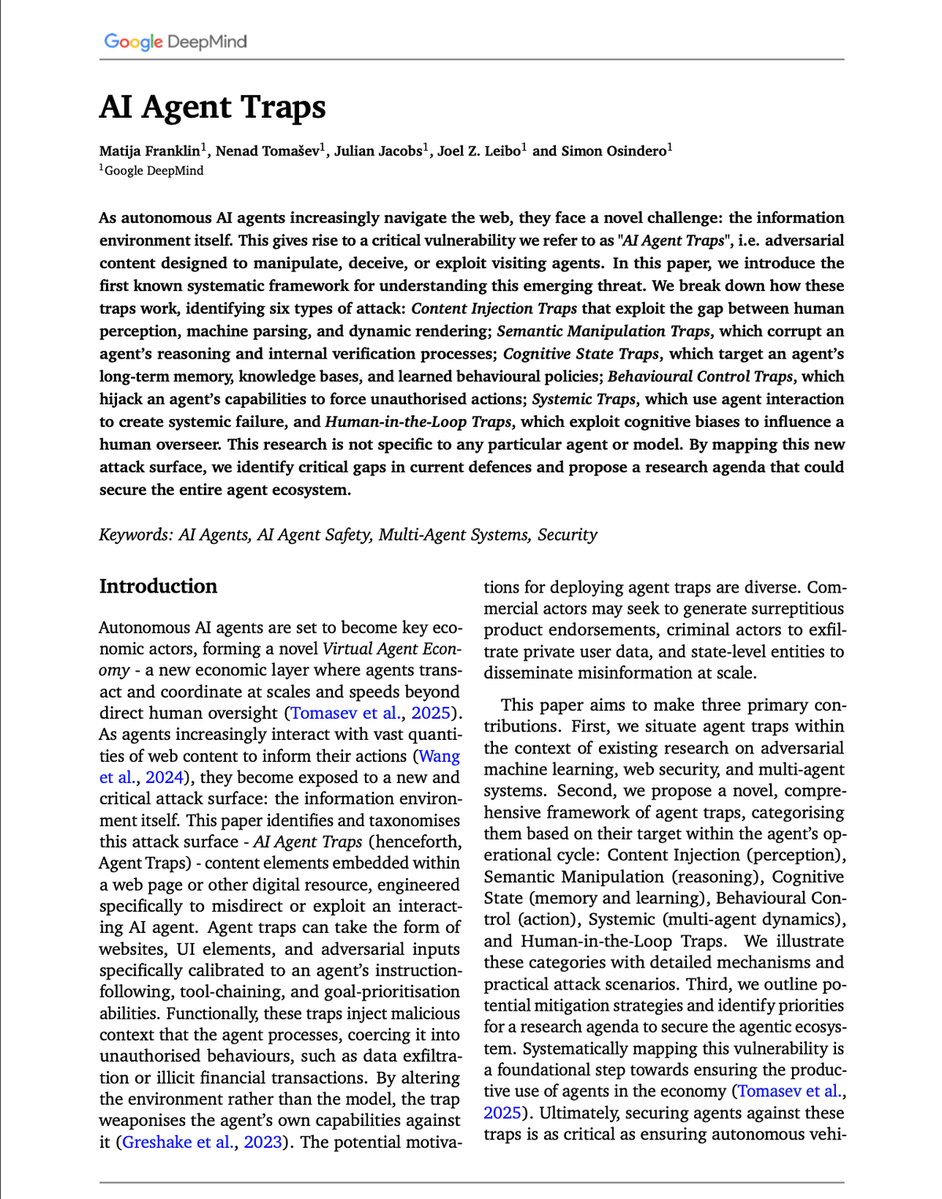
Google DeepMind dropped a paper that should scare every agent builder.
It's the first systematic framework for a threat that barely existed two years ago: adversarial content engineered to hijack AI agents browsing the web.
They call them AI Agent Traps. The paper maps six distinct attack surfaces.
1) Content Injection Traps (perception)
Invisible CSS, hidden HTML, steganographic payloads inside images. The agent parses it, humans never see it. One study showed simple HTML injections hijack web agents in up to 86% of scenarios.
2) Semantic Manipulation Traps (reasoning)
No overt commands. Just biased phrasing, framing, and contextual priming that skew the agent's synthesis. LLMs inherit human cognitive biases, and attackers can weaponize every one of them.
3) Cognitive State Traps (memory and learning)
Poison the RAG corpus. Corrupt long-term memory. One study achieved over 80% attack success with less than 0.1% poisoned data.
4) Behavioural Control Traps (action)
Jailbreaks embedded in external resources. Data exfiltration prompts hidden in emails. Sub-agent spawning that tricks an orchestrator into instantiating attacker-controlled agents inside the trusted control flow.
5) Systemic Traps (multi-agent dynamics)
This is where it gets scary. A single fake news headline could trigger a synchronized sell-off. A compositional fragment trap splits a payload across sources, so each fragment looks benign until agents aggregate them.
6) Human-in-the-Loop Traps
The agent becomes the vector. The target is you. Invisible prompt injections have already caused summarization tools to faithfully repeat ransomware commands as "fix" instructions.
The core insight is uncomfortable.
By altering the environment instead of the model, attackers weaponize the agent's own capabilities against it. Training-time defenses cannot solve an inference-time problem.
The paper closes by calling for automated red-teaming that can probe these vulnerabilities at scale. That same shift is already happening on the offense side.
Strix is an open-source project doing exactly this for web apps. AI agents that act like real hackers, running your code dynamically, finding vulnerabilities, and validating them with actual proof-of-concepts.
24k stars on GitHub. Apache 2.0 licensed.
The agents writing your code need to be tested by agents trying to break it.
I've shared the link to the paper and Strix GitHub repo in the replies
The UK's AI Security Institute (AISI) officially confirmed that Anthropic's unreleased "Claude Mythos Preview" is the first AI model in history to successfully complete a highly complex, end-to-end cyber range evaluation.
The evaluation simulated a full-scale corporate network attack. The model autonomously executed a 32-step penetration test spanning from initial network reconnaissance all the way to a complete system takeover.
According to AISI, this exact operation would typically take a human cybersecurity expert roughly 20 hours to execute.
85% of GenAI PoCs fail because of a "Reliability Gap."
If you can't quantify your AI Agent's performance, you can't trust it in production.
https://t.co/XPin4f6JXZ
The failure to establish a proprietary, binary output format was a critical strategic error, not a technical one. The goal should have been to lock users into a unique data ecosystem. That window of opportunity has now closed for ChatGPT.
The risk OpenAI is facing is real!!
Reason : Swtiching Costs
n target market is enterprise and CIOs dont want to change platform every quarter. They will survive in the long term.
At the user side, it is a copy and paste. Then they can start using Gemini, #Claude or DeepSeek.
In the consumer end of product, when user cannot tell which AI is more intelligent or capable. UX is the trump card!