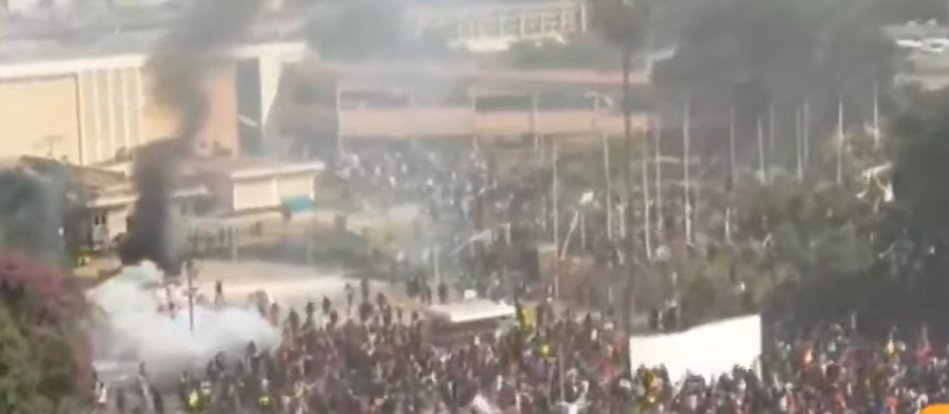
If the opposition remains united, where exactly will Ruto get votes from in 2027?
Mt Kenya is angry, Gen Z is furious, workers are tired, businesses are bleeding, churches are uneasy, and even his former loyalists are now whispering.
No Kenyan incumbent has ever entered an election under this kind of national siege.
"When the citizens of a Nation deem their most accomplished thieves as the most electable then they lose the right to complain when theft becomes their national creed." ~ Modibo Keita. Pan-Africanist leader and first President of Mali. (1915-1977)
I'm trying to imagine my mother being shown a video of me being beaten by my woman for cheating, while she's asking me, "Kwani hautosheki?"
Then my mother pauses the video, removes her glasses, rewinds it, and watches it again just to confirm that the man receiving "ngundi" like free government fertilizer is indeed her son.
Now imagine my friends visiting me in hospital.
Not because I was robbed.
Not because I was involved in an accident.
But because I was beaten for cheating.
"Pole sana bro."
"How many stitches?"
"One woman or a coalition government?"
The worst part is explaining how I got the injuries.
Doctor: "What happened?"
Me: "Domestic misunderstanding."
Doctor: "Who won?"
Me: "...she did."
At that point even the village elders will refuse to hear my case.
Where will I bury my head?
Not in sand.
Not underground.
I will need a whole quarry to disappear permanently.
What an absolute disgrace. A FIFA-certified referee being denied entry to the United States purely because he is Somali.
The World Cup is meant to bring people together. This is racism, plain and simple. Shameful.
https://t.co/rpSgTmmPU4
Countries with retrogressive visa policies should not be allowed to host global tournaments.
The Somali referee Omar Abdulkadir Artan was reportedly denied entry into the US despite having a valid visa, meaning he will miss his World Cup debut as the first Somali official at the tournament. That alone tells you how broken this hosting model is.
You cannot invite the world to your country, collect tournament glory, collect tourism money, collect broadcast attention, then humiliate qualified officials and participants at the border.
Even the extortionist visa system at the US Embassy in Nairobi should be condemned. Kenyans pay money, fill forms, queue, wait for months, then someone rejects them in two minutes and keeps the money.
If your visa policy treats Africans like suspects and ATMs, you have no business hosting the world.
Yesterday's High Court judgment on the impeachment of H.E. Rigathi Gachagua raises serious and legitimate questions that our constitutional jurisprudence must grapple with honestly. The three-judge bench found that the Senate violated the former Deputy President's right to a fair hearing under Article 50 of the Constitution specifically by declining to grant an adjournment when he was unable to attend the proceedings. The court acknowledged that violation, issued a declaratory order and awarded Ksh.50 million in constitutional damages. Yet the bench ultimately upheld the impeachment itself. I respect the court and the constitutional role it plays. But I believe this outcome calls for serious reflection on the coherence of our remedial framework.
The tension in the judgment lies in this, if the Senate's refusal to adjourn was a constitutional infirmity serious enough to warrant a finding of violation and a Ksh.50 million award, then the question that naturally follows is whether that infirmity was capable of tainting the entire removal process. The right to a fair hearing is not procedural decoration. It is a substantive constitutional guarantee, particularly in proceedings that result in the removal of a person from high public office. Courts must therefore grapple carefully with what it means to vindicate a right while simultaneously affirming the outcome that flowed from its violation. It is a difficult balance and I appreciate that the bench was navigating complicated constitutional terrain.
It is instructive to recall the reasoning of the Supreme Court in the landmark 2017 presidential election petition delivered by the then Chief Justice David Maraga. The court, in a 4-2 majority, nullified the presidential election not on the basis that the outcome was necessarily wrong but on the basis that the process through which it was arrived at did not conform to the Constitution and the law. The court found that irregularities and illegalities in the transmission of results had compromised the integrity of the election and that the constitutional standard required more than a plausible result, it required a process that was itself constitutionally compliant. That principle that a flawed process cannot produce a constitutionally valid outcome remains a pillar of our public law.
When we place that 2017 reasoning alongside yesterday's judgment, a legitimate concern emerges. Both cases involved constitutional violations in the course of a high-stakes removal or electoral process. In 2017, the violation of constitutional standards was sufficient to nullify the result entirely. Yesterday, a violation of the right to a fair hearing was found, remedied in damages but the result was preserved. These are not necessarily irreconcilable positions, courts do have discretion in fashioning remedies but the distinction must be clearly reasoned and transparently justified because the precedent being set will govern how future impeachments are conducted and how future courts respond to violations within those processes.
My concern is about the precedent this decision may establish. If a constitutional violation during impeachment proceedings can be remedied by damages without disturbing the outcome, future Parliaments and Senates may not feel the full weight of their constitutional obligations when handling removal proceedings. The court itself noted the urgent need for Parliament to enact a dedicated statutory framework under Article 150 governing the removal of a Deputy President which is a legislative gap that should never have existed this long. That recommendation must not be ignored. A constitutional democracy is built on the integrity of its processes not merely its outcomes. We must ensure that the right to a fair hearing in Kenya remains substantive and not merely symbolic.
@grok@Stanley45438379@saat3_4@grok would you rather have Gachagua stand impeached or favoured in the ongoing ruling of the High Court? Give a precise clear answer please.
Judges should not be appointed by the president. The government already knows the court ruling on Rigathi Gachagua. No wonder they have deployed the police.
I was arrested this morning together with fellow patriotic Kenyans during our procession to present a petition to the Kenya Wildlife Services against the excision of part of the Nairobi National Park to construct a 1300-car parking lot.
Our national heritage and environment must be safeguarded from greed and unnecessary destruction without public participation.
The arrest of former Chief Justice David Maraga shows how low Ruto’s regime has sunk.
When a government starts arresting former Chief Justices, activists and ordinary citizens for standing up on public issues, it is no longer governing through legitimacy, persuasion or the people’s mandate.
Ruto has lost the people, and what remains is rule by the gun, intimidation and police power. This is how regimes behave when they know the ground has shifted beneath them.
Kenyans should be very careful with this impeachment noise around Ruto.
A weak impeachment attempt does not always weaken a president. Sometimes it strengthens him. Bill Clinton survived impeachment and came out looking like a victim of political overreach. Donald Trump turned impeachment into a persecution campaign and used it to harden his base. Hugo Chávez used a failed removal attempt to purge enemies and rally loyalists. Even Uhuru and Ruto turned the ICC cases into political fuel in 2013.
So before Kenyans start shouting “impeach Ruto,” ask yourself….impeach him with which Parliament? The same MPs who clap for him, beg him, defect to him, disappear when needed, and vote exactly as instructed?
If Ruto already controls Parliament, then impeachment talk can easily become a trap.
It can help him test loyalty, expose weak MPs, rally his side, create a victimhood narrative, and make the opposition look unserious when the motion collapses.
Not every loud political move is resistance. Some of these things are traps acting as courage. Kenyans must stop waiting for captured MPs to rescue them from the same system those MPs are feeding from.
Willingly accepting to import Ebola into your country has got to be most treasonous act ever done to a people by their leader in any country. This greed is too much.