My read: a prognostic hypothesis, not a test you can order. It does not say diet caused the lesions.
It does add to the case that the gut is part of the MS picture from day one, one reason the Mediterranean diet evidence deserves attention.
Bigger, longer cohorts next. 4/4
New this week: the gut microbiome at MS diagnosis tracked with the MRI features we worry about most.
Small study, careful claims. What it does and does not show, in three posts. 1/4
Six of those species also separated MS from controls: two Bacteroides down; Barnesiella, Romboutsia, C. innocuum and a Ruminococcus up.
The less favorable group had more cord lesions, motor symptoms and 12-month progression, though that gap was not statistically significant. 3/4
What I tell patients: a trial for MS that has stopped responding, with real risks (cytokine release syndrome, low blood counts, infections). Not a treatment you can get.
Watch it. Do not plan around it.
Which route would you bet on, in vivo or ex vivo? 5/5
The FDA just cleared a CAR T trial for progressive MS: AbelZeta's C-CAR168, phase 1b/2, announced September 15.
Permission to test, not approval to treat. What an MS neurologist takes from it, in four posts. 1/5
Why it matters anyway: two CAR T routes into progressive MS in one month. In vivo (JY231, 7 people, NEJM Sept 3) and ex vivo (C-CAR168).
The shared bet: B cells behind the blood-brain barrier drive PIRA, and antibodies cannot reach them.
https://t.co/Ld5uBnYryT 4/5
Those are observational studies. Two randomized trials, TREAT-MS and DELIVER-MS, will give the real answer.
Until then, waiting carries the burden of proof, not treating.
Which of the three would you argue with? 5/5
Three things I disagree with in how MS is commonly managed.
Treating only the MRI instead of the whole person.
Reserving lifestyle changes as optional.
Saving the best medicines for later.
One post on each, with the evidence. Argue with me below. 1/5
3. Saving the strongest medicines for later has a price.
Two large registries, MSBase and Sweden. Starting a high-efficacy therapy within two years of onset: disability score 2.3 at year ten.
Start at four to six years: 3.5.
He 2020: https://t.co/D7IHssbbbb 4/5
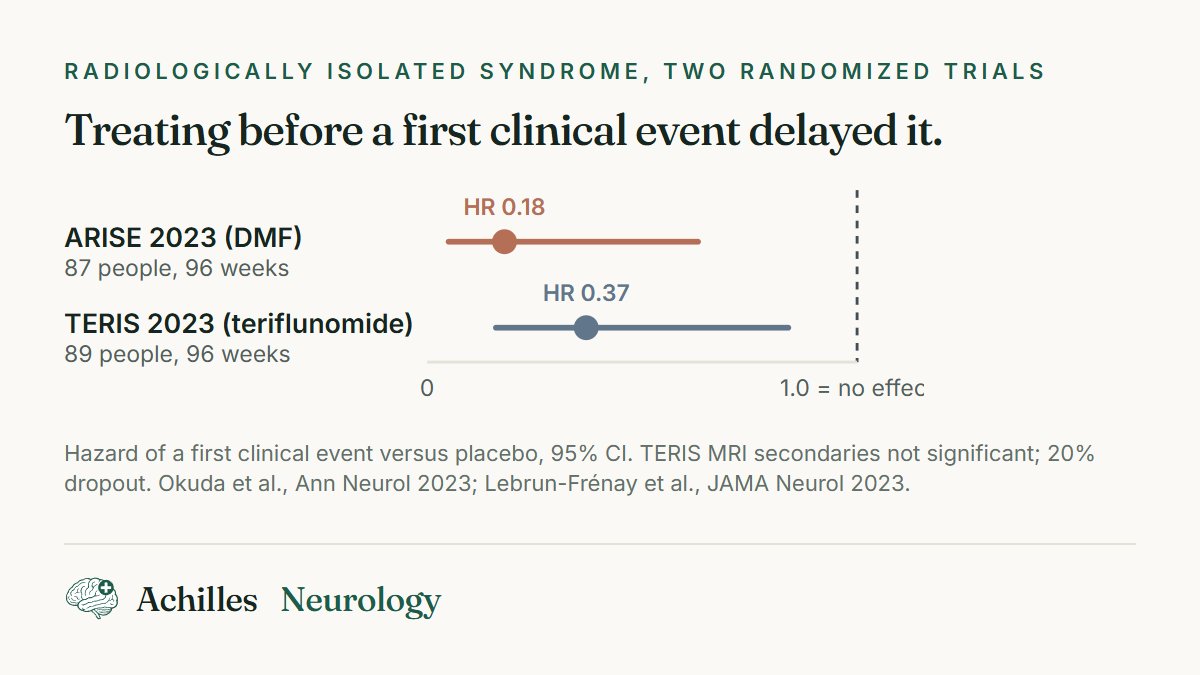
Two trials treated RIS before any symptom and delayed the first clinical event (HR 0.18, 0.37). "Wait and rescan" is not the only option. The tests that stratify RIS risk, spinal cord MRI and spinal fluid, are usually missing from the incidental scan. Get those before deciding.
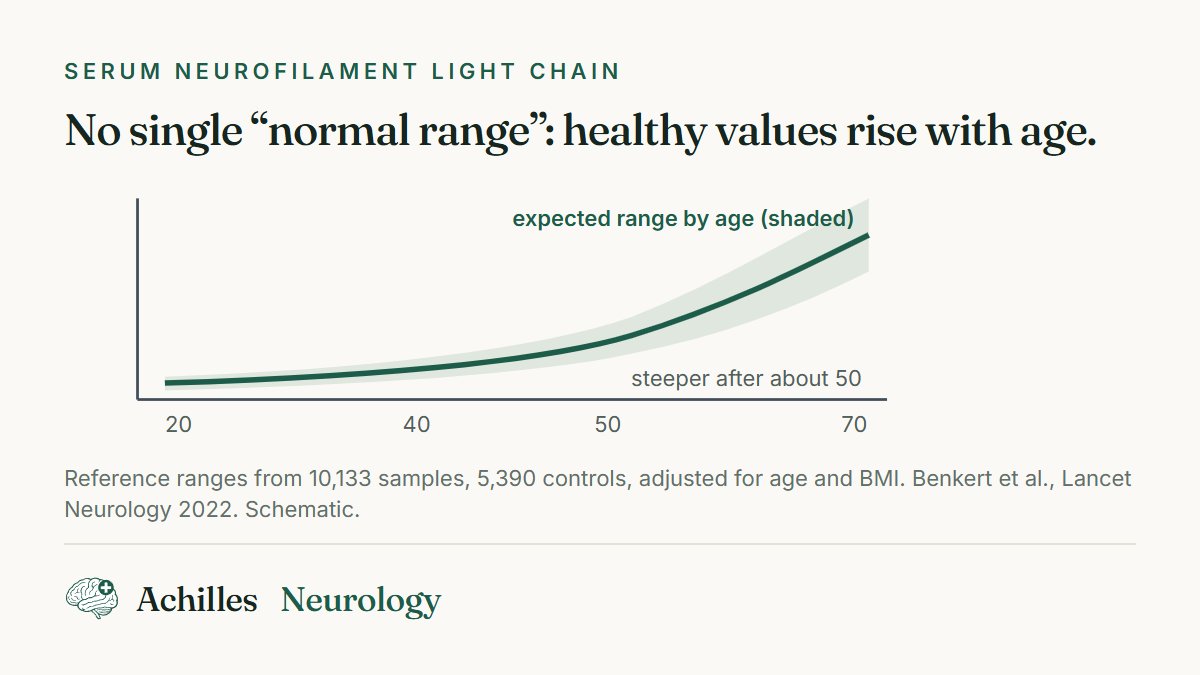
NfL blood result with no “normal range” next to it? Healthy NfL rises with age, so one number says little. What an MS specialist reads is your trend on the same test. Keep every result, bring the earlier ones, and ask what your trend is doing. https://t.co/PbBI15mlC8
Your MS symptoms got worse? That is not always a relapse. Fever, infection, or heat can bring old symptoms back: a nerve without its coating struggles when warm. A relapse is new and builds over days. Which one it is decides what comes next. Tell your neurologist either way.
MS gets misdiagnosed when vague symptoms meet a vague scan. In 110 people wrongly diagnosed, migraine was the commonest true diagnosis and 70% were on MS drugs. The tell was spots plus symptoms that never localized. Spots need a fitting story before they earn a diagnosis.
RiboX reports one fatal serious adverse event with a different delivery platform in systemic sclerosis. Causality is undisclosed. Longer, product-specific follow-up matters. https://t.co/ESJJngQkF9
CAR T cells made inside the body, with no ex vivo manufacturing or lymphodepleting chemotherapy. JY231 achieved this in an early study including 7 people with progressive MS, with significant benefit reported but no active comparator. https://t.co/Ld5uBnYryT
Safety in the full cohort: Cheng et al reports mild cytokine-release syndrome in 11/16. Giovannoni also reports 3 cases of severe, reversible neutropenia. Fewer preparation steps do not remove toxicity.