The threat to your SaaS company isn't your customer vibe coding their way off your product. It's their CFO going: “we have a $10 million tech budget, last year we spent $100k on AI, this year we're spending $3 million, so we need $2.9 million in savings. Turns out we don't need five productivity apps. You’ll love Teams when you get to know it.”
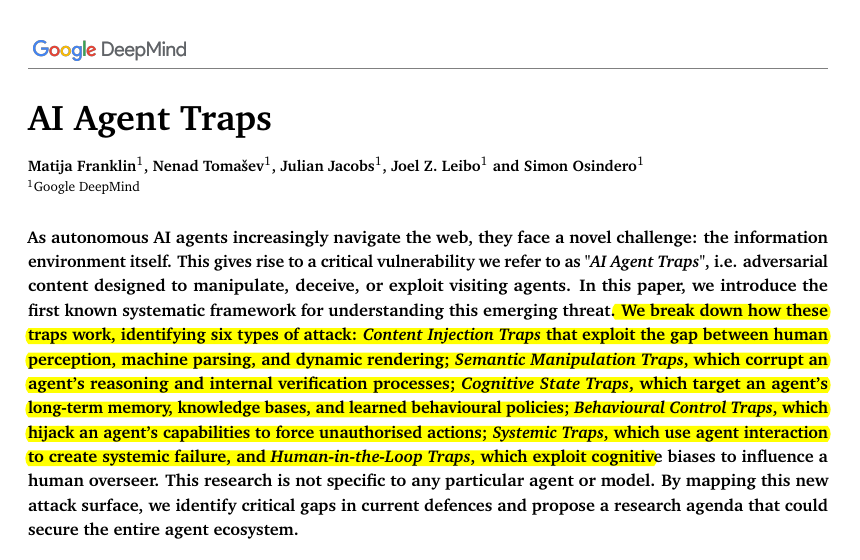
A warning for anyone using autonomous agents Google DeepMind’s paper.
Gives the first clear taxonomy of 6 attack types where harmful websites can detect AI agents and show them hidden content humans never see, like
- Instructions buried in HTML comments or white-on-white text
- Steganography in image pixels
- Override commands in PDFs, metadata, or even speaker notes
- Memory poisoning that persists across sessions
- Goal hijacking and cross-agent cascades in multi-agent setups
The real security problem for AI agents is not just the model, but the environment it reads.
The web itself can be weaponized against autonomous AI agents. As agents increasingly browse the internet, read emails, execute transactions, and spawn sub-agents, the information environment becomes an attack surface.
In one cited benchmark, hidden prompt injections embedded in web content partially commandeered agents in up to 86% of scenarios, sub-agent hijacking working 58–90% of the time, and data exfiltration attacks clearing 80% across five different agent architectures.
That reframes the whole debate.
We usually talk about model safety as if the danger sits inside the weights, but agents do something more fragile: they browse, retrieve, remember, and act on untrusted material in real time.
Here’s the thing to worry about.
A web page does not have to look malicious to be dangerous to an agent, because the agent may parse what humans never see: hidden HTML comments, metadata, CSS-hidden text, formatting syntax, or adversarial content embedded in images and other media.
The threat gets more serious once memory enters the loop.
If an agent uses RAG or persistent memory, poisoning no longer has to win in one shot. It can sit quietly in a corpus or memory store and activate later, which is why the paper highlights results showing latent memory poisoning above 80% attack success with less than 0.1% data contamination.
---
ssrn. com/sol3/papers.cfm?abstract_id=6372438
Since February, I've designed and built the world's fastest RC airplane in my college dorm, and that’s not clickbait. Reaper has a 5kg carbon-fiber frame, 250N turbojet, and flies at 500mph. New to X and will be going through the whole build here in the coming days.
#aerospace
Happy Canada Day!
I love this country. I’m proud to be Canadian, and grateful to call Ontario home.
Our challenges are real, but so is our promise. Canada remains one of the luckiest countries on Earth, and together, we can build a even better future.
Canada can still win. 🇨🇦
@confusedqubit With new tech, it’s always easier to integrate with the existing platforms. Eventually you’ll be right though. Agents need context. And for individuals that be in a variety of places on your windows or Mac. But eventually there’ll be agent protocols and Mac/win won’t be needed
@qcapital2020 China priorities market share over profit. And little intellectual property rights, lots of local competition. So lots of pressure keeps prices low. Which means stock valuations kept low
These models are not all the same. We call this segmentation. As the market grows, users will self select into the current segment. It will not be a winner takes all market
DeepSeek just popped the American AI bubble.
Not by killing AI.
By killing the fantasy of unlimited AI pricing power.
DeepSeek V4 Pro:
Input: $0.435 per 1M tokens
Output: $0.87 per 1M tokens
OpenAI GPT-5.5:
Input: $5.00
Output: $30.00
Claude Opus 4.7:
Input: $5.00
Output: $25.00
Claude Sonnet 4.6:
Input: $3.00
Output: $15.00
DeepSeek is roughly:
11.5x cheaper than GPT-5.5 on input
34.5x cheaper than GPT-5.5 on output
28.7x cheaper than Claude Opus on output
17.2x cheaper than Claude Sonnet on output
If a model is “good enough” at 1/20th or 1/30th the cost, margins will compress faster than Wall Street expects.
AI is not dead.
But the AI bubble just lost its pricing power.
$NVDA $MU $AMD $SMCI $AVGO $ARM $MSFT $GOOGL $META $AMZN $ORCL $PLTR $CRWV $NBIS
#AI #DeepSeek #AIBubble #ArtificialIntelligence #Semiconductors #HBM #DRAM #Nvidia #Micron #AMD #TechStocks #Nasdaq #StockMarket #Investing #WallStreet #YapayZeka #Borsa
As models get even better, the need for transparency grows. Last year @nvidia adopted our SynthID invisible watermark, and today we’re excited to announce @OpenAI, Kakao, and @ElevenLabs will join them.
We’re also going further by adding C2PA Content Credentials verification to @GeminiApp alongside Synth ID detection and bringing both to Search and Chrome so you can easily check whether content was captured by a camera, or created/ edited with gen AI tools.
@confusedqubit Maybe I’m misunderstanding. I want local to be like the cloud for sure. But why would I want local to do production work. Unless it’s a way to debug production issues??
I don't know who needs to hear this but your ability to create the reality that you want is directly determined by your willingness to experience its opposite.
Saving money will have you feeling broke while it's actually making you rich.
Setting boundaries will have you feeling alone while you're creating new healthy relationships in your life.
Digging up your trauma will have you feeling broken while it's actually healing you.
Working out has you feeling weak while its really making you strong.
Learning something new makes you feel dumb while it's making you more intelligent.
Your ability to attain the thing that you want is directly correlated with how willing you are to experience its opposite. You have to be ok with being uncomfortable to truly achieve success!
You got this
Offices that have recently opened up and/or are opening up in Toronto:
- OpenAI
- Harvey
- Decagon
- NVIDIA
- Opendoor
- Lyft
- EliseAI
- Zip
- Cognichip
People are blasting bezos as if copying Elon was a bad thing to be ashamed of. If anything it's acknowledgement Elon was right and the world needs competition. More resources getting thrown in the right direction means advancements will progress faster. That's a good thing.