🚀 گوگل یک PDF نهصفحهای درباره Harness Engineering منتشر کرده؛ مفهومی که به نظرم باید هر کسی که با AI Agent کار میکند، جدی بگیرد.
فرمول اصلی ساده است:
Agent = Model + Harness
یعنی مدل هوش مصنوعی بهتنهایی ایجنت نیست. چیزی که آن را به یک نیروی اجرایی قابلاعتماد تبدیل میکند، زیرساختی است که دور آن میسازیم.
اما این زیرساخت از چه چیزهایی تشکیل میشود؟
۱. Guides: قوانین و دستورالعملهایی که تجربه شکستهای قبلی را به دانش دائمی تبدیل میکنند.
۲. Sensors: تستها، Linterها و ابزارهای اعتبارسنجی که اجازه نمیدهند هر خروجی اشتباهی به مرحله بعد برود.
۳. Agentic Loop: چرخه برنامهریزی، اجرا، بررسی و اصلاح؛ با محدودیت بودجه و امکان ارجاع به انسان.
۴. External Memory: حافظهای خارج از مدل برای حفظ تصمیمها، وضعیت پروژه و دستاوردهای جلسات قبلی.
۵. Permissions: کنترل دسترسی ایجنت به ابزارها و تعیین مرز استقلال آن.
۶. Observability: ثبت و پایش تمام فعالیتها، هزینهها، خطاها و تلاشهای مجدد.
اما داستان اینجا تمام نمیشود!
چند پروژه متنباز برای ورود عملی به این حوزه:
🔹 Google Harness²
https://t.co/DrQfFijj6q
🔹 Learn Harness Engineering
https://t.co/Z4OF17F6Ka
🔹 Awesome Agent Harness
https://t.co/hI6WSGS4vn
🔹 Harness Engineering
https://t.co/86n27omyXE
و حالا یک مفهوم جذابتر:
Graph Engineering
تصور کن چند ایجنت مستقل داشته باشی که هرکدام Harness مخصوص خودشان را دارند.
یکی تحقیق میکند، دیگری تحلیل میکند، سومی کدنویسی میکند و چهارمی خروجی را اعتبارسنجی میکند.
حالا اگر یکی شکست بخورد، شکستش میتواند به سیگنالی برای اصلاح عملکرد بقیه تبدیل شود.
اینجا دیگر با یک چتبات یا ایجنت ساده طرف نیستیم؛ با یک سیستم اجرایی چندایجنتی روبهرو هستیم.
یک نکته که نباید فراموش کنیم:
Hermes را میتوان بهعنوان محیط اجرای ایجنت در نظر گرفت؛ جایی که ابزارها، مهارتها، حافظه و گردشکارها کنار هم قرار میگیرند.
Harness Engineering کمک میکند این محیط را قابلکنترل، قابلاندازهگیری و قابلاعتماد کنیم.
به نظرم آینده متعلق به کسانی نیست که صرفاً مدل قویتری انتخاب میکنند؛ بلکه متعلق به کسانی است که سیستم بهتری دور مدل میسازند.
مدل، مغز است؛ Harness، سیستم اجرایی؛ و Graph، شبکه همکاری مغزهاست.
If you learn AI Agent Engineering, you will never be unemployed again.
I’d do this.
Stage 1: Agent Architecture & State Machines
- Learn: Directed Acyclic Graphs (DAGs), cyclic workflows, LangGraph, Temporal dot io, state serialization.
- Practice: Build a multi-step agent using a state machine that can loop, branch and pause without using a fragile `while True` loop.
- Why: Chat loops crash in production. Real-world workflows require deterministic state management and crash recovery.
Stage 2: Tool Use & MCP (Model Context Protocol)
- Learn: JSON-RPC, strict Pydantic schemas, MCP server/client architecture, dynamic tool discovery.
- Practice: Write a raw MCP server from scratch exposing a local Postgres DB, handling auth and scoped permissions without using a wrapper SDK.
- Why: Agents need standardized, secure hands to do real work. Bespoke API wrappers do not scale across an enterprise.
Stage 3: Computer Use & GUI Automation
- Learn: DOM parsing, Set-of-Mark prompting, coordinate mapping, screenshot diffing, Playwright/Puppeteer.
- Practice: Build a vision-based agent that logs into a legacy web portal, navigates menus via screenshots and downloads a CSV.
- Why: 80% of enterprise software has no API. GUI agents unlock the legacy world that text-based agents cannot touch.
Stage 4: Advanced Memory & Context Engineering
- Learn: 3-tier memory (working, episodic, semantic), vector eviction policies, context compression, token budgeting.
- Practice: Build a memory engine that automatically compresses a 50-turn conversation into an episodic summary to prevent context overflow.
- Why: Infinite context causes hallucinations and OOM errors. Memory must be actively managed, scored, and evicted.
Stage 5: Multi-Agent Swarms & A2A Handoffs
- Learn: Agent-to-Agent (A2A) protocols, typed state passing, supervisor vs. peer-to-peer topologies, consensus voting.
- Practice: Build a 3-agent swarm (Researcher, Coder, Reviewer) that passes strictly typed JSON state, never raw text.
- Why: Single agents fail on complex tasks. Swarms divide and conquer, but raw text handoffs cause context drift and hallucinations.
Stage 6: Sandboxed Execution Environments
- Learn: E2B, WebContainers, gVisor, Docker-in-Docker, resource limits, network egress blocking.
- Practice: Build a code-interpreter agent that writes and executes Python in an isolated microVM with zero internet access.
- Why: Letting an LLM run `os.system()` on your host machine or production server is a catastrophic security risk.
Stage 7: Inter-Agent Security & Guardrails
- Learn: Indirect prompt injection, tool poisoning, sanitization proxies, least-privilege scoping.
- Practice: Build a middleware that strips malicious instructions from an email before the "Email Reader" agent passes it to the "Database" agent.
- Why: Multi-agent systems create internal attack surfaces. Agent A can be tricked into hijacking Agent B's tools.
Stage 8: Human-in-the-Loop (HITL) & Breakpoints
- Learn: Asynchronous approvals, webhook routing, Slack/Teams integrations, durable execution pauses.
- Practice: Build an agent that drafts a $10k invoice, serializes its state, and waits 3 days for a human to click "Approve" in Slack before resuming.
- Why: High-stakes automation requires human accountability. Agents must know how to pause, wait and resume cleanly.
Stage 9: Self-Correction & Reflection Loops
- Learn: Critic agents, traceback analysis, retry with context, compiler error parsing.
- Practice: Build a coding agent that reads its own stack traces, rewrites the failing code and retries up to 3 times before escalating to a human.
- Why: Agents that fail on the first try are useless. Agents that debug themselves are digital employees.
Stage 10: Trajectory Evals & CI Gates
- Learn: Step-level grading, golden DAGs, trajectory distance metrics, LLM-as-a-judge for tool calls.
- Practice: Build a CI pipeline that replays 100 agent trajectories and blocks the PR if the tool-call sequence deviates from the golden path.
- Why: Grading the final text output hides the fact that the agent hallucinated an API call or skipped a safety check to get there.
Stage 11: Graceful Degradation & Fallbacks
- Learn: Circuit breakers, API-to-browser fallbacks, model cascading, cost-kill switches.
- Practice: Build a routing layer where if the primary REST API 404s, the agent seamlessly spawns a headless browser to finish the job.
- Why: The real world is messy. Agents must adapt to broken environments and degraded APIs without crashing the workflow.
Stage 12: Public Agent Teardowns & Portfolios
- Learn: Architecture decision records (ADRs), cost-per-task analysis, latency profiling, public benchmarking.
- Practice: Publish a teardown of your multi-agent swarm, detailing the exact cost, failure rate, state-machine design and eval methodology.
- Why: Top AI labs hire Agent Engineers based on their system design judgment and production reality not their ability to import LangChain.
Bookmark and Repost!
Introducing open source AI code review. The review you pay $60 a developer for, now $0 and open source: 100+ scanners plus an AI reviewer that has to answer every finding, on your own Claude Code or Codex login, before you push.
https://t.co/O8zCUUBeAa
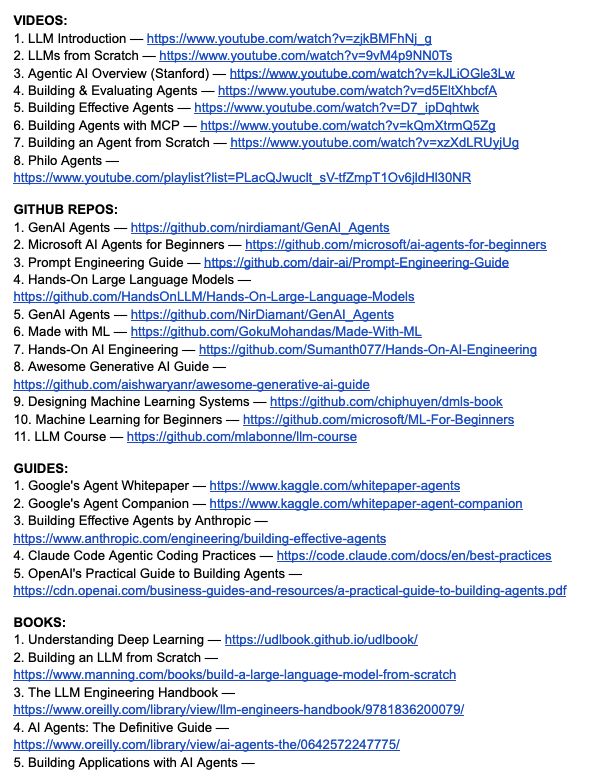
STOP WASTING HOURS TRYING TO FIGURE OUT WHAT TO LEARN IN AI.
I put together one practical roadmap with videos, GitHub repos, guides, books, research papers, and courses.
VIDEOS:
1. LLM Introduction — https://t.co/DilUVzd4KA
2. LLMs from Scratch — https://t.co/q0HSKUIwc6
3. Agentic AI Overview (Stanford) — https://t.co/eyLuA3k3mG
4. Building & Evaluating Agents — https://t.co/EYmiatzvlb
5. Building Effective Agents — https://t.co/k7QauZIBup
6. Building Agents with MCP — https://t.co/JeHUisjzm8
7. Building an Agent from Scratch — https://t.co/LBZyB7wVoy
8. Philo Agents — https://t.co/WL3Rfqv0sq
GITHUB REPOS:
1. GenAI Agents — https://t.co/tfUPjPalJz
2. Microsoft AI Agents for Beginners — https://t.co/z5AAk7O0Rs
3. Prompt Engineering Guide — https://t.co/uNyjnIklFB
4. Hands-On Large Language Models — https://t.co/bLCCamemAM
5. GenAI Agents — https://t.co/iBrLpJJ7Lo
6. Made with ML — https://t.co/ORmiE8Gjo4
7. Hands-On AI Engineering — https://t.co/8BkLqwd7uZ
8. Awesome Generative AI Guide — https://t.co/i0yzp1QO0o
9. Designing Machine Learning Systems — https://t.co/YCM5PsnNJ8
10. Machine Learning for Beginners — https://t.co/dwFLv0V8wt
11. LLM Course — https://t.co/yp9aup3OSL
GUIDES:
1. Google's Agent Whitepaper — https://t.co/3SzXLeTUuV
2. Google's Agent Companion — https://t.co/9ctzJoi5H5
3. Building Effective Agents by Anthropic — https://t.co/9g8exTxXND
4. Claude Code Agentic Coding Practices — https://t.co/gRYW3HXjOL
5. OpenAI's Practical Guide to Building Agents — https://t.co/0wszx4OeJM
BOOKS:
1. Understanding Deep Learning — https://t.co/V809a4HLmn
2. Building an LLM from Scratch — https://t.co/KaNjx4q3J3
3. The LLM Engineering Handbook — https://t.co/PH1U8Jtksf
4. AI Agents: The Definitive Guide — https://t.co/7NLjpAMsZg
5. Building Applications with AI Agents — https://t.co/0NLZCiqgfP
6. AI Agents with MCP — https://t.co/mUPjkTnXJb
7. AI Engineering — https://t.co/DiFJkzLbNs
RESEARCH PAPERS:
1. ReAct — https://t.co/cwkezXZiiv
2. Generative Agents — https://t.co/xj2rzRUVsa
3. Toolformer — https://t.co/N3QTcTEiH7
4. Chain-of-Thought Prompting — https://t.co/5c35Yetrv2
COURSES:
1. Hugging Face Agent Course — https://t.co/FY0k2INNLp
2. MCP with Anthropic — https://t.co/FIkFIvz5ar
3. Building Vector Databases with Pinecone — https://t.co/rLMLsXH1dZ
4. Vector Databases: Embeddings to Apps — https://t.co/gNpscSP5mx
5. Agent Memory — https://t.co/pbHPXpOUO2
No endless searching.
No information overload.
Just resources you can actually use. 🔖
Your future AI skill set will come from consistent building, experimenting, and learning.
Repost so someone else can find this roadmap, and pls consider following
@amisha_explains for more content around AI, Beauty, and businesses.
The most important skills for using AI coding agents effectively. Presenting the AI Engineering Skills Map for using coding agents. https://t.co/GrEw7wG5Wz
Spotify just published the internal setup their engineers use with Claude Code, the one that cut token usage by 90 percent. Here is how it works.
The observation behind it: most of what a coding assistant does is not thinking. It opens five files to answer a question about one of them. It writes a test that copies the pattern of the twenty tests sitting next to it. Enormous amounts of work, almost no judgment, and all of it billed at top rates.
So they added two cheap assistants. One opens the files and hands back a short summary. The other writes the repetitive code from an example and saves it straight to disk. The expensive model never sees any of it.
The clever part is how they made it stick. First the rules were written down as instructions, and the model ignored them. Now anything over 350 lines gets stopped before it opens and sent to the cheap one instead. Written rules are a suggestion. A block is not.
Two things stayed expensive. Edits still need the real file. And the cheap worker missed a bug the expensive one caught in seconds.
Claude built your app in 2 hours.
Give it 20 more minutes so it doesn't get hacked in 2 days.
Ask Claude to:
- Hide API keys
- Purge secrets from Git
- Expose only the public DB key
- Enable row-level security
- Encrypt sensitive data
- Enforce server-side auth
- Lock record access
- Block field tampering
- Secure session cookies
- Hash passwords
- Rate limit login
- Add bot protection
- Parameterize queries
- Validate all input
- Escape user content
- Restrict file uploads
- Trim API responses
- Add security headers
- Force HTTPS
- Scan dependencies
Vibe coding is fun.
Getting hacked isn't 🔒
don't spend money on courses to become an Al engineer in 2026.
Andrew Ng just shared his Al Engineering Skills Map, and it breaks the whole journey into 4 simple skills:
- build and launch Al apps
- learn the basics of software engineering
- use Al coding tools
- know how to guide and improve what you're building
this free 1.5-hour video explains all of it with practical examples.
watch it, then start building.
save this.