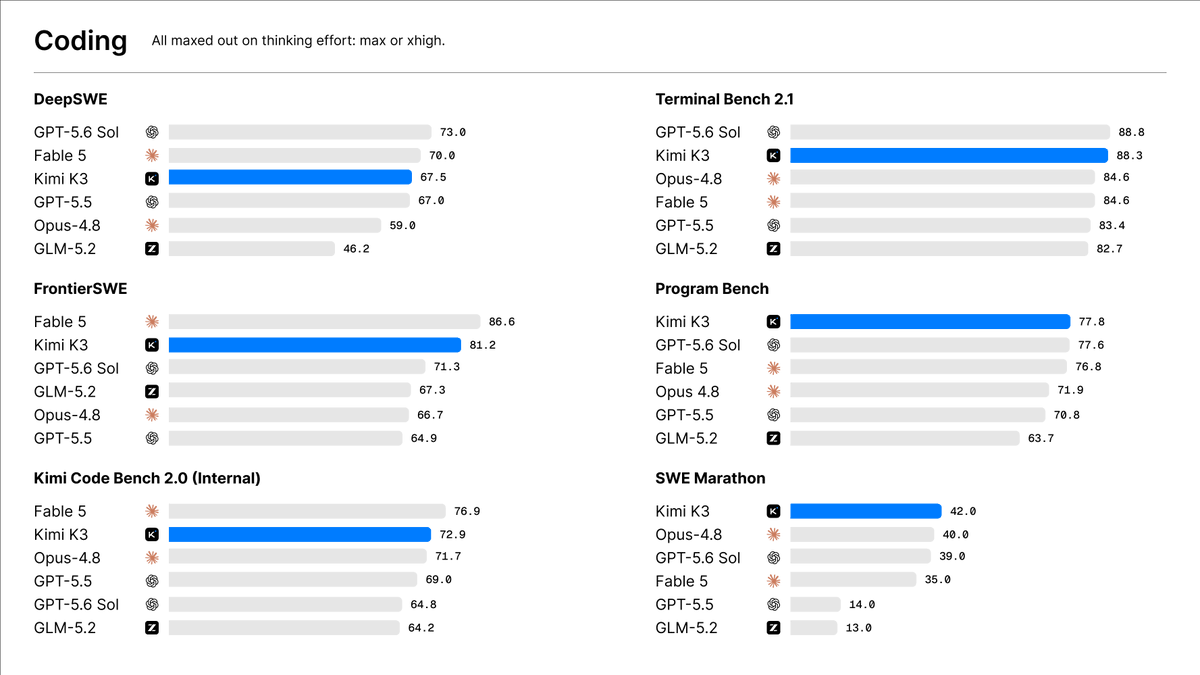
Introducing Kimi K3: Open Frontier Intelligence
🔹 2.8 Trillion Parameters, 1 Million Context, Native Multimodal
🔹 Kimi Delta Attention enables up to 6.3x faster decoding in million-token contexts
🔹 Attention Residuals deliver ~25% higher training efficiency at <2% additional cost
🔹 Built for long-horizon agentic coding and self-evolving workflows
Kimi K3 is now live on on https://t.co/zrk6zZxZUo, Kimi Work, Kimi Code, and the Kimi API.
Open Weights by July 27, 2026.
🔗 API: https://t.co/XCrgjXAqMw
🔗 Tech blog: https://t.co/YTfiMSNM1f
(1) Today we're releasing Muse Spark 1.1 -- a strong agentic and coding model at a very low price. It's available through our new Meta Model API and in Meta AI.
Introducing DiffusionGemma, our first exploration with open diffusion text generation models
🔥Generate blocks of text at a time
🤏26B MoE built on top of Gemma 4
⚡️Up to 4x faster in popular consumer GPUs
🤗Apache 2.0
Excited to see what the community builds with it!
🎉 Meet vLLM-Omni v0.22.0, a major upgrade for omnimodal world models and production-grade multimodal serving.
🌍 Day-0 @NVIDIAAI Cosmos 3 world models: text, image, audio, video, and action, in and out.
🤖 Robot serving: DreamZero + OpenPI realtime API.
🎙️ Production TTS: Qwen3-TTS, Qwen3-Omni, VoxCPM2 and more.
🎨 Faster image/video/diffusion: Wan 2.2, HunyuanVideo 1.5, LTX-2.3.
⚡ Broader quantization (FP8/INT8, MXFP4/MXFP8, W4A16, ModelOpt) and hardware coverage.
339 commits, 124 contributors, 52 of them new. Thank you all. 🙌
🔗 https://t.co/76ttSM6FHs
Super excited about the release of the Colab CLI! 🔥
Enabling your agents to easily interact with Colab is about to unlock lots of fun experiments
https://t.co/xyQ6GFINtg
Before the week ends, let's acknowledge one of the most INSANE week ever for open AI, with 25+ notable open-weight drops across every modality:
🧠 LLMs
→ NVIDIA Nemotron 3 Ultra: 550B hybrid Mamba-MoE, only 55B active, 1M context, MMLU 89.1. NVFP4 variant claims ~5x throughput on Blackwell. First openly-weighted 550B hybrid Mamba-Transformer, closing the gap with frontier closed models.
→ Google Gemma 4 12B: fully open dense any-to-any (text/image/audio/video), 256k context, encoder-free, 140+ languages, AIME 2026 at 77.5. Shipped with a 23-checkpoint QAT wave (mobile ONNX + MLX). Most deployable model of the week.
→ StepFun Step-3.7-Flash: 198B sparse MoE VLM, ~11B active, SWE-Bench PRO 56.3. Apache 2.0.
→ Liquid AI LFM2.5-8B-A1B: edge MoE, just 1.5B active, 128k ctx, MATH500 88.8, MLX-ready. Best on-device option this week.
→ JetBrains Mellum2-12B-A2.5B-Thinking: their first open MoE, near-Qwen3-14B coding at 2.5B active. Apache 2.0.
🎨 Image gen (the surprise of the week)
→ Ideogram 4: their FIRST-EVER open weights. 9.3B flow-matching DiT trained from scratch. #2 overall behind GPT Image 2, top open-weight model on Design Arena + LMArena. Strongest open checkpoint for text-rich images, full stop. It has taste. Still can't believe this is open weights.
🔊 Audio & Speech (a breakout week for open TTS, 4 labs shipped)
→ Boson Higgs Audio v3 4B: 102 languages, 21 emotions, singing/whispering/shouting, sub-second TTFA.
→ RedNote dots.tts: the only fully continuous (no codec) open TTS pipeline, Apache 2.0.
→ Google Magenta RealTime 2: real-time music gen, <200ms latency, text+audio+MIDI. multimodalart ported it to PyTorch within hours with live ZeroGPU demos.
→ NVIDIA Nemotron-3.5 ASR: 600M streaming, 17x more concurrent streams vs Parakeet RNNT 1.1B.
👁️ Vision & VLMs
→ PaddleOCR-VL-1.6: SOTA document parsing at 1B params, Apache 2.0.
→ Baidu NAVA: 6.3B joint audio-video gen, best-in-class A/V sync, Apache 2.0.
🎬 Video, 3D & World Models
→ NVIDIA Cosmos3-Super: 64B omnimodal world model coupling action trajectories with video+audio gen, for Physical AI.
→ JD JoyAI-Echo: up to 5-min multi-shot text-to-video on LTX-2.3.
→ ByteDance Bernini-R + VAST TripoSplat (single-image-to-3D Gaussian splats, MIT).
Super excited to introduce Gemma 4 12B! 💎
- Multimodal: audio, image, video, and text input
- Novel architecture: we removed the multimodal encoders for a unified, streamlined arch
- New MacOS desktop app powered by LiteRT
- MTP support
Excited to see what you build with it!
Meet Gemma 4 12B!
A unified, encoder-free multimodal model designed to bring high-performance intelligence directly to your laptop, and released under an Apache 2.0 license.
Bridging the gap between edge efficiency and advanced reasoning. Here is what’s new with Gemma 4 12B: 👇
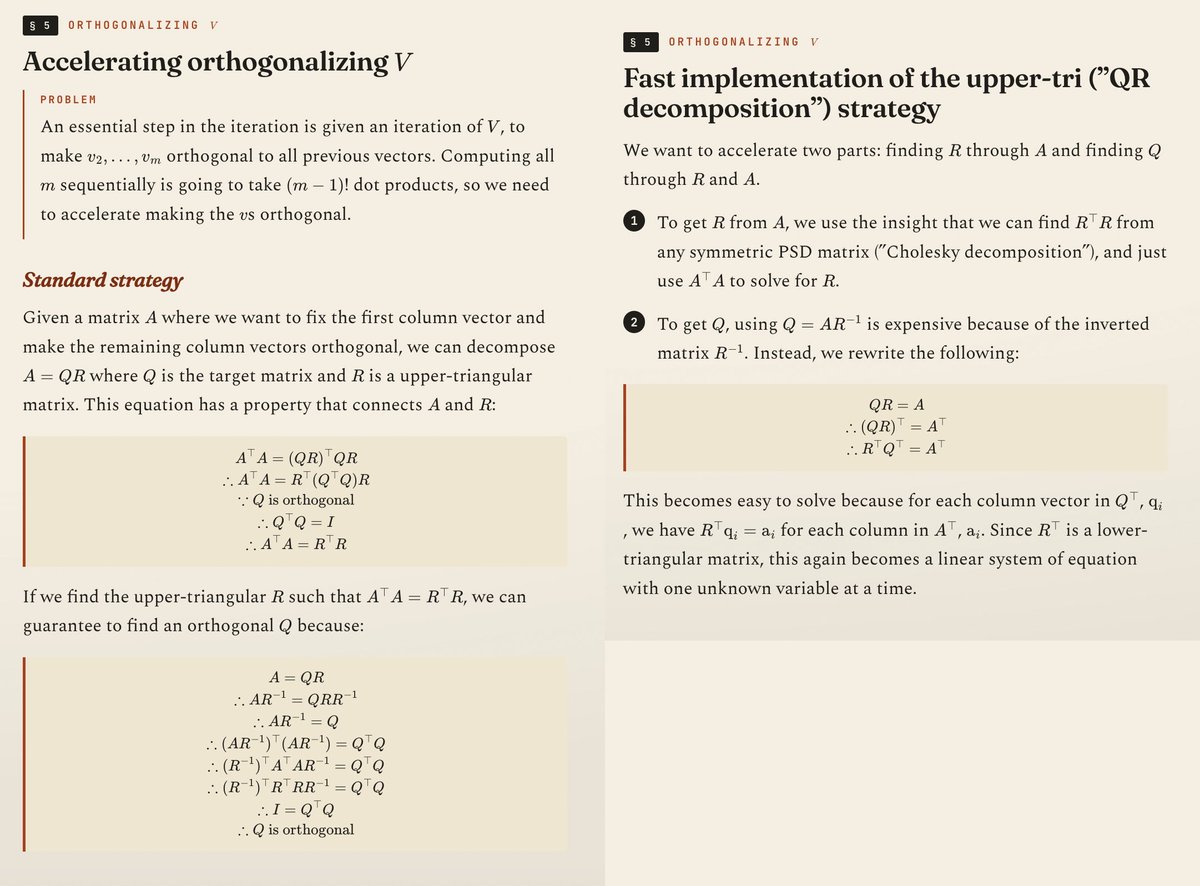
I am a big fan of Jianlin Su's blog because it always starts from first principles in mathematics, rather than "ML tricks", to approach a typical ML problem (eg. training-free MoE load balancing).
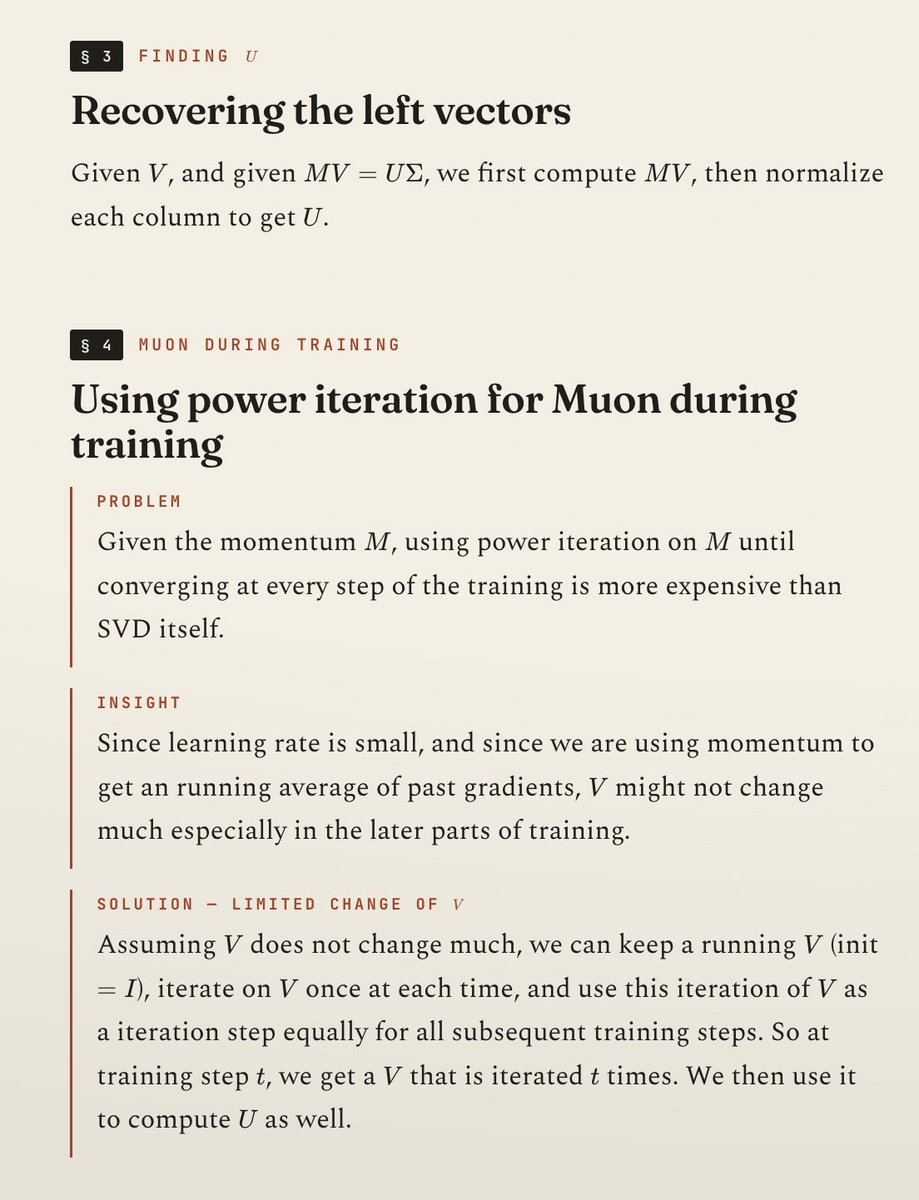
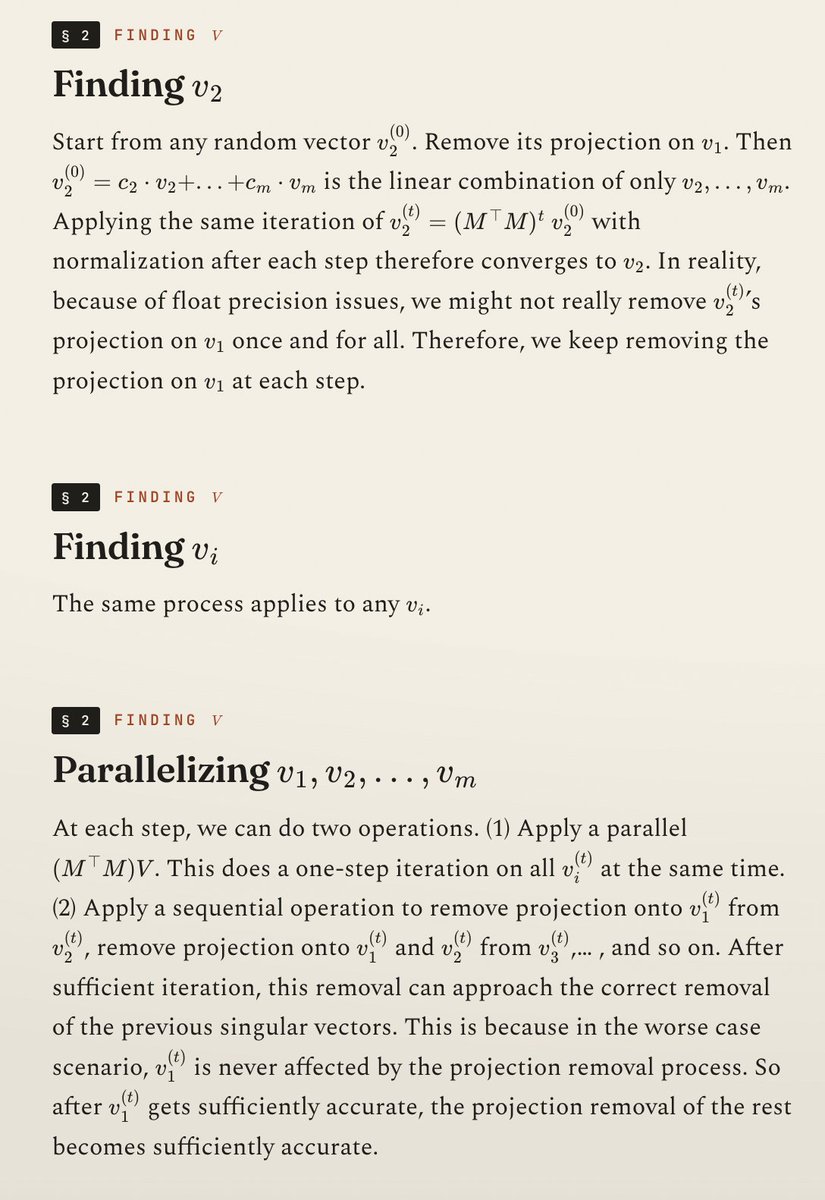
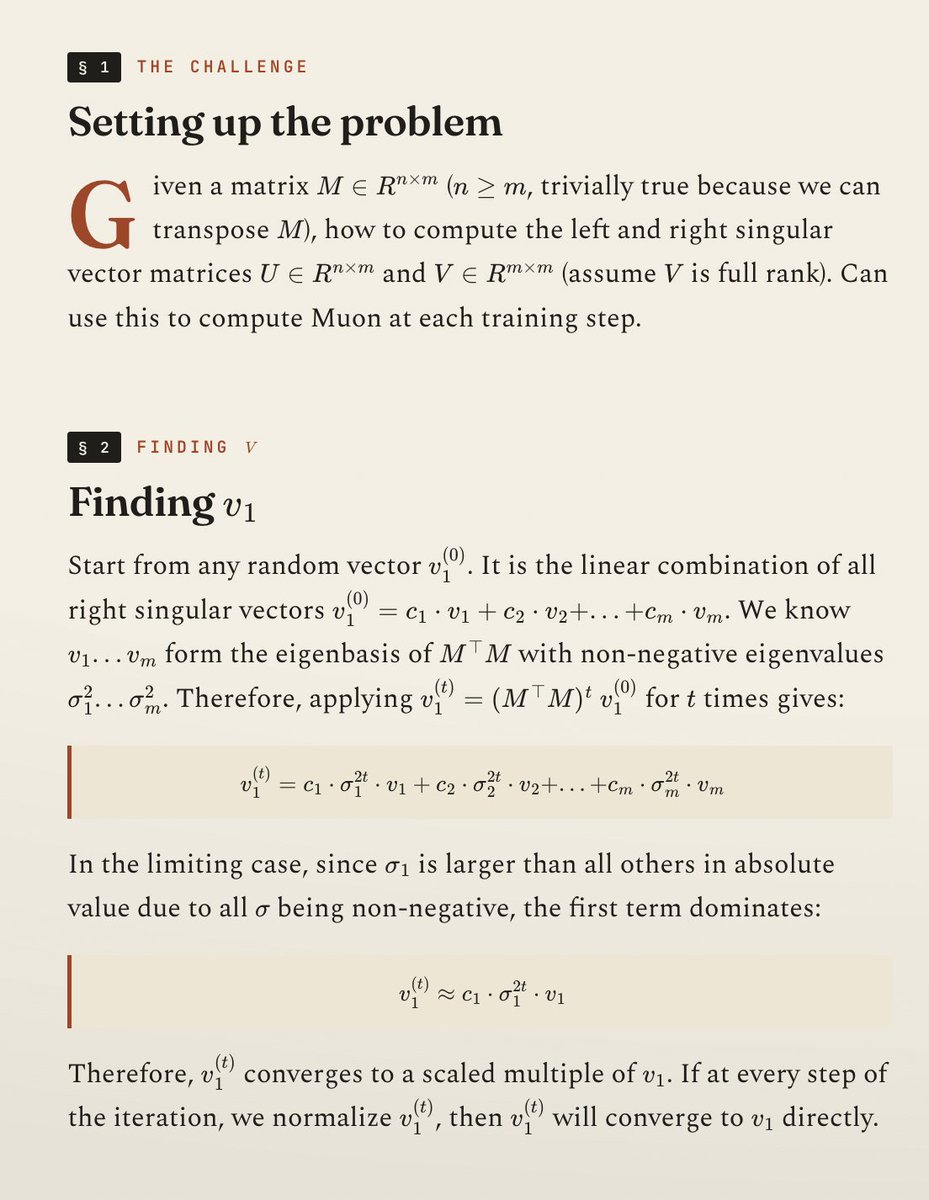
Here is me trying to "reinvent" one such blog which provides an elegant alternative to compute Muon, by filling in all the derivations that the blog skips for a less math-savvy audience (besides being entirely in Mandarin).
The goal of the blog is to find a way to compute a essential component of Muon, ie. the left and right singular value matrices U and V for the gradient G, **individually**. In the standard form, Muon really just needs their product UV^T, hence the standard way to compute it via computing a low-rank polynomial of G many times ("Newton-Schulz"). But there are more variants of Muon to control the properties of model updates if we can get both individually, hence the blog's proposal to revisit some fundamental linear algebra techniques for the computation.
The methodological takeaway from the blog's thought process is that there are three components to breaking down a ML problem: (1) how to be able to compute something (power iteration), (2) how to compute it fast (cholesky decomposition), and (3) how to compute it accurately given finite floating points (repeated orthogonalization). The goal of reading inspiring blogs like this is, in Feynman's term, to be able to "reinvent" them at any time to grasp the fundamental approach of doing similar work.
Original blog: https://t.co/5ksKPICpMW
The release candidate for MCP 2026-07-28 is out. The protocol is now stateless: no handshake, no session id, any request can hit any server instance. Plus extensions as first-class (MCP Apps, Tasks), auth hardening, and a proper deprecation policy so we don't have to do this again.
https://t.co/XRLTu1BSkB
Today, we share a breakthrough on the planar unit distance problem, a famous open question first posed by Paul Erdős in 1946.
For nearly 80 years, mathematicians believed the best possible solutions looked roughly like square grids.
An OpenAI model has now disproved that belief, discovering an entirely new family of constructions that performs better.
This marks the first time AI has autonomously solved a prominent open problem central to a field of mathematics.
Today we're sharing our work on interaction models. A new class of model trained from scratch to handle real-time interaction natively, instead of gluing it onto a turn-based one.
https://t.co/MoS5s4cm60
“If India bows to domestic PR campaigns and leaves its easternmost flank demilitarized and underdeveloped, we are effectively handing over the Indian Ocean to adversarial naval powers”.
Read this timely thread explaining the several imperatives of developing Nicobar Island as a strategic maritime hub for India. The naysayers should not be allowed to block this game changing project!
Introducing Pods
Hyperspace Pods lets a small group of people - a family, a startup, a few friends, to pool their laptops and desktops into one AI cluster. Everyone installs the CLI, someone creates a pod, shares an invite link, and the machines form a mesh. Models like Qwen 3.5 32B or GLM-5 Turbo that need more memory than any single laptop has get automatically sharded across the group's devices - layers split proportionally, inference pipelined through the ring. From the outside it looks like one OpenAI-compatible API endpoint with a pk_* key that drops straight into your AI tools and products. No configuration beyond pasting the key and changing the base URL.
A team of five paying for cloud AI burns $500–2,000 a month on API calls. The same team's existing machines can serve Qwen 3.5 (competitive on SWE-bench) and GLM-5 Turbo (#1 on BrowseComp for tool-calling and web research) for free - the hardware is already on their desks. When a query genuinely needs a frontier model nobody has locally, the pod falls back to cloud at wholesale rates from a shared treasury. But for the daily work - code reviews, refactors, research, drafting - local models handle it and nobody gets billed. And when it is idle, you can rent out your pod on the compute marketplace, with fine-grained permissions for access management.
There's no central server involved in inference. Prompts go from your machine to your pod members' machines and back: all of this enabled by the fully peer-to-peer Hyperspace network. Pod state - who's a member, which API keys are valid, how much treasury is left - is replicated across members with consensus, so the whole thing works on a local network. Members behind home routers don't need port forwarding either. The practical setup for most pods is three models covering different jobs: Qwen 3.5 32B for code and reasoning, GLM-5 Turbo for browsing and research, Gemma 4 for fast lightweight tasks. All running on hardware you already own.
Pods ship today in Hyperspace v5.19. Model sharding, API keys, treasury, and Raft coordinator are all live.
What Makes This Different - No middleman. Your prompts travel from your IDE to your pod members' hardware and back. There is no server in between reading your data.
- No vendor lock-in. Pod membership, API keys, and treasury are replicated across your own machines using Raft consensus. If the internet goes down, your local network keeps working. There is no database in someone else's cloud that your pod depends on.
- Automatic sharding. You don't configure layer ranges or calculate VRAM budgets. Tell the pod which model you want. It figures out how to split it across whatever hardware is online.
- Real NAT traversal. Your friend behind a home router with a dynamic IP? Works. No VPN, no Tailscale, no port forwarding. The nodes handle it.
- Free when local. This is the part that matters most. Cloud AI bills scale with usage. Pod inference on local hardware scales with nothing. The marginal cost of your 10,000th prompt is the electricity your laptop was already using.
Coming soon:
- Pod federation: pods form alliances with other pods.
- Marketplace: pods with spare capacity can sell inference to other pods.
As reported in @Analyticsindiam , the launch of PARAM SHAKTI at @iitmadras marks a decisive step in India’s journey to own its entire compute stack—from chips to full-scale systems and real-world applications.
This fully indigenous 3.1 petaflop supercomputing facility, powered by C-DAC’s Rudra systems with Indian servers and software, is part of the National Supercomputing Mission. Delivering over 3.1 quadrillion calculations per second with energy-efficient infrastructure, it is already operating at high capacity—driving aerospace simulations, climate modelling, advanced manufacturing, and drug discovery.
But the story goes beyond hardware. PARAM SHAKTI strengthens an ecosystem that has generated thousands of patents, hundreds of deep-tech startups, and significant research output—ensuring compute power translates into innovation, enterprise, and national capability.
As highlighted, this is about avoiding vendor lock-in, building architectural fluency, and bridging the “missing middle” between semiconductor design and AI deployment.
PARAM SHAKTI isn’t just a machine—it’s a signpost. India isn’t looking to rent the cloud. It aims to build, run, and scale it.
Watch it here: https://t.co/4sDt3vcAgW
Nothing, absolutely NOTHING stops you from creating a Claude Code skill named /security-check, adding a one-liner like "Thoroughly investigate the current feature for security problems, permission gaps. Act like a red-team pen-tester. Suggest fixes."
Run before you commit.