Excited to share the first original research article from the Krishna Group in @ApCatB !
https://t.co/89AcUaII8M
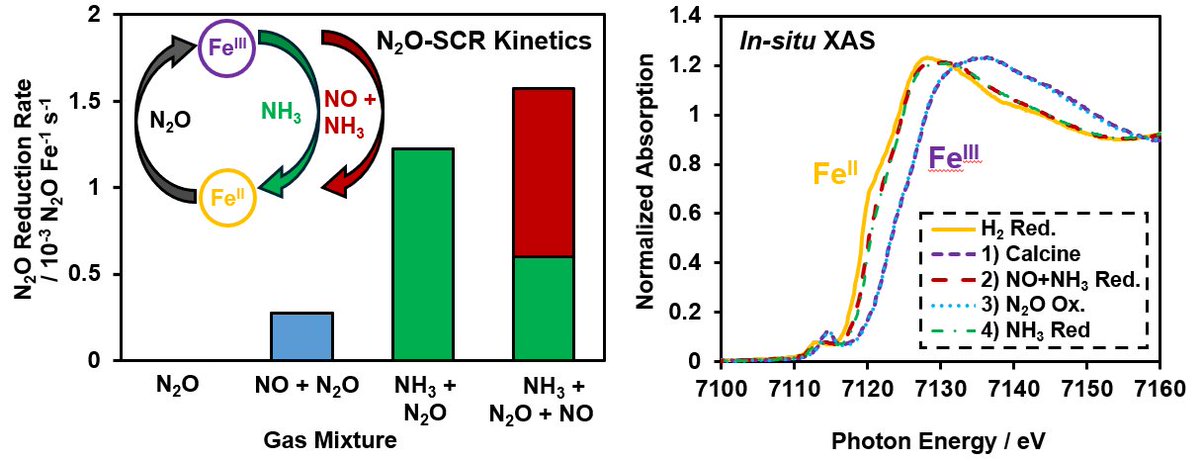
We elucidate the redox pathways by which greenhouse gas N2O is reduced by NO and NH3 over iron-zeolite catalysts, an important technology for renewable NH3 engines.
Check out the latest work by @gwhuber2 and colleagues from @UWMadison in producing δ-valerolactone from biobased 2-hydroxytetrahydropyran by copper catalysts at optimal conditions validated by experimental and modeling.
https://t.co/vDxmLNYRJQ
Check out the latest work by @Flaherty_Lab from @GeorgiaTech in revealing the most suitable cobalt site in ZSM-5 for CH3CN formation through a trimolecular primary reaction among C2H6, NH3, and O2.
https://t.co/s2tc42CxUa
The recent work led by @GrunwaldtJD and Maria Casapu evaluated the optimal loading of Pd on CeO2 catalyst for achieving high methane oxidation activity and stability. Find out more from https://t.co/BfN0cr2Q8k
An experimental + theoretical work led by Jingguang Chen, Ping Liu, and Zhexi Lin from @Columbia and @BrookhavenLab demonstrates the effects of Cu in regulating biomass dehydrogenation over molybdenum-based catalysts.
https://t.co/HFr1RBcRvu
Experimental + theoretical work led by @PaolucciGroup and @uvachechair from @UVA reveals the impact of the cu speciation on sulfur poisoning during high-temperature SCR of NOx over Cu/ Cu-SSZ-13 catalysts.
https://t.co/c35YlizhrC
Check out this recent Review led by Placidus Amama from @KState evaluating the prospects, challenges and technical considerations for MXENES applications in photocatalytic NOx oxidation.
https://t.co/KYTsCFAKe8
Check out this recent work led by Charlie Werth @UTAustin for a Cu-based catalyst design strategy enabling electrocatalytic nitrate selective removal from water.
https://t.co/QIfTW0nBki
First paper with superstars @YomairaPT and @ErandaNikolla is online! Great job, Abdullah! Stay tuned for the follow up coming later this year!
https://t.co/l8s110pcJg
Integrated solar-driven PV-EC system with diaphragm electrolytic reactor can achieve 12 % solar-to-hydrogen energy conversion efficiency and one-step efficient sulfur-related product recovery process.
Check out more here:
https://t.co/kCVFKKyLXZ
Did you know tuning active site locations in MWW zeolites can significantly alter liquid-phase reactions? Ohsung and @DP0TTSY07's new paper in @ApCatB shows active sites located in the sinusoidal channels have the greatest 1-hexene epoxidation rates. https://t.co/fDYK7I3IAg
Si quantum dots coupled with Cu-doped zinc indium sulfide heterostructure was shown to split water into hydrogen and oxygen under visible light illumination due to the synergy of SiQDs (facilitate water oxidation) and Cu doping (drive hydrogen evolution)
https://t.co/YwXyHPWyCJ
Machine learning to predict activation energies? Check out the paper by Dion Vlachos and colleagues @UDelaware for developing models to predict activation energies of C-C and C-H scission in C1 to C6 species in hydrogenolysis reactions on Ru, Pt, and Rh.
https://t.co/NLrl1zvVls
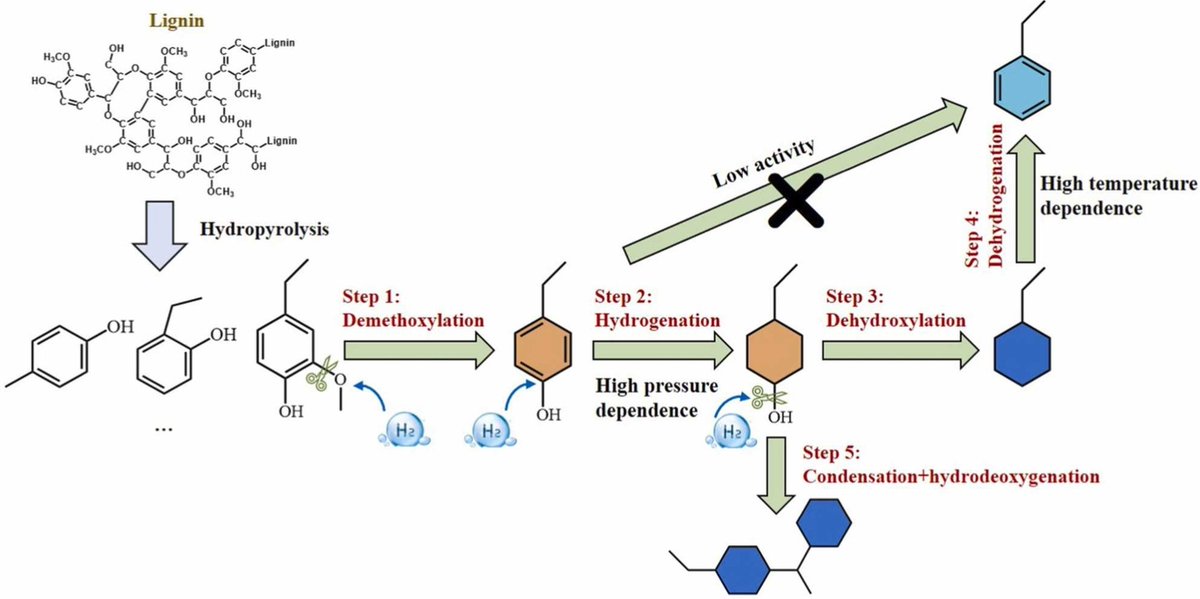
By using NiMo/SiO2 catalysts in the hydropyrolysis of lignin, selectivity of 21.99% liquid hydrocarbons and 70.50% aviation-range hydrocarbons can be achieved. This study marks a significant step forward in the pursuit of #sustainableaviationfuel.
https://t.co/vF8kIyrF5F
Recent publication has demonstrated that enriched oxygen vacancies were stabilized with ruthenium doping on niobium oxide/3-D reduced graphene oxide nanosphere to prepare a functional separator layer for LiPSs diffusion prevention.
Find out more:
https://t.co/EQYMlgrndp