QUEST 5 REVEALED - HOW TO SECURE A TAPROOT WIZARD WL
we’re all broke in crypto. this is your chance to showcase your business savvy!
your mission: wear your wizard outfit, and make a video showing us how you’re planning to earn 0.2 BTC for the mint!
more details below 👇
Regarding OP_CAT, it seems like what everyone wants OP_CAT for is concatenating things so they can be hashed. Why not instead have a incremental hashing operator that you pass data into one piece at a time before finalizing it and extracting the hash? I have no opinion on whether or not this would be better than OP_CAT, and in fact it seems less flexible OP_CAT, but it's interesting that I haven't heard it mentioned as an alternative.
BREAKING: OP_CAT GETTING ACTIVATED IN 2024
there’s been TONS of progress in the quest to bring back OP_CAT
set a reminder below 👇 to join our community space and learn more! https://t.co/1NHhmY5Kbz
They key to solving the indexing vs. governance challenge is maintaining client diversity yet enabling standard evolution. As a step towards this, I am happy to announce that I am joined by the leading players in the brc-20 indexing space, including @ALEXLabBTC, @bestinslotxyz, @okxweb3, @hirosystems and @unisat_wallet. Excited for what this collaboration can unlock!
Last week @piv_piv and I turned the tables on the @_capsule21 podcast and he became the GUEST!
If you love @piv_piv and/or inspirational rises to glory you should watch this interview!
Introducing The Ethscriptions Virtual Machine (ESC VM)
The ESC VM enhances the functionality of the Ethscriptions Protocol by enabling ethscriptions to function as computer commands in addition to digital artifacts.
These computer commands allow users to interact with special computer programs called Dumb Contracts.
The Ethscriptions Virtual Machine is not yet a true VM in that it currently executes only curated Dumb Contracts. This will change as we progress toward bringing general purpose computation to Ethscriptions.
Using Dumb Contracts
The ESC VM accepts two commands: Deploy, which creates a new Dumb Contract, and Call which calls a state-changing function on an existing Dumb Contracts.
To issue these commands, create a new ethscription with address(0) as the "to" and JSON in this format as the ethscription content.
Deploy template:
Call template:
Writing Dumb Contracts
Dumb Contracts are specified in Solidity but can run using any programming language as long as the behavior matches the Solidity spec.
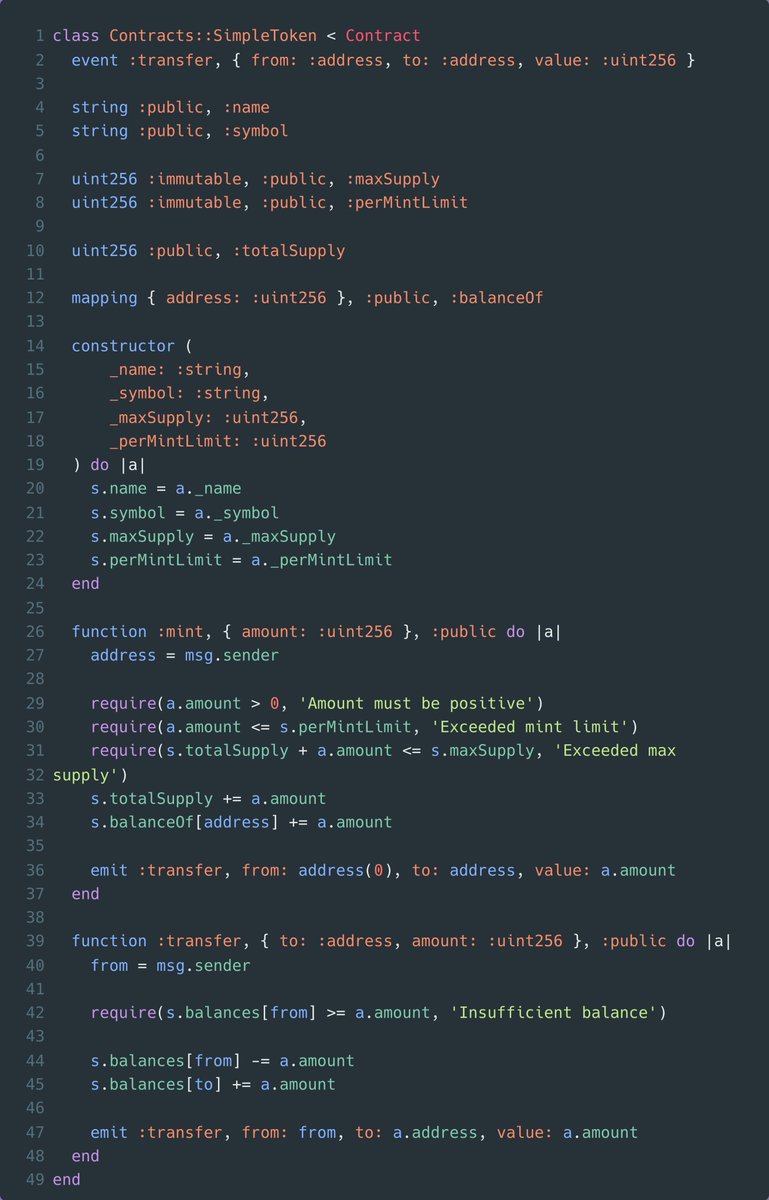
Our current Dumb Contract implementation is written in a dialect of Ruby called "Rubidity"
The ESC VM is Live on Goerli
Check it out here: https://t.co/KPLr4sBq5e. There is a tutorial for creating and using a dex liquidity pool Dumb Contract.
You can also check out the full write up on GitBook with more technical details as well as answers to questions like "is this an L2?" (it isn't)
https://t.co/TiH1AD4feP
Finally leave feedback in this GitHub issue: https://t.co/PZzV7THCdH
Thanks!
Yesterday:
Ordinals are the future! Two teams successfully completed Ord:Ord and Ord:BRC20 trustless swaps in a single day. On-chain Bitcoin DeFi is coming!
Today:
Burn it all down! Ribbits going to 0, everything orange is going to 0, everything is wash trading, grifts, and psyops.
Smart Contracts v. Ethscriptions
Smart contracts are a convenient mechanism for decentralized computation.
But their utility does not extend past convenience. There is nothing smart contracts can do that off-chain execution layers like Ordinals and Ethscriptions cannot.
If you treat Ethereum as a “black box,” taking into account only its behavior and properties as observed from the outside, it is impossible to determine whether smart contracts even exist! They are “formally eliminable.”
Why is this true?
- Off-chain execution layers and smart contracts operate using the exact the same information (user calldata). Smart contracts have internal storage, but this storage is derived from calldata and contains no unique informational content.
- They also have the same capabilities with respect to this data (Turing Complete computation)
- Finally, external parties have exactly the same mechanisms to verify whether their computations are correct—i.e., "re-enacting" transactions to determine the correct current state and comparing it against the contract or execution layer's output. Notably this is does *not* apply in the case of an L2.
What does this mean?
On Planet Earth it doesn’t make sense to eliminate smart contracts because in a small but very important percentage of cases their convenience outweighs their cost.
However, using smart contracts should be the exception, not the default choice. Today this is not feasible because the tools do not exist. Also, while these protocols are immature there will be more bugs and exploits as developers (including and especially me) adapt.
But I believe we will overcome these short term problems and create a cheaper world of decentralized blockchain use and development for everyone!
New Event!
Ethscriptions Marketplace Symposium
What
Forum to collaborate on best practices for running an Ethscriptions Marketplace. Help each other succeed!
When
Tomorrow (Friday, June 7) at 1pm ET!
Where
The Ethscriptions Discord Stage: https://t.co/633s69RPQA