They've wanted to expand reverse onus for awhile, and this will only be a start.
"A reverse onus provision places the burden on a person accused of a crime to prove why they should get bail."
https://t.co/VkHQHmJQiO
(1/2) Yesterday, the Bail and Sentencing Reform Act (#C14) received Royal Assent and will come into force on July 15, 2026.
This legislation reflects the #GC promise to help make communities safer and increase trust in the criminal justice system. https://t.co/teP3dQgHEy
Fourth homicide in a year: Prison worker unions seek more staffing, mental-health support. "the Union of Canadian Correctional Officers has tied the violence to federal budget reductions" How is the $132M reduction affecting COs? https://t.co/WDvjId3FxJ
The NL Govt seems to not understand poverty reduction & instead is on a one-way path to bring its province/people into more poverty & related issues with all their cost-cutting to the most important areas/groups. We cannot afford more. It impacts all | CBC https://t.co/PTYqGjETy2
“‘…concern that people can be displaced & have things happen to them with a really big impact…really quickly,’…understands concerns from residents…(but not)…dealing with the root cause of the problem. ‘…done as a cost-cutting measure’(McDermott)”|CBC https://t.co/GKzHhzigyN
Please share widely.
My paper has just been published in Clinical Psychologist: “Arguing the need for Aboriginal specific testing of attachment theory as a foundation of culturally informed child protection and attachment best practice.”
This paper, I believe is critically important to reducing Indigenous child removals.
The gap it documents is this: Aboriginal child removals have increased 119% over a decade. Non-Indigenous removals are down 12%. And the primary scientific tool used to assess infant attachment — Ainsworth’s Strange Situation Procedure — has been validated in more than 40 countries. Never with Aboriginal Australians.
That is not a footnote. That is a foundation missing from every child protection decision made about Aboriginal families by a workforce that is 94% non-Indigenous.
Based on over two decades of original research and clinical work, this paper presents new models for understanding culturally informed attachment — including collective caregiving, kinship obligation, skin and avoidance relationships, race-mediated trauma, and Black Identity Formation — and what it means for assessment and treatment.
The Westerman Jilya Institute has secured funding to do what this paper argues is urgently needed: validate the SSP with Aboriginal children for the first time, and build the first evidence-based attachment program designed from within Aboriginal culture.
https://t.co/rKxCr7gf4o
In my latest @PsychToday post, I examine @AwaisAftab's attempt to rescue psychiatry on pragmatic grounds after conceding longstanding critiques of its foundations.
I argue the defence fails—and it leads not to reforming the psychiatric paradigm, but to moving beyond it.
https://t.co/7NdhEoeR0W
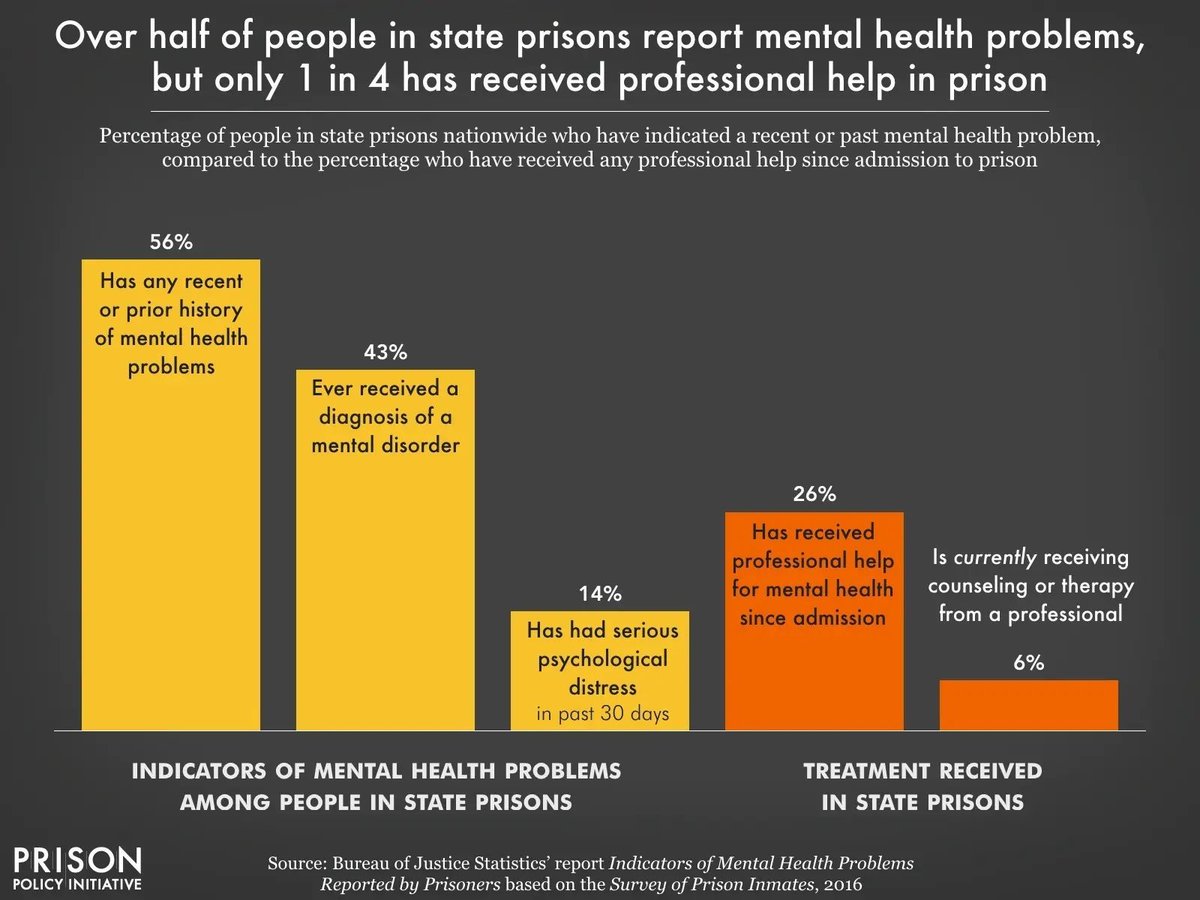
June is National PTSD Awareness Month – a condition that disproportionately affects incarcerated people.
Not only does the criminal legal system cause mental health issues, but it exacerbates existing problems in an already-vulnerable population.
Narcissists, psychopaths (predators) brazenly push through when exposed. Most of us would be too embarrassed to show our faces let alone maintain a platform. Not predators! Lack of fear, empathy & shame plus a powerful ego means predators behave differently when they’re exposed.
What’s the perfect way for a narcissist, psychopath to hide?
By working/advocating in the area of narcissists, psychopaths, domestic violence, criminology.
Has anyone observed a subtle smirk/left right facial asymmetry & other red flags re an advocate/worker in these fields?
❌ MYTH: Some people need to go to jail to get treatment and services.
⚠️ REALITY: Time & time again, people trapped in the system are left worse off because they cannot get the treatment they need.
Jails and prisons are designed for punishment, not care.
Natuashish teen Wally Rich was isolated by language, bullied by staff, and encouraged to seek mental health care elsewhere in the days before his death while in care. His family hopes his legacy will keep any other child from going through his experience https://t.co/rQP5bhnPDk