@Vertiv CFD is only as useful as its boundary conditions. For outdoor heat-rejection equipment, include discharge height and velocity, nearby obstructions and prevailing wind, then check whether exhaust can return to the intake under adverse conditions—not just the nominal layout.
Before connecting cooling-tower pipework, check flange alignment before bolting. Bolts should close an aligned joint, not pull a pipe into place; forced fit-up can transfer load to the tower connection. Confirm supports and expansion provisions against the approved drawings.
@Vertiv For cooling towers, operating context matters: water temperatures, flow, fan status and entering wet-bulb conditions help separate changing duty or weather from a developing mechanical issue. Linking an alert to inspection history makes it more useful for maintenance teams.
When checking cooling-tower performance, compare leaving-water temperature with the entering-air wet-bulb temperature—not dry bulb. Record them alongside hot-water temperature, flow and fan status. Without readings from the same operating period, a change in approach may just reflect different conditions.
Drift and evaporation are different losses in a cooling tower. Evaporation is part of heat rejection; drift is liquid water carried out with the exhaust air. If make-up demand is higher than expected, check for leaks, overflow, blowdown rate, and damaged or poorly seated drift eliminators before changing the tower duty.
Before a cooling tower starts verify the basics basin and strainer clear fan rotation correct and spray coverage even across the fill. If rotation is wrong stop and correct the electrical connection before running never inspect near moving equipment. A short ordered pre-start check can save a lot of troubleshooting later.
@JindalPower_In It helps to separate the two duties: the condenser transfers heat from exhaust steam to the circulating water; the tower then rejects that heat to ambient air. If condenser pressure rises, check both sides of that chain rather than the tower alone.
On a cooling-tower layout, footprint is only half the check. Leave a clear route to remove the fan drive and access the fill. If a gearbox is used, confirm the lifting path before the plot plan is frozen; service access is easier to solve on paper than after installation.
Cooling-tower water distribution is worth checking by its wetting pattern across the fill, not just by confirming the pump is running. Dry areas may point to blocked nozzles, uneven header flow or a level issue. Check during stable operation; isolate the pump before opening a line.
When a cooling-tower fan starts vibrating, don't jump straight to a bearing diagnosis. Compare vibration and motor current at the same operating point, then check for blade fouling or damage, loose fasteners and alignment issues. Isolate and lock out the fan before any hands-on inspection.
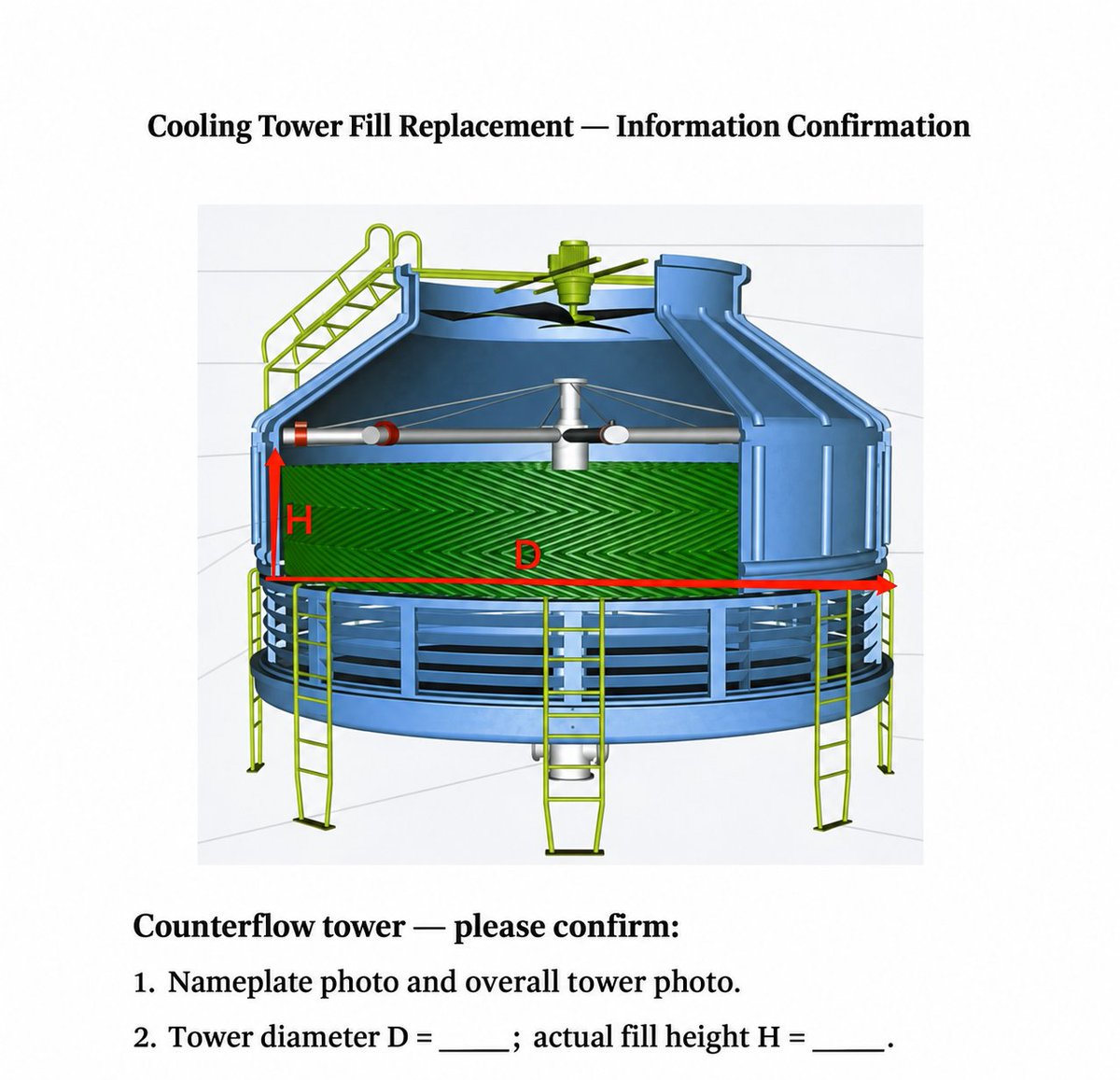
Replacing cooling-tower fill starts with fit-up details, not a capacity guess. These checklists cover round and square counterflow towers and crossflow towers: nameplate and overall photos, fill-block dimensions, number of layers, sheet size and assembly method. Clear measurements help us check the replacement layout against the existing structure before supply.
If you are planning a replacement, start with the tower nameplate, interior photos and one fill sheet with its dimensions. #CoolingTower
Good topic. In a selection review, I check that range and approach are stated at the same design condition. Range is the water-side temperature drop; approach is the leaving-water temperature above the entering-air wet-bulb. Without the wet-bulb, an approach figure has no climate context.
One number often gets mixed up in a closed-circuit tower quote: process flow is not make-up water demand. In the SCC, process fluid stays inside the coil while spray water circulates outside it. To size the water budget, ask for a separate balance for evaporation, blowdown and drift at your actual duty. How do you keep those two flow figures clear in RFQs?
The SDV’s V-coil layout keeps the footprint compact per kW. But the base dimensions are only the start of a site check: confirm the design dry-bulb, power supply and installation clearances, then check the fan discharge path and whether hot air could return to the coil intake. A compact cooler still needs a workable layout.
@HVACR_Online A useful field skill is checking the original design basis before adjusting controls: flow, entering/leaving temperatures and the design ambient help technicians tell whether operating conditions have changed.
@FranklinHodgeUK Good reminder—safe access is part of maintainability and needs to be coordinated with the equipment layout early. Do you usually see access requirements set by the tower supplier or by the site team?
With a closed-circuit tower, the process fluid stays inside the heat-transfer coil; separate spray water cools the coil from the outside.
That keeps the two circuits apart, but it doesn’t make water treatment disappear. The spray-water side still needs its own operating and maintenance plan.
When you review a closed-circuit tower, do you look at the process loop and spray loop separately?
@PedroInenmex A useful next step is to map those modes against the site’s hourly dry-bulb profile and required supply/return temperatures. One design point can miss how many hours partial free cooling is actually available.
On a coastal site, coil material is a design decision—not a checkbox. Our SDV V-type dry cooler lists coated fins, Cu/Cu and stainless options, but the right choice depends on actual site conditions. What usually drives your decision most: salt exposure, water quality, or maintenance plan?
@ToddWhipple Fair point—“server farm” still describes the hardware. The newer data-center conversation is usually about power density, cooling and redundancy at much larger scale. Either way, the heat has to go somewhere; that’s the part I spend my time thinking about.