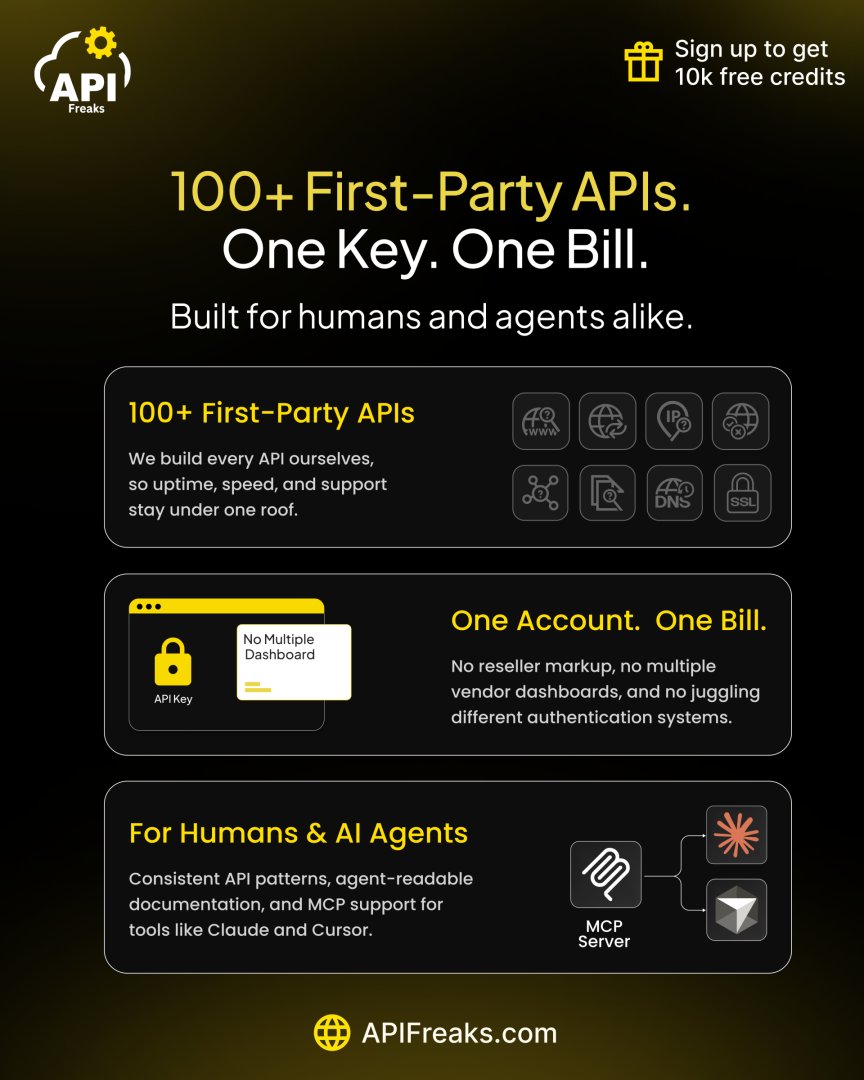
APIFreaks: 100+ first-party APIs across 20+ categories, no resold vendors. One key, one credit pool, one SLA we own. Built for developers and AI agents alike.
100+ first-party APIs. One key. One bill. Built for humans and agents alike.
IP intelligence, WHOIS, DNS, geocoding, email and phone validation, SSL, screenshots, PDF tools, currency, weather. All of it behind a single integration.
That's APIFreaks 👇
5/ None of the three raises an error, so they surface later.
The Domain WHOIS Lookup API returns registrar and registry data in separate fields over WHOIS or RDAP. It cannot return contact details registries redact.
Which TLD broke your parser first?
https://t.co/437ghTwNvl
1/ A WHOIS parser can fail without raising an error: name servers come back, the dates do not, and your batch job moves on.
We tested a popular Python WHOIS library and found 3 silent failures. Below: each one, plus 3 checks that catch them with any parser.
4/ Failure 3: two expiry dates. google.com showed 13 September 2028 from the registrar and 14 September 2028 from the registry. The parser labelled neither, so a renewal check can pick the wrong one.
Check 3: store registrar and registry dates in separate fields.
A design choice we made in a PDF template endpoint: to get the latest template version you omit the version parameter, and passing the word latest is rejected. Pinning takes a value like v2. Do you prefer an explicit alias or an omitted default?
1/ A DNS lookup shows the record as it is now. When mail starts bouncing, the question is when the MX or SPF record changed, and the current answer cannot tell you.
3/ Caches blur the timeline. A resolver can serve the old answer until the TTL expires, so a change at 09:00 can show up at different times for different users.
4/ The IP Threat Intelligence API returns a threat_score from 0 to 100 with VPN, proxy, Tor, relay and bot flags, and fields limits the response to the ones your rule reads.
1/ A scanned PDF has no text layer, so text extraction returns an empty string and the pipeline indexes nothing without raising an error. Check every page for it before chunking.
3/ Send only those pages as images. Vision input costs more than text, and a page-level split keeps typed pages on the cheap path. A resolution around 200 DPI is a common starting point for text.
A VAT rate hard-coded in checkout can go stale, so store the rate you applied on each invoice line at charge time. The VAT Rates by Country API returns standard, reduced and super-reduced rates, and its optional state parameter covers sub-national VAT.
2/ The Live Weather API accepts an ip parameter and infers the location, so no geocoding step sits before the widget. IP location is approximate. #nextjs
1/ In a server component, read the visitor IP from the x-forwarded-for header with await headers() and take the first entry, since later ones are proxies.