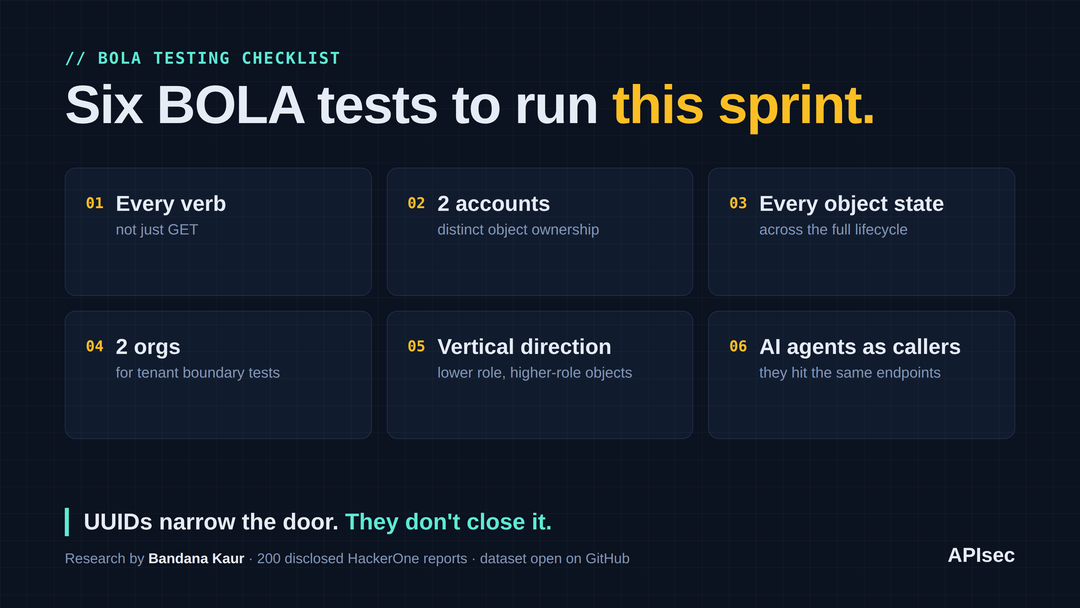
BOLA testing checklist from @HackWitHerr:
- Every verb, not just GET
- 2 accounts, distinct ownership
- Every object state
- 2 orgs for tenant tests
- Vertical direction
- AI agents as callers
UUIDs narrow the door. They don't close it.
Dataset is open.
#BOLA#OWASP
A 200 with your injected value echoed back isn't proof of mass assignment.
Send "status": "returned" on an order. API says 200, status: returned.
The proof is whether you can now claim the refund.
It's not a vuln until the money moves. New from @JoseHaroPeralta#AppSec
Learn this free at apisec University: https://t.co/mFiG1WfRoZ
Take Perry's course, Foundations of AI-based Application Exploitability: https://t.co/XuF9S2o8qG
With BOLA, the code looks fine. The endpoint checks you're logged in, just not that the record is yours. Perry Menezes at apisec|con: most of the OWASP API Top 10 are logic flaws, and that's where pattern-matching tools are weakest.
Your IDOR tag count is lying to you.
@HackWitHerr sorted 200 HackerOne reports into 6 BOLA families.
The OWASP API Top 10 directly covers 1. Four are missing entirely.
The guidance under-weights what the data over-represents.
#BOLA#OWASP#IDOR
Perry Menezes at apisec|con: AI is capacity, not another scanner. It can trace authorization across an OpenAPI spec in minutes. It can also be confidently wrong, and it isn't deterministic. His rule: use it, then govern it, and keep a human checking the answer.
$15,000 for 26,000 agents running for 48 hours. That number from Bashar Abouseido at apisec|con should change how every security team thinks about attacker effort.
Models aren't deterministic. They don't find the same thing on every run. At this price, it doesn't matter. An attacker can afford enough runs to get lucky.
Defenders can't rely on luck. We need to know what applications we have, what they're made of, and which issues are exploitable, and we need to find them before the swarm does.
"It's not a tool anymore." Perry Menezes at apisec|con: AI agents that read repos, write PRs and connect to gateways are privileged identities. Govern them like service accounts: human approval, least privilege, and defenses against prompt injection hiding in code comments.
Remediation model from Bashar Abouseido at apisec|con: validated exploitable findings get fixed now. Detection teams add compensating controls (like a WAF rule) to buy time. Everything else stays on the normal 30-day cadence. How does your team split it?
Inventory said 340 APIs. Gateway logs said 412. One was a v1 mobile banking API that should've been retired two years ago, still serving account details, no owner. Perry Menezes at apisec|con: you can't prioritize by exploitability if you don't know your exposure.
Watch the full fireside chat with Bashar Abouseido from apisec|con 2026: https://t.co/uAXGY0ulgB
Read the takeaways for security leaders: https://t.co/t1u9sPLsNE
Bashar Abouseido, former Schwab CISO, on why AppSec lags: most CISOs come from infrastructure, so they build controls around apps and leave AppSec to developers. His fix: "you need to start with applications first." A candid take from one CISO to his peers. Agree?
Most teams test the wrong half of BOLA.
In 200 disclosed HackerOne reports, unauthorized reads were only about half. The rest: modify, delete, approve, transfer.
One Mozilla bug deleted a victim's account. No data leaked.
New from @HackWitHerr#BOLA#OWASP
Bashar Abouseido said something at apisec|con that a lot of CISOs think but rarely say: most security leaders came up through infrastructure, so that's where the investment goes.
I'd add one thing. The application layer has changed under our feet. Applications are now APIs, and AI is an API too. If your program still treats AppSec as a developer side project, you're defending the old perimeter.
Start with what's actually deployed and how it works. That's where the risk is.
Your team closed 1,100 vulns. The board asks: which open ones could an attacker use against our customers tomorrow? Silence. Perry Menezes at apisec|con on why exploitability, not volume, is the question security leaders now have to answer. Could your team?