Strength training might be the single most potent habit for aging gracefully and extending lifespan. It certainly appears to be one of the best methods to prevent the need for joint replacement surgery. After 30 years of practice, there’s no doubt that, in general, and within reason, stronger people keep their joints longer.
Muscle is not simply a tissue that moves us around; it is one of the most metabolically active and adaptable organs we have.
In this post, I explore why a tissue we initially thought only provided locomotion and stability should probably be considered one of the most critical tissues in the body.
https://t.co/eNecuayTvP
Had a phone call with a 51M who is 420 pounds. Knee and hip are in bad shape. One chiro tried to sell him a half year plan to work exclusively on his upper neck. A PT he consulted with said nobody EVER needs surgery, it’s just a matter of finding the right exercises…🤦♂️
@mboyle1959@hjluks I think that’s a good overall characterization, but we really try to embed those principles into compound movements and sequences that allow for a global adaptation instead of just a local one. Because @hjluks has other broad goals centered around strength/hypertrophy/power.
This is the reason we do what we do. Giving people a piece of their life back that they thought was gone forever. Couldn’t ask for a better colleague in @Sportee_SnC and a more diligent and trusting client/colleague in @hjluks.
15 years ago had to stop golfing due to pretty awful LBP. I did PT, injections… nothing allowed me to golf comfortably.
My dad who’s 90 loves golf and he loves when we play. So when I visited him i would load up on Advil to get through 6-7 holes and suck it up.
Enter my two trainers over the last few years.
@Sportee_SnC and
@Apollopcny
Well. We just got off the course.
9 holes. With my dad and my son.
And no LBP 😊!!!
Cause and effect???
Maybe not… but I’m giving credit to Stephen and Brett as well the effort I put forth.
All the work was worth the memories today will yield.
@FinleySawyer1@hjluks I think sometimes LBP can be over diagnosed. In absence of red flags, we view everything as a mechanical diagnosis in which movements and patterns just need to be introduced, scaled, and progressed. @hjluks definitely has certain tendencies but we all do!
@Hurricane__44@hjluks If I may I think it’s that myself and @Sportee_SnC really view rehab and training as one in the same. Our goal is to create adaptation, so scaling it to where the person is becomes key. We also believe in a heavy focus on rotational strength and stability in general.
@mboyle1959@hjluks I wouldn’t say golf was a specific focus but with all the rotational work we prioritize and @hjluks trusting us and putting in the work, it’s a great outcome to get! Shout out to @Sportee_SnC for the collab and all credit to @hjluks for sticking with us
@mboyle1959@hjluks Our approach has basically been to expose Howard to a ton of rotational stability through the hips and T-spine while gradually working in high intensity speed work via med balls and cable exercises. Healthy dose of sleds/compound movements as well.
One of my favorite parts of working through a care plan with somebody is to see the evolution of how they handle minor aches/pains/setbacks. What started as major panic and overreaction morphs into calm conversations and self adjustments. That’s something that lasts a lifetime.
Unfortunately common consult yesterday. 3 year history of high hamstring pain. No clear diagnosis given. Short stint of therapy where he felt ignored and pain worsened. Drove hours on multiple occasions to have PRP and injections recommended. Proper loading/movement here we come!
Clients say this to me all the time after they’ve changed their lifestyle, and it’s absolutely true… Most people don’t realize how bad they feel at baseline until they get themselves healthy.
It’s always been funny to me that we call physical therapy/rehab “conservative care”. It should be called “standard care”. And in that light, surgery should be called “last ditch care”. Sometimes we need last ditch care. Most of the time though… we don’t.
In the musculoskeletal rehab world, we need to get away from complicating things. Instead of spending 30 minutes trying to get the posterior tibialis to “fire”, push a sled. Does what you’re looking to do, builds confidence, and builds other athletic qualities as well.
Under-stimulation in rehab not only sets people up for re-injury of the current ailment, but it creates a step down in overall fitness. Stack enough “minor injuries” together over the years, and you have an out of shape person, that’s removed activities, and is terrified to move
Surgery can actually be a blessing in disguise. If you attack it with the mindset that it’s a fresh start and a means to dial in your habits and goals. When you view it as strictly negative, I can almost guarantee your recovery outcomes will suffer
Many of the people we deal with don’t have a problem pushing themselves. In that case, we often find our role is to slow people down, fill the gaps in their program, and create plans that strategically select when to push and when to back off.
@MattBMartin@simplavida Funny side story.
I work with both guys @Apollopcny .:. my latest primary reason. To stop pushing soooo hard and hurting myself. Not big injuries. Just nagging annoying discomfort that just isn’t healthy.
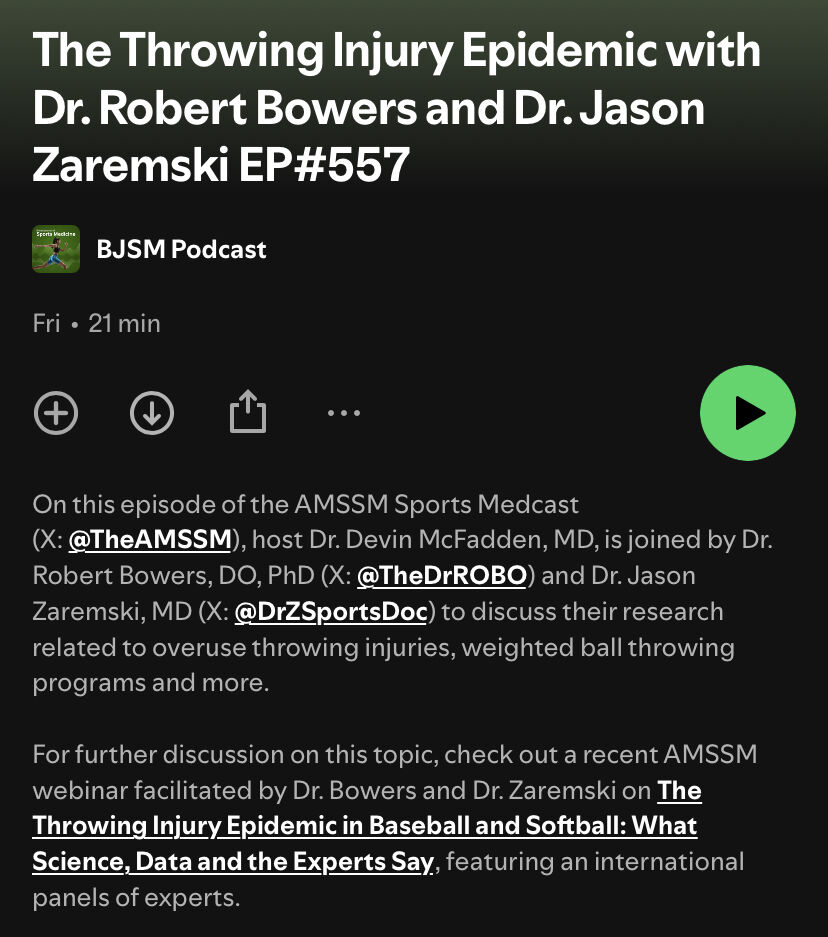
⚠️ The throwing injury epidemic
NEW #BJSMPodcast 🎧 from the AMSSM where Dr. Robert Bowers and Dr. Jason Zaremski deep dive into overuse throwing injuries ⚾️
Includes some fantastic resources ✅
Listen ➡️ https://t.co/dzp2pfzpBY
With many of my acute back pain clients, it’s so much more valuable for me to say “I’m sorry I know this sucks, but trust me it will get better”, as opposed to making up some fake reason why it happened in the first place.