High-quality mobile & residential proxies.
50M+ global IPs for automation, scraping, multi-account workflows & research.
Built for real infrastructure.
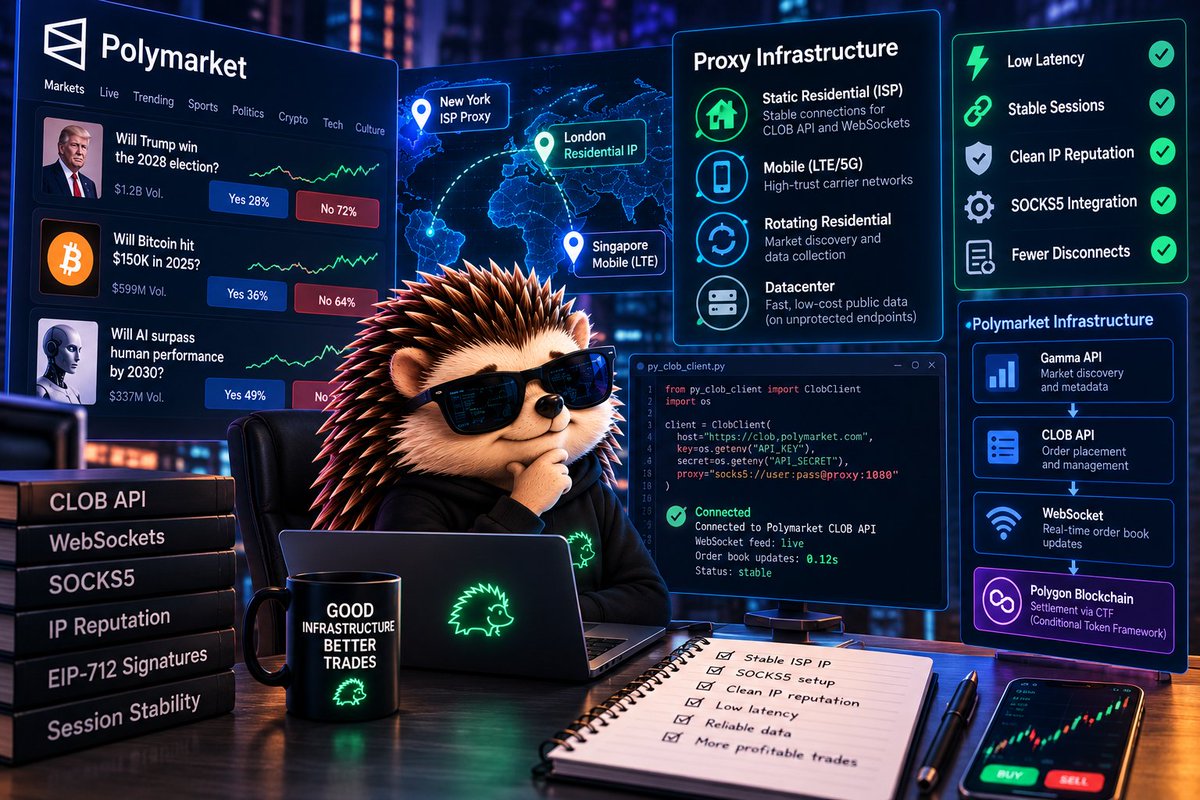
I used to think prediction-market automation was all about API. But the network layer is also important.
@Polymarket stack mixes the CLOB API, WebSockets, @Polygon settlement, and authenticated sessions. If the connection underneath that stack is unstable, everything above it becomes harder to debug.
For long-running CLOB polling and WebSocket feeds, I found that stability matters more than aggressive rotation. A static residential/ISP connection is usually easier to reason about than changing IPs mid-session.
SOCKS5 also makes sense when the same environment needs to route different application traffic through one consistent endpoint.
The second important thing is IP quality. Before attaching a trading process to any proxy, I’d verify ASN, geolocation, reputation, and whether the address is classified as hosting, VPN, residential, or mobile.
For market discovery and public-data collection, rotating pools can still be useful. For authenticated sessions, I’d keep the network identity predictable. And regional access rules should be handled as a compliance constraint, not something to bypass.
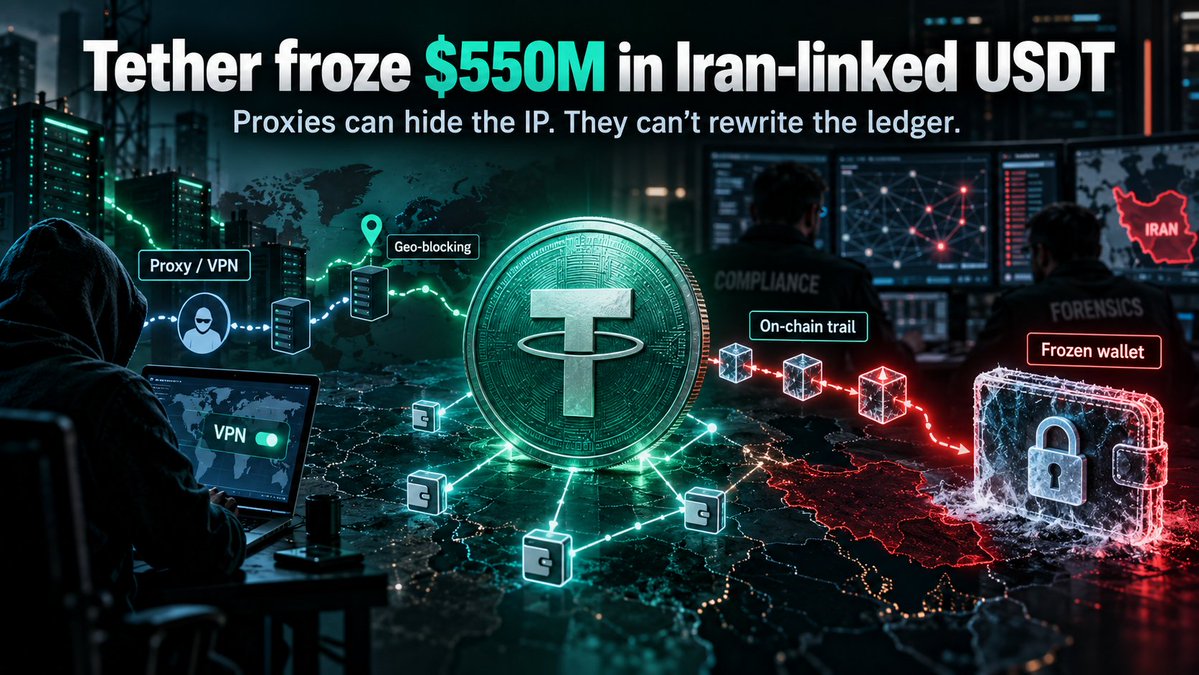
Tether says it helped freeze nearly $550M in Iran-linked USDT in 2026.
But the real story is the cat-and-mouse game between IP identity and blockchain identity.
A proxy or VPN can make a user in a sanctioned country look like they’re connecting from somewhere else. That’s why crypto platforms use geo-blocking and why OFAC explicitly recommends tools that detect VPNs and suspicious IP patterns.
But proxies only hide where you connect from. They don’t erase the blockchain. Wallets still leave a trail. Funds still move between addresses. Once investigators connect those wallets to sanctioned networks, @tether can blacklist the USDT.
That’s the new reality of crypto compliance:
Hide the IP.
Trace the wallet.
Freeze the funds.
A proxy can disguise your location.
It can’t rewrite the ledger.
I thought Amazon Buy Box monitoring was just: fetch page → parse price → repeat.
Then came captchas, 403s, and inconsistent regional results.
The real issue wasn’t parsing. It was network context + data quality.
For legitimate monitoring, I now track which region produced each observation, verify exit-IP location/reputation, and compare regional storefront data before trusting the result.
Bad network data = bad pricing decisions.
Amazon monitoring isn’t just a scraping problem. It’s an infrastructure problem.
I used to think Web3 identity was mostly an on-chain problem.
RPC requests still carry network metadata. If multiple environments route through the same gateway, they can look related even when the wallet addresses are different.
That’s why the network layer matters too: mobile vs datacenter IPs, ASN type, browser fingerprints, Canvas/WebGL signals, protocol support, and RPC stability.
My biggest takeaway:
Don’t evaluate a Web3 environment only on-chain. Test the network layer too.
And if a protocol has anti-Sybil or eligibility rules, design your infrastructure around those rules
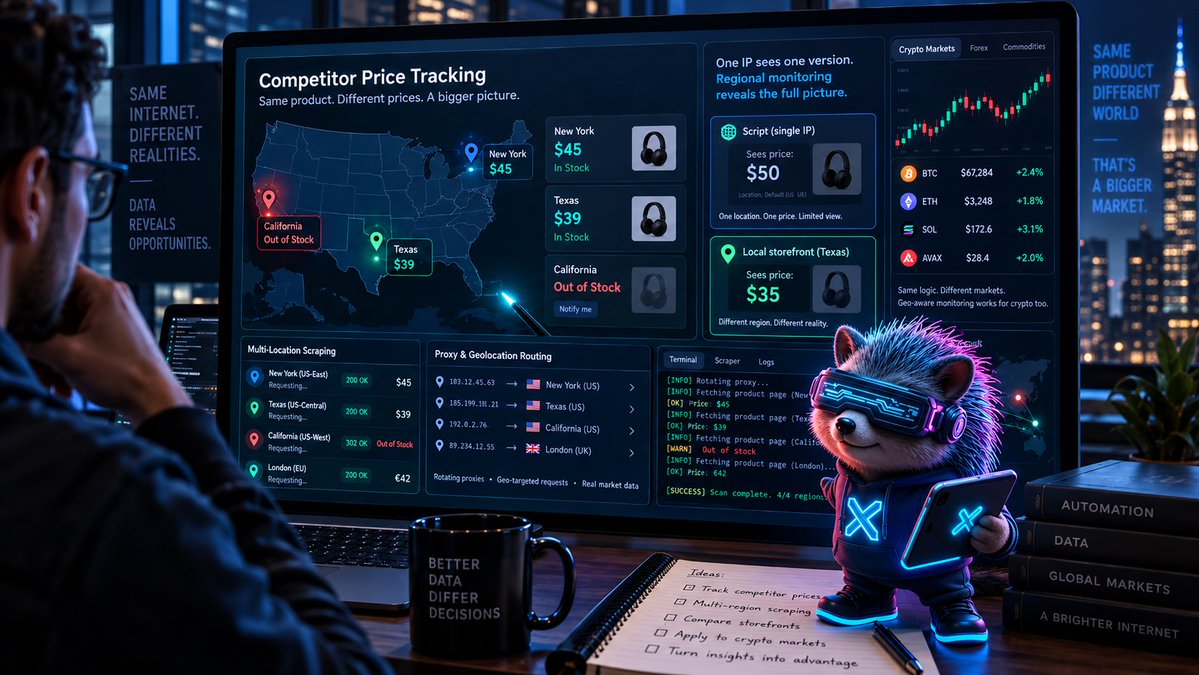
I thought my competitor tracker was accurate until one product showed $50 in my scraper and $35 from another region.
The same problem exists in crypto: prices, offers, liquidity, and payment options can look different across regions.
So I started running the same checks through residential proxies in multiple cities and built a regional price map instead of trusting one IP.
One location gives you one version of the market.
Whether you're tracking e-commerce competitors or crypto markets, geo matters.
“Decentralization” in DeFi is often much more limited than people think.
shoutout to @HyperliquidX
A protocol can run on-chain and still depend on centralized frontends, RPC providers, hosting, compliance systems, and access controls. If a wallet can be restricted because of exposure to sanctioned addresses, then permissionless settlement does not necessarily mean permissionless access.
That distinction matters.
The biggest perp DEXs are becoming serious financial infrastructure, but serious infrastructure increasingly operates under external rules. The result is a hybrid system: decentralized execution combined with centralized access points.
This is also why privacy infrastructure matters. Proxies can help traders reduce unnecessary IP exposure, separate trading activity from a fixed network identity, and improve operational privacy across DeFi platforms.
They are not a substitute for compliance or a tool to bypass restrictions, but they can be an important part of basic trading security.
DeFi may be decentralized at the protocol layer.
The CLARITY Act and Proxies
The CLARITY Act aims to create clearer rules for the U.S. digital-asset market, including how crypto exchanges, intermediaries, and DeFi platforms are regulated. For companies using proxy infrastructure, the key point is that proxies themselves are not generally prohibited.
A proxy routes internet traffic through another IP address. Crypto businesses can use residential, mobile, ISP, or datacenter proxies for legitimate purposes such as geo-location testing, market research, security monitoring, API access, and checking whether regional restrictions work correctly.
However, a proxy should not be treated as a way to bypass regulation. Using a proxy or VPN to appear as if you are in another jurisdiction does not change your actual legal location or remove KYC, AML, sanctions, tax, or other compliance requirements.
The safest approach is to use proxies as compliance and infrastructure tools. For example, a crypto platform can test whether restricted services are correctly blocked in certain regions or monitor publicly available market data from multiple locations.
For DeFi projects, smart-contract proxy systems may also matter. If an administrator can upgrade or materially change a protocol, regulators may consider that level of control when determining how decentralized the project really is.
This article is for informational purposes only and is not legal advice
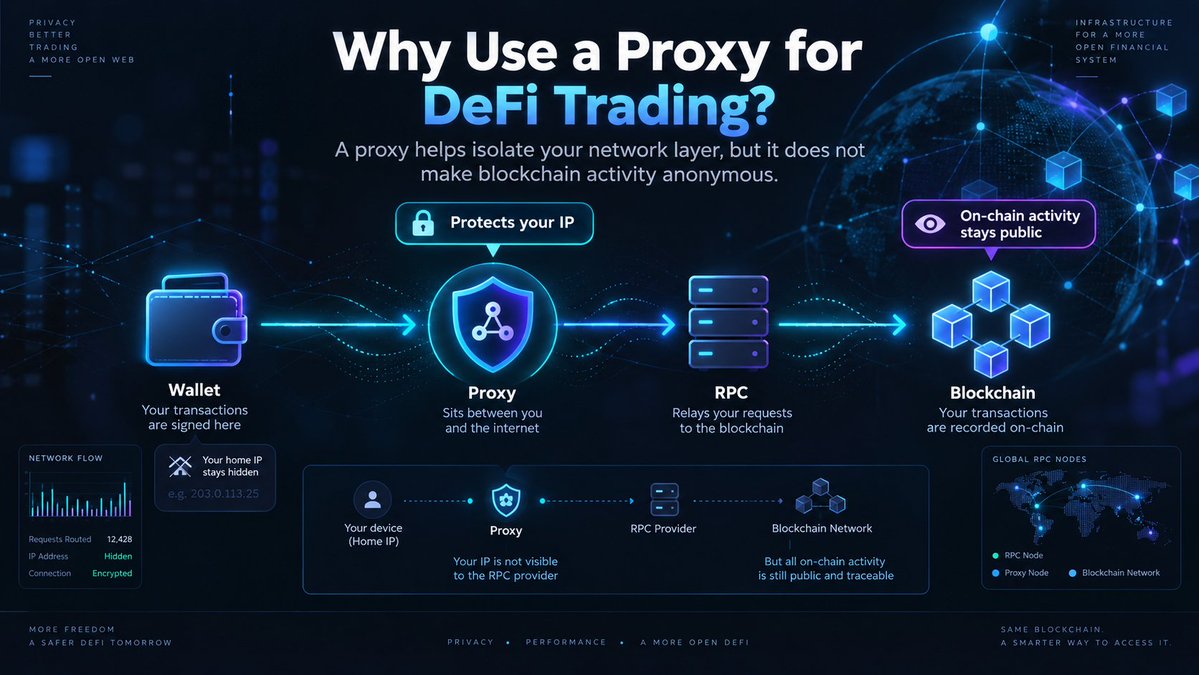
If you trade on DeFi through @MetaMask, there’s a privacy layer many users overlook: the network between your wallet and the blockchain.
Your wallet may be non-custodial, but your browser and RPC provider can still process metadata such as your IP address and connection requests.
A proxy changes that network path. This can be useful if you want to keep your home IP separate from your DeFi activity, maintain isolated environments for different wallets, or give automated trading infrastructure a consistent network route.
But a proxy does NOT make you anonymous on-chain. Transfers between wallets, contract interactions, balances, and transaction history remain public.
Trading on @HyperliquidX : Why Proxy Infrastructure Matters
Imagine your bot detects a bitcoin:native setup, calculates the entry and sends an order. If the connection is unstable, market data is delayed or your WebSocket drops, even a profitable strategy can fail at execution.
This is where proxy infrastructure can help.
A dedicated static proxy or controlled egress IP gives your trading system a predictable network path:
Bot → Proxy → Hyperliquid API
For teams running bots across multiple cloud servers, containers or strategies, this can make infrastructure easier to manage.
However, proxies should not be treated as a shortcut for bypassing API limits or geographic restrictions. A strong trading architecture should respect platform rules, use WebSockets efficiently and reduce unnecessary REST requests.
Airdrop season is getting serious again 👀
Some of the biggest opportunities on the radar include @Polymarket , @MetaMask , @base , @opensea and @Backpack . But in 2026, simply connecting a wallet and making one transaction is rarely enough.
Projects increasingly look at long-term activity, trading patterns, wallet history and other signals to separate real users from low-quality farming.
That also makes your network setup more important. If you legitimately manage several wallets or Web3 profiles, clean residential or mobile proxies can help keep sessions isolated, reduce IP overlap and improve account security.
Farm smarter
Running e-commerce, market research, or regional ad verification in Saudi Arabia? Local anti-bot filters and geo-restrictions require clean, authentic network identities to avoid instant blocks.
CyberYozh offers dedicated static Residential and Mobile proxies in Saudi Arabia sourced from real local ISPs and carriers—delivering stable sessions, high connection speeds, and HTTP/SOCKS5 protocol support. Pre-check your target IPs with our Fraud Score tools before running traffic to ensure seamless operational predictability.
🔗 Access reliable Saudi Arabia proxies: https://t.co/uXyC6zjSzn
#SaudiArabia #ProxyInfrastructure #ResidentialProxies #AdVerification #MarketResearch #CyberYozh
Managing localized accounts or ad campaigns in Germany?
Standard IPs won't cut it when target platforms require authentic local network signatures.CyberYozh offers dedicated German mobile LTE/5G proxies operating through real carrier networks—complete with unlimited bandwidth, API-driven rotation, and OS fingerprint switching.
Combine raw proxy access with pre-flight Fraud Score checks to keep multi-account workflows, SMM, and ad verification completely secure.
🔗 Get dedicated German mobile proxies:https://t.co/1FKh6Ol8Yc
#MobileProxies #Germany #ProxyInfrastructure #AdVerification #MultiAccounting #CyberYozh
🚨 Who is Pauly & why is he on the run?
- Real name: Jeremy Cahen, known for pushing the theory that BAYC NFTs have nazi symbolism
- got sued by Yuga Labs & lost $9M.
- Launched Pond0x in 2023, exploited his own token contract & stole 450
ethereum:native , causing Ethereum gas fees to hit 400 gwei.
- Dropped more scam coins like Fartcoin2 & Trump2, cashing in on hype.
- Now on Puerto Rico’s most wanted list
- Twitter banned, location unknown.
If you want to be like Pauly you need a trusted proxy. It is an important layer of crypto security. It can reduce IP-based tracking, protect your location, and make it harder for malicious actors to profile your activity
Running automated Midjourney tasks or Discord bots at scale? Unmasked server IPs and frequent connection drops will trigger rate limits and waste your fast hours fast.
To keep your generative AI pipelines running continuously, you need clean, long-lived network layers. CyberYozh provides dedicated Static ISP and Mobile LTE/5G proxies with pre-flight Fraud Score checks to keep your Discord agents stable without triggering verification blocks.
🔗 Scale your Midjourney automation smoothly: https://t.co/n2vZLFcmsz
#Midjourney #GenerativeAI #AIAutomation #DiscordBot #ProxyInfrastructure #CyberYozh
Scaling operations or scraping price data on Temu? Generic datacenter proxies get flagged instantly due to heavy anti-bot protections.
To keep sessions stable, you need real ISP network identities. CyberYozh provides dedicated static Residential and Mobile proxies designed for seamless geo-targeting, automated scraping, and multi-account management.
🔗 Check out our Temu Proxy solutions:https://t.co/jTEwM2zlsi
#WebScraping #Temu #DataCollection #ResidentialProxies #Automation
Buying an aged Amazon account is only half the battle. The real challenge is keeping it from getting banned. Reusing flagged IPs or ignoring setup risk will burn your investment fast. We broke down the operational playbook for managing aged accounts—from matching static Residential/Mobile IPs to pre-flight risk checks. Read the full guide:https://t.co/54q7pFKBVs
5/ Step 4: Local Environment Interference. Active local VPNs, background firewalls, or conflicting network adapters often intercept proxy traffic. Disable local network tunnels before testing new proxy endpoints.
https://t.co/NJpKF0qITR
80% of reported proxy failures are not caused by server downtime. They stem from client-side misconfigurations, authentication mismatches, or protocol errors. Here is a step-by-step diagnostic checklist to debug non-responsive proxies. /1
4/ Step 3: Target Boundary & Firewall. Test the proxy against a plain IP-checking endpoint (like ipinfo. io) versus your target domain. If the proxy works on the check endpoint but fails on the target site, the target domain has flagged the subnet, not the proxy server itself.