@zephyr_z9 Worth noting the 2.8x gap isn’t fully apples-to-apples: HySparse2 reports its 2.69GB at FP8, while V4.1-Flash’s 890B/token uses FP4 main KV with QAT. The architectural gap is smaller than the raw numbers suggest though DeepSeek clearly still leads on cache compression.
Carnegie just dropped its new AI Talent Tracker and the shift since 2022 is pretty striking.
Among the NeurIPS researchers in its sample, 57.4% did their undergrad in China, up from 46.3% in 2022.
The US fell from 19.8% to 13.3%.
But the more interesting change is where they now work
But this isn’t a story of the US suddenly losing its ability to attract talent.
The US still has by far the largest net talent gain: +2,145 in Carnegie’s sample. China is at -1,729.
What changed is that China now produces so much AI talent, and retains much more of it, that both things can be true at once.
This might be the most interesting number in the whole report:
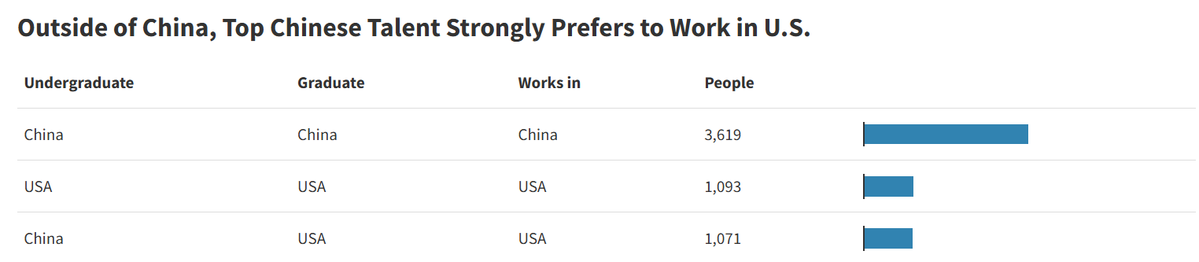
3,619 researchers followed a China → China → China path:
Chinese undergrad, Chinese grad school, now working in China.
China → US → US: 1,071
US → US → US: 1,093
The domestic Chinese AI pipeline is now enormous.
Carnegie China’s study of the 2025 NeurIPS cohort found that 69% of Chinese-origin AI researchers now work in China, up from 57% in 2022.
Where is AI talent flowing next?
The study tracks the shifting distribution of global AI talent.
Coming 23 September.
The wild part is that Samsung itself reportedly had to license YMTC’s hybrid-bonding IP for its next-gen NAND.
YMTC had 119 disclosed hybrid-bonding patents vs 83 for Samsung and just 11 for SK hynix.
Korean reports said Samsung concluded it was basically impossible to design around YMTC’s patents, so it licensed them instead.
That tells you how serious YMTC’s IP position has become.
Pretty remarkable milestone for YMTC.
A German court found Micron infringed two YMTC utility models covering 3D NAND staircase structures and word-line contacts, and issued injunctions.
China’s NAND challenger is now enforcing its own IP against an incumbent.
https://t.co/t3vyhCvCxL
Pretty remarkable milestone for YMTC.
A German court found Micron infringed two YMTC utility models covering 3D NAND staircase structures and word-line contacts, and issued injunctions.
China’s NAND challenger is now enforcing its own IP against an incumbent.
https://t.co/t3vyhCvCxL
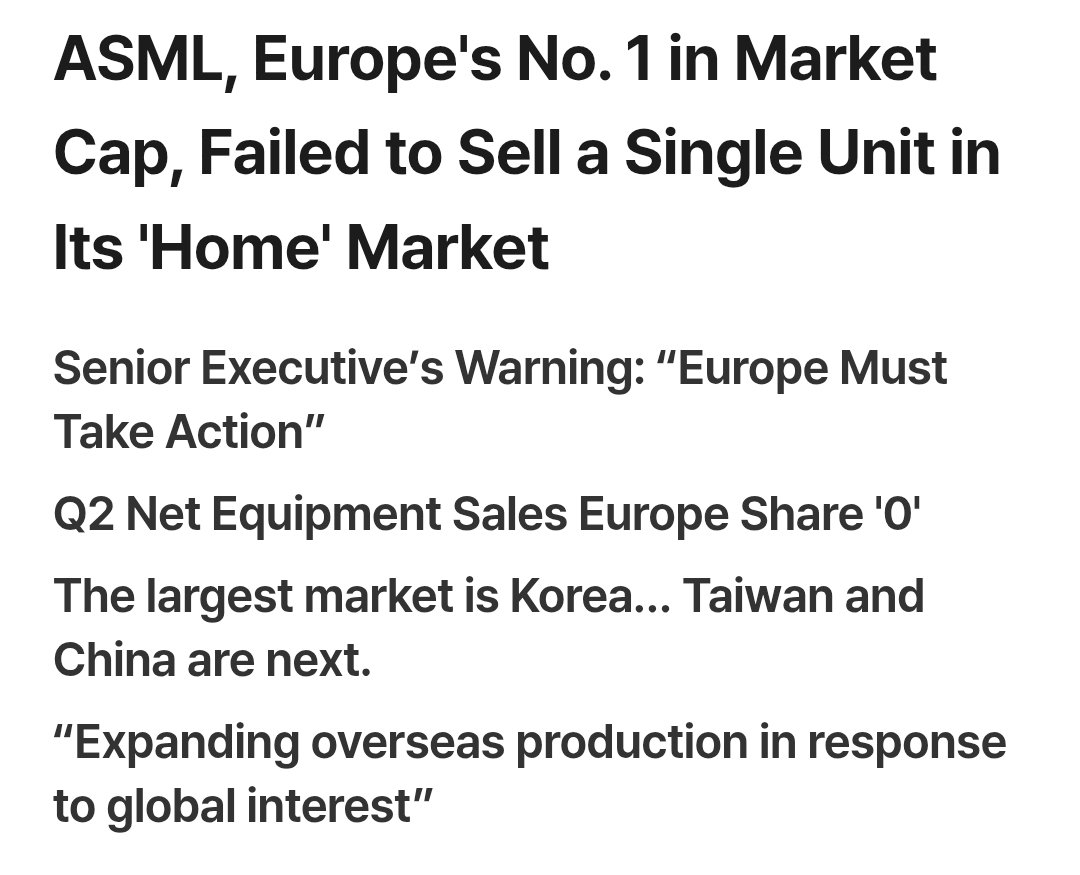
According to Bloomberg on the 22nd (local time), Frank Heimskerk, Executive Vice President of ASML, stated at an event held in Amsterdam the previous day, “We are not selling anything in Europe.” He, who oversees global external affairs, explained, “This is because Europe is not investing, and semiconductor factories are not being built in Europe.”
ASML is the world’s only company that manufactures extreme ultraviolet (EUV) lithography equipment, which is essential for producing cutting-edge semiconductors.
This technology is indispensable for producing high-tech semiconductor chips.
Companies such as Taiwan’s TSMC and Samsung Electronics use this company’s equipment to etch fine transistor circuits onto silicon wafers, serving as the foundation supporting the global artificial intelligence (AI) boom.
@zephyr_z9@teortaxesTex Yeah, the “China has no RL environment” claim feels too strong. MiMo-V2.6 alone released 7,000+ RL environments, while UI-TARS trains across GUI, terminal and filesystem sandboxes. China may lack US-style SaaS APIs, but that’s not the same thing.
@_LuoFuli MixRL + MOPD looks like the key idea here: jointly train what is verifiable and rollout-efficient, then train hard/long-horizon domains separately and distill them back on-policy. That turns capability integration itself into a scaling problem, not just an RL algorithm choice.
@zephyr_z9 The interesting question may be less “who has the best model?” and more “who can afford a persistent VM per user.” In China that probably favors the cloud + distribution giants Alibaba, Tencent, ByteDance, maybe Huawei far more than standalone model labs.
@teortaxesTex The part I’m most curious about is the hardware. If Yandex can’t legally buy frontier compute, what did they actually train ~18T tokens on — old Nvidia stock, gray-market GPUs, Chinese accelerators, or something domestic?
@zephyr_z9 Curious about the CPU > GPU point: if personal agents scale massively, wouldn’t inference demand explode too? What makes the CPU side grow faster per-agent VMs/sandboxes, lower GPU cost per token, or something else?