A lot more people are organizing China tech trips these days, which I actually think is great. More people should come see what’s happening here firsthand.
But here’s what I think makes @techbuzzchina different: deep domain expertise.
Our trips didn’t start as tours. They grew out of our work with fundamental investors who needed to meet companies face-to-face, ask detailed questions, pressure-test what they were hearing, and understand the environments in which these companies actually operate.
Today we work with a much broader group: VCs, founders, executives, and others across tech and investing. So the trips have expanded too. We might visit a factory, an R&D facility, or a robotics lab alongside closed-door company meetings. Every trip is built around what the group actually needs to learn.
But the underlying model hasn’t changed.
We’re not general business, marketing, or China consultants who moved into tech because AI, robotics, semiconductors, and other deep-tech sectors happen to be where the action is now.
I’ve worked in tech, finance, and investing for more than 20 years. I know the companies, the technologies, the investors, and the ecosystem. And because I live and work in Silicon Valley as well, I understand what people coming from overseas already know, what they think they know, and where the real knowledge gaps are.
That means we’re not just arranging access. We know who is worth meeting, what is worth seeing, what questions to ask, and how to put what you hear into context.
That’s the product.
More info below:
Come with us at @techbuzzchina to see China tech in action. We work with investors, founders, corporate executives, and other research organizations. Because we get so many different types of requests, we have now started to really figure out what kind of product makes sense for each type of customer.
In addition, the reason why we're good at our job is because we are doing more than just visits: we are also doing research and consulting for specific partners. So maybe you go to China with us and then decide that you actually need to work with folks there: we can help you identify the right partners. In fact, we're doing some projects right now in robotics, which is really exciting.
For those of you who have reached out and are still waiting to hear back from us, sorry! We've just been inundated with requests, and we are trying to figure out the best product for you!
I've been blown away by the energy, optimism, and hard work that has created the China I've seen on this trip. It had been seven years since I was last here, and it might as well have been forty. Invigorating to see what's possible. The West has no excuse for its managed decline.
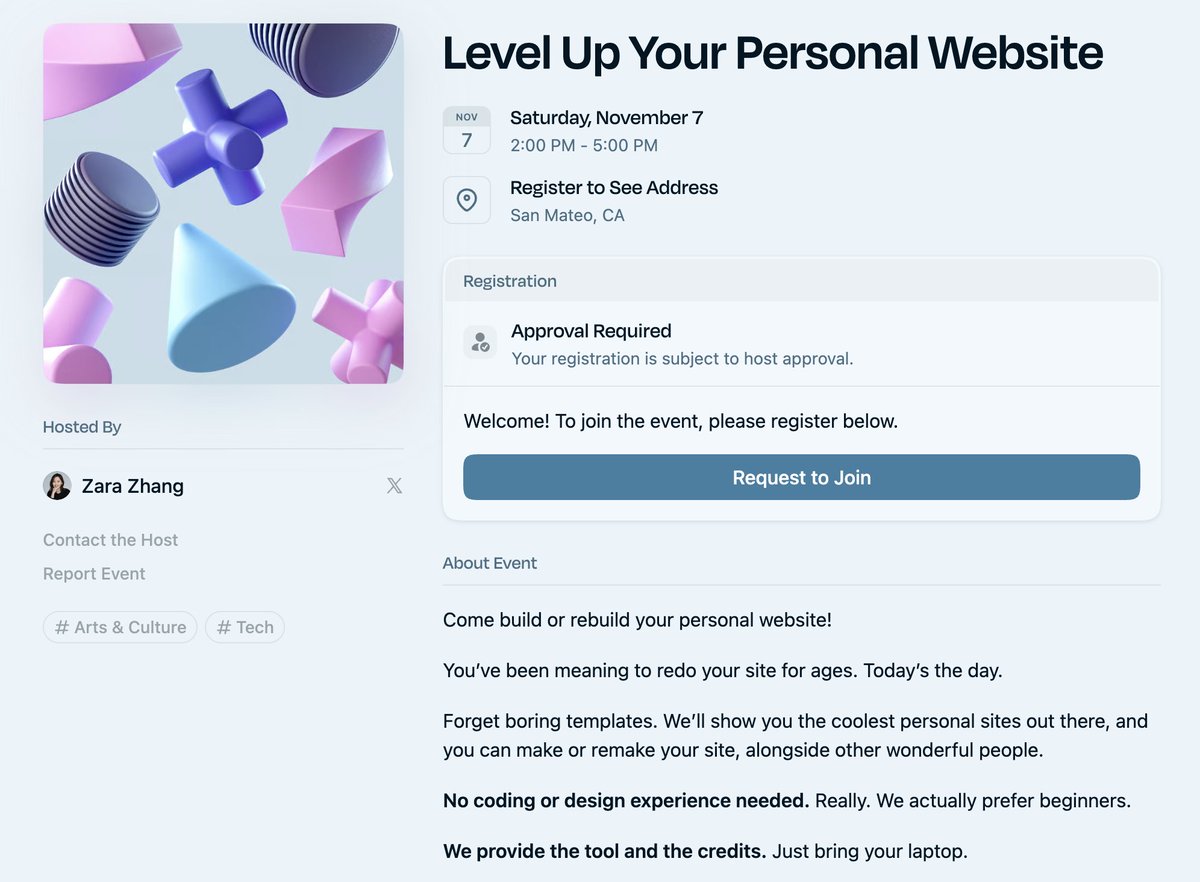
I'm hosting an event in the Bay Area (San Mateo) on Nov 7 (Saturday) where you can come build/rebuild your personal website!
We’ll show you the coolest personal sites out there, and you can make or remake your site, alongside other wonderful people.
ZERO coding/design experience needed (beginners preferred). RSVP here: https://t.co/XKE7Qgp4DN
Cool, but also, how in the world do people keep up with all the releases?
1. What's going to happen to all the folks who claimed that Chinese models are dead like two weeks ago? I guess nothing, since the chip deficit remains stark and potentially growing. I just personally think it's more dynamic than that.
2. Cool on all the 3D websites and all, but I can't remember the last time I went on a website and actually read it in detail because it's so much easier to just stay within my AI tools and retrieve the answer. I mostly go to see if there's enough disclosure to make me feel comfortable it's not a scam, lol, although that method has very limited utility now, IMO. Gaming and education etc and all those other use cases where the 3D environment is the point / makes a huge difference though, I get it
Saw the head of McKinsey China post this on LinkedIn today, quoting a former Google executive. I think it depends on the sector, but in most areas of tech, it feels like it's less than 10%
“Westerners have about 10 percent of the knowledge of China that Chinese people have about the West.”
@andypshi Also, lots of people don't really know how to use Pinyin, whether because they're a little bit older, because they just didn't learn it well, or because they have such a heavy accent that their Mandarin isn't amazing.
WeChat has a function called Read Aloud Continuously, where if you're driving and you missed a bunch of messages (maybe in a group chat), you can just listen to it. It's great.
It sounds a little funny because, for some reason, their English has a slight Chinese accent. It's also not super great at saying usernames (for example, it just calls me Ma).
But it's just another example of why WeChat is such a great app (most of the people who diss on it simply don't seem to really know how to use it sorry lol).
I'm waiting for the same feature on X. There are so many incredibly interesting threads; I don't understand why you wouldn't be able to just "save for listening" and listen to the threads.
"Yes. Your brain can continue functioning remarkably well even when cancer, such as lung cancer, has metastasized to the brain. In fact, some people with brain metastases have completely normal cognitive function and don't even realize the cancer has spread there.
The key distinction is that cancer spreading to the brain does not mean the entire brain is affected."
Man, people like you are hopeless. Maybe you should get your brain checked out.
As a friend and several commenters pointed out, it was only eight years ago, in 2018, that the hit Chinese film Dying to Survive came out. Based on a real case from the early 2000s, it told the story of a man helping leukemia patients obtain generic cancer drugs from India at a fraction of the price of the treatments available in China, which many patients simply couldn’t afford.
At the time, cancer survival rates in China were also substantially lower than in developed countries, partly because patients lacked access to advanced treatments, but also because of late diagnoses and uneven quality of care.
The film sparked widespread public outrage over the cost of lifesaving medicines. China certainly hasn’t solved all these problems, but access to innovative drugs has improved dramatically since then. It’s remarkable how much has changed in less than a decade.
In January 2025 my mom’s lung cancer spread to her brain. The drug with the best chance of helping her was approved in China but not here.
A doctor told me, almost as an aside, that if she were Chinese she could buy it at a pharmacy.
So I flew to Shanghai and came home with 26 boxes in my luggage. That was 19 months ago. My mom is still here, still working, and in her words has had an amazing three years.
The drug was approved in China in 2023. The FDA approved it in July 2025. It still is not for sale here. I know of at least 30 Americans who have made the same trip.
I have been scared to tell this story because I worried it could cost my mom access to the medicine keeping her alive. But the problem matters more than my silence. These drugs need to be developed and available here, and that means FDA reform.
Art Allen at KFF Health News told our story this week. It also ran in The Washington Post.
https://t.co/tHKV3L004L
I still like to write a physical to-do list, especially now that I have so many AI initiatives that I'm working on. It's really easy for me to lose track of what I'm doing when I'm switching contexts ha.
I usually have somewhere around 15+ things I'm trying to accomplish with AI at any given time, and it's just so satisfying when you can cross them off one by one with a pen.
Lol, just read this in Chinese:
“The world has moved so fast these past two years. We all assumed AI and robots would be washing our dishes, mopping our floors, and scrubbing our toilets, so we'd be free to write poetry, paint, and gaze at the stars.
Instead, it's the other way around — AI is busy writing the poetry and making the art, and I'm still doing the dishes and mopping the floors myself.”
I alreadt greatly prefer watching YouTube videos to trying to read inscrutable user manuals, and now it will become even easier!
Chinese manufacturers need to do this immediately. So many of the negative comments on Amazon are about poor manuals, and now here is a super elegant and fast solution.
IKEA manuals, but they come to life.
I built the real BILLY instructions in 3D, so you can watch every step happen exactly as drawn. try it: https://t.co/BqCpNrpeIi
I'm extremely embarrassed to say that about 10 days ago (and I'm not even quite sure how it happened), something wiped my Hermes agent setup, which I didn't have proper backup for. I've been spending the last two weeks fixing things intermittently.
I now have proper backup, yay! But man, I also realized just how much work I've moved to AI, and how excruciating it is when stuff is broken.
I don't disagree with you, but I think there's still a lot of spontaneity, motivation, and connection work to be done, not just the scripting of the instruction part.
For example, people bring up Montessori as a great example. Montessori teachers basically go through scripts for their jobs, but it's not like they don't love what they do. As far as we can tell (we've been in Montessori for two years), it's great: the teachers love it, the kids love it, and we love it as parents.