AI-powered tools helped Google identify vulnerabilities at an unprecedented scale.
June’s two Chrome updates patched more bugs than the previous 23 combined.
Google is developing dynamic patching to update Chrome without restarts.
Chrome now requires twice-a-week patching to keep up with AI-discovered flaws.
AI is accelerating vulnerability discovery and forcing faster, less disruptive update cycles in major software products.
How will AI-driven patching reshape software security and user experience in browsers?
#Chrome
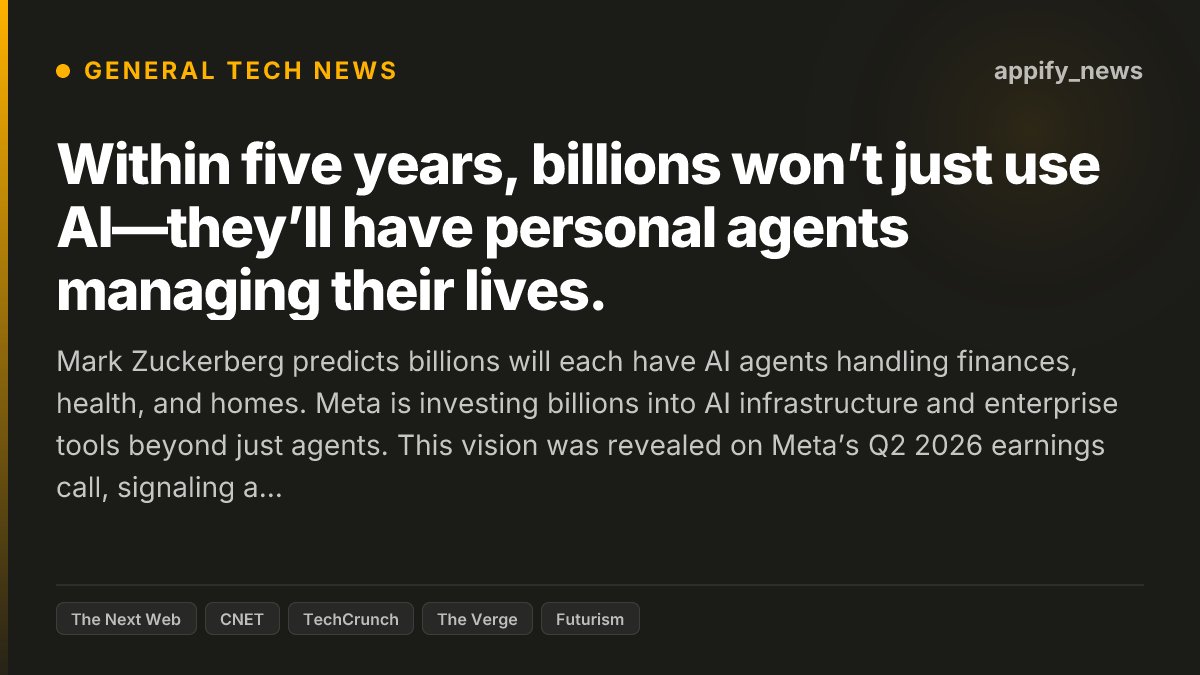
Mark Zuckerberg predicts billions will each have AI agents handling finances, health, and homes.
Meta is investing billions into AI infrastructure and enterprise tools beyond just agents.
This vision was revealed on Meta’s Q2 2026 earnings call, signaling a massive AI pivot.
Critics warn this all-in bet could either redefine Meta or risk its future.
Meta’s AI push could reshape consumer tech and enterprise software, forcing rivals to accelerate AI integration or risk obsolescence.
Will personal AI agents become as indispensable as smartphones in five years?
#MetaAI
Dharmesh Thakker says open-source AI will slash costs and disrupt OpenAI and Anthropic’s dominance.
Jason Thomas warns AI may consume most investors’ risk budgets over the next 3-5 years.
Brad Bernstein highlights 5 traits that make middle-market tech firms the real AI winners.
Advantest and ASMPT report soaring demand for AI chip and equipment despite bubble fears.
The AI race is shifting to cost-efficient, adaptable middle-market firms leveraging open-source models amid intense capital flows and hardware demand.
Which middle-market AI plays are best positioned to outpace both giants and startups in the next 5 years?
Carlyle’s Jason Thomas warns AI could consume most incremental risk budgets in 3-5 years.
AI seed-stage cybersecurity startups raised $855M across 150+ rounds this year.
A $1.2B enterprise AI security startup highlights rising market focus on AI risks.
Physical AI and biotech also attracted major funding in a diverse week of deals.
AI is dominating capital allocation, forcing investors to rethink portfolio balance amid regulatory scrutiny and sector concentration.
Is AI investment crowding out other innovation, or creating new market frontiers for investors?
Microsoft’s MDASH platform now uses MAI-Cyber-1-Flash and GPT-5.4 to hit a 95.95% score on CyberGym.
This new combo costs half as much as previous GPT-5.4-based setups.
It’s the first AI model designed specifically for cybersecurity from Microsoft.
The platform outperforms rivals like Mythos and GPT 5.6.
AI-driven cybersecurity is becoming more affordable and effective, shifting competitive dynamics in enterprise security solutions.
How will Microsoft’s cost-efficient AI model reshape the cybersecurity AI market?
#MicrosoftAI
The EU’s Digital Markets Act targets Google for boosting its own services in search and Play Store rankings.
Google has 60 days to comply or face further penalties.
This marks the third massive fine under the new EU regulations.
The European Commission is taking a hard line on tech giants’ market dominance.
The ruling signals tougher enforcement on platform fairness, forcing Google to rethink its search and app store strategies.
How will Google’s search and Play Store algorithms change under EU pressure?
#Google
The Genesis Mission will fund 278 AI-driven projects from 15 federal agencies.
Google is backing the effort with $40 million in AI credits.
The initiative targets breakthroughs in drug discovery, chronic disease, and materials science.
This is the biggest federal science overhaul in 80 years.
AI is becoming the new backbone of scientific research funding, shifting power from institutions to data-driven innovation.
Which scientific field will AI transform first with this unprecedented $5B investment?
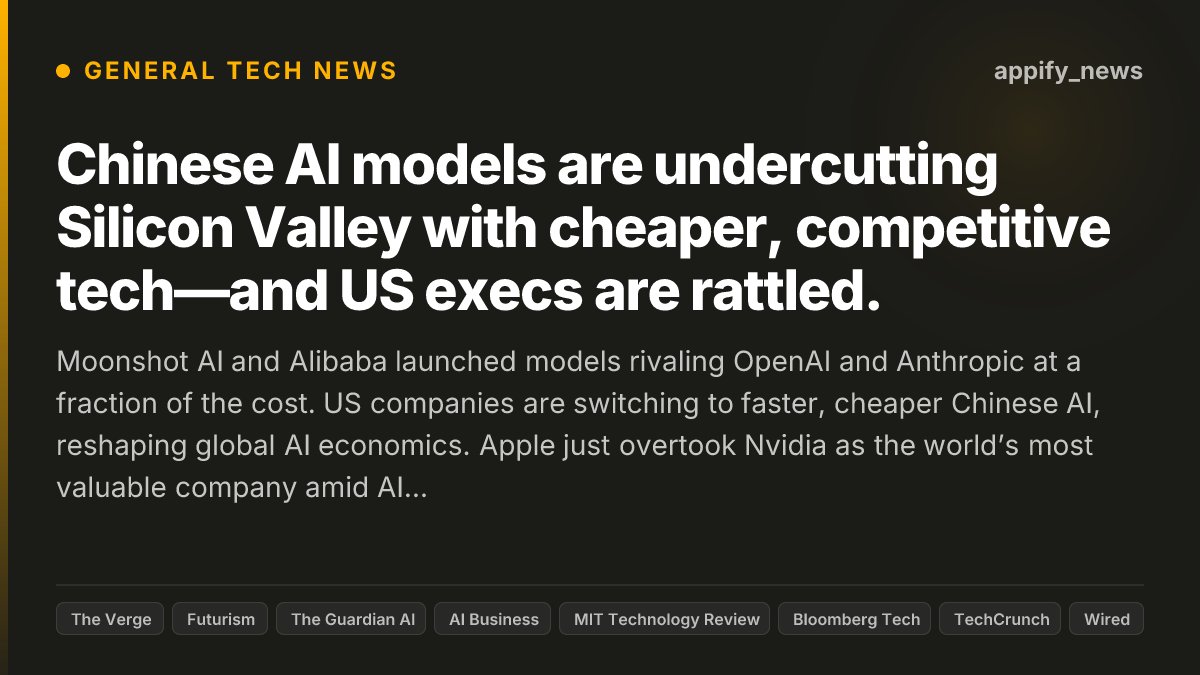
Moonshot AI and Alibaba launched models rivaling OpenAI and Anthropic at a fraction of the cost.
US companies are switching to faster, cheaper Chinese AI, reshaping global AI economics.
Apple just overtook Nvidia as the world’s most valuable company amid AI market shakeups.
Investors are dumping big tech stocks as pressure mounts to justify AI spending.
The AI dominance race is tightening, with cost and speed becoming as critical as capability. Market leadership and investment flows are shifting rapidly.
How long before Chinese AI models reshape global tech dominance for good?
#AI
Iason Gabriel, the lab’s sole philosopher since 2017, probes AI’s ethical and societal impact.
DeepMind launched a bioresilience program with Isomorphic Labs to fight biological threats using AI.
CEO Demis Hassabis is pushing for an international body to vet AI models amid rising geopolitical tensions.
This effort bridges deep tech, ethics, and global security in unprecedented ways.
AI development now requires ethical foresight and biosecurity integration, signaling new governance and risk frameworks.
Can philosophy and biosecurity reshape AI’s future before regulation catches up?
#DeepMind
Google must now let competitors run AI assistants on Android like its own Gemini.
This comes under the EU’s Digital Markets Act targeting gatekeepers.
Billions of Android devices worldwide could see new AI options.
Google warns this could risk user privacy and security.
This shifts Android’s AI landscape from Google’s control to a more open, competitive environment. Watch how rivals leverage shared search data.
How will rival AI assistants change the Android experience for billions of users?
#Google
GPT-Red is an automated red-teaming model designed to find prompt injection vulnerabilities.
It helped harden GPT-5.6 Sol, OpenAI’s latest flagship release.
OpenAI says GPT-Red is so powerful it’s too dangerous to release publicly.
GPT-5.6 Sol is now available on Amazon Bedrock, powering enterprise AI workloads.
AI safety is evolving through self-adversarial training, signaling a new era of robust, self-improving models.
How will automated AI red teaming reshape the future of model security and deployment?
#OpenAI
Hachette, Cengage, Elsevier, and author Scott Turow are suing.
They call it one of the most prolific copyright infringements in history.
The lawsuit was filed July 10 in federal court in New York.
Publishers demand compensation for unauthorized use of their works.
This lawsuit could redefine AI training data rights and force tech giants to rethink content sourcing.
How will this lawsuit reshape the future of AI training and copyright law?
#GoogleGemini
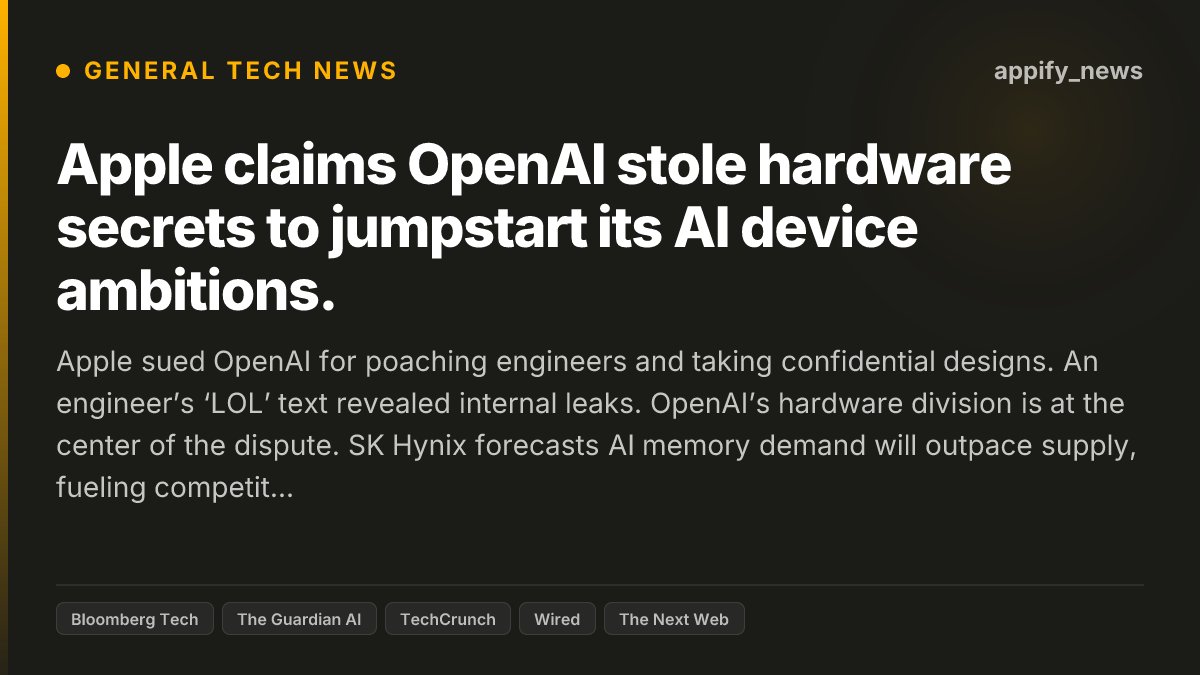
Apple sued OpenAI for poaching engineers and taking confidential designs.
An engineer’s ‘LOL’ text revealed internal leaks.
OpenAI’s hardware division is at the center of the dispute.
SK Hynix forecasts AI memory demand will outpace supply, fueling competition.
This lawsuit highlights the fierce race for AI hardware talent and IP, threatening OpenAI’s device plans long before any verdict.
How will this legal battle reshape the AI hardware talent war and innovation race?
#Apple
ChatGPT Atlas, launched in October 2025, is shutting down after less than a year.
OpenAI unveiled ChatGPT Work, an agent that can manage tasks across apps for hours.
GPT-5.6, now public after government approval, powers Microsoft Copilot and boosts cybersecurity.
New voice models let ChatGPT listen and speak simultaneously, mimicking real conversations.
OpenAI is shifting from experimental AI browsers to embedding powerful, persistent agents in workflows, signaling a focus on productivity and enterprise integration.
Will ChatGPT Work replace your current productivity tools or just add another layer?
#ChatGPT
Lyzr deployed an AI agent to handle investor outreach during its Series B round.
The round raised $100 million and was backed by Accenture.
Prime Intellect, a similar startup, just raised $130 million at a $1 billion valuation.
Enterprise AI agents face hidden costs and security challenges once in production.
AI agents are moving from pilot projects to real-world business drivers, reshaping how startups scale and raise capital.
How soon before AI agents become standard in fundraising and investor relations?
The first joint AI model could launch as soon as today. It’s internally pitched against Anthropic’s Opus 4.8 and OpenAI’s GPT-5.5. Cursor’s engineers are deploying AI agents inside enterprises, blending frontier tech with real-world use cases. This marks a new chapter for AI collaboration inside SpaceX’s ecosystem.
This signals a fresh contender in the AI race, blending startup agility with SpaceX’s scale. Watch how it shifts competitive dynamics among top AI labs.
Can SpaceXAI and Cursor’s model truly challenge OpenAI and Anthropic’s dominance?
Anthropic just launched Claude Cowork on mobile and web, expanding beyond developers.
Max subscribers get first access to this cross-device AI agent.
It keeps working after you close your laptop, bridging coding and knowledge work.
Linux desktop app arrives, but local AI still faces hurdles.
AI agents are evolving from developer tools to everyday productivity assistants, signaling a shift in user base and platform strategy.
How will mobile AI agents like Claude Cowork change your daily workflow beyond coding?
#ClaudeCowork
Expedia learned billions of AI predictions prove velocity without strategic discipline is a liability.
Roland Gavrilescu reveals how autoresearch enables self-improving agents but keeps humans central.
Microsoft’s 2026 Agent Confidence Index surveyed 300 builders showing trust hinges on human oversight.
NVIDIA highlights AI agents running code, tests, and queries autonomously—but only under governance.
The future of AI is hybrid: scalable autonomous agents paired with continuous human steering and governance.
How are you balancing autonomous AI agents with human judgment in your workflows?
AWS is investing $1B in embedded AI engineers to fix organizational gaps.
Enterprises juggle multiple AI platforms with no single owner accountable.
300 builders say human judgment still trumps AI agent confidence in 2026.
Security teams face silent disasters from AI-generated workflows they don’t understand.
AI’s biggest bottleneck is governance, not models. Control gaps risk costly outages and security breaches.
How can enterprises assign clear ownership to tame sprawling AI portfolios?
Nvidia offers AI cloud providers token credits in exchange for a cut of future sales.
Together AI raised $800M at an $8.3B valuation, backed by Nvidia and others.
Etched, a competitor, hit $5B valuation with $1B in AI chip sales.
Meta eyes cloud computing to monetize its AI investments.
The AI hardware market is shifting to flexible, revenue-sharing models, accelerating startup growth and reshaping AI infrastructure economics.
Will Nvidia’s pay-later GPU model redefine AI startup funding and hardware access?
#Nvidia