Let’s talk about cyberpunk. Has the game featured elements of this genre before? Oh, absolutely!
I’ll be drawing on several sources and backing up my points with screenshots. Together, we’ll explore some of cyberpunk’s defining features and see how they appear in the game.
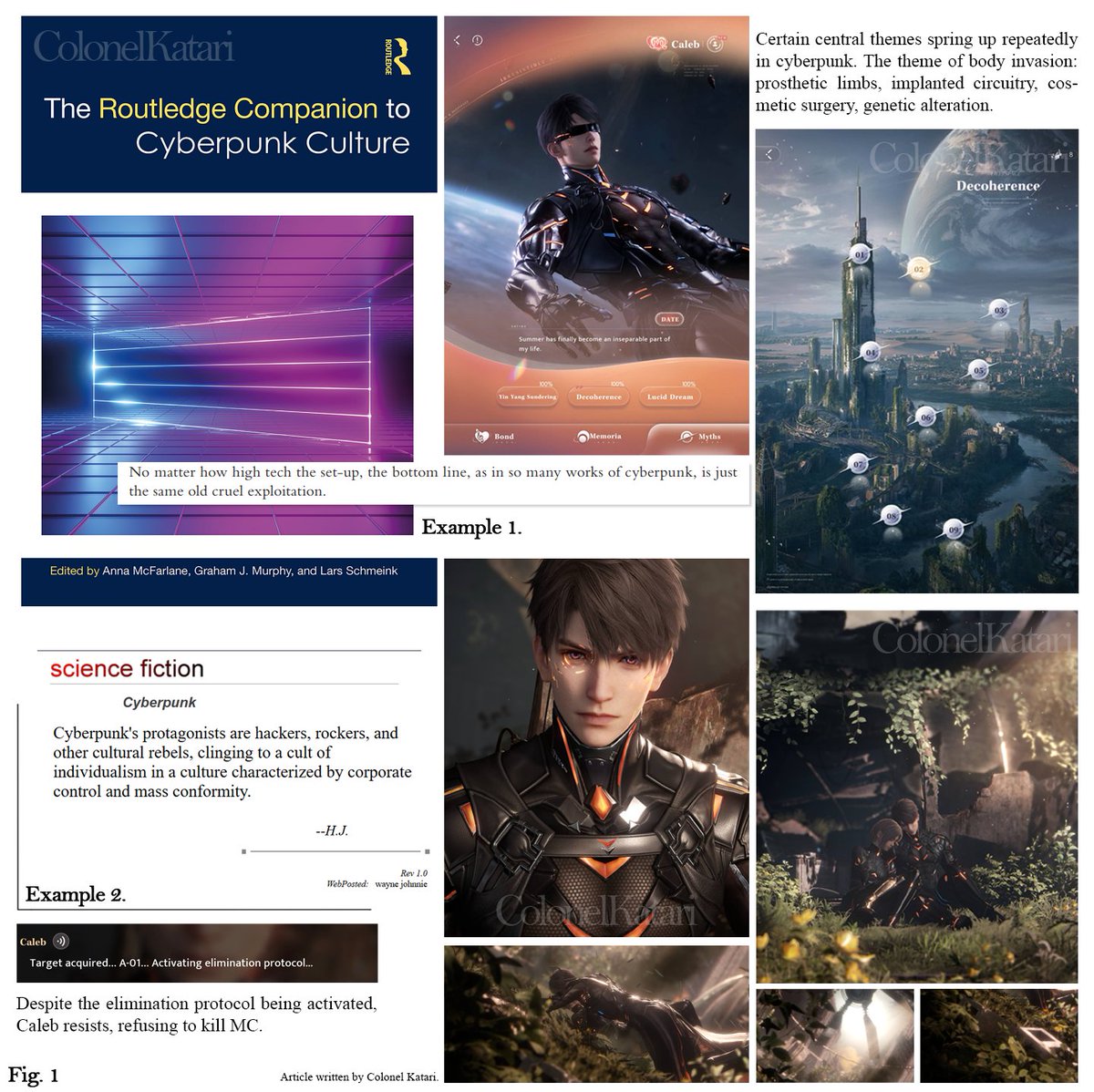
One of its central principles is “high tech, low life”: technological advancement takes priority while human well-being takes a back seat. People become subject to various forms of exploitation (Example 1 in Fig. 1).
This is exactly the kind of story we see in Caleb’s limited myth, Decoherence. After escaping the laboratory where they were turned into living weapons, the protagonists travel through the world and witness the conditions ordinary people are forced to live in. This world is doomed, so they decide to leave it behind in search of a paradise of their own.
This brings us to another characteristic of cyberpunk: characters resisting the system that dictates the rules of their world. This isn’t just speculation on my part: the quotation from popular culture scholar Henry Jenkins directly supports this idea. He discusses it in an overview published on the website of MIT, where he previously taught (Example 2 in Fig. 1).
To understand the world Caleb and MC inhabit in Decoherence, even the opening chapters provide a useful introduction:
Chapter 1 offers the clearest account of how this world operates. The capital’s luxury stands alongside the devastation of the rest of the planet. Those in power maintain their authority through surveillance and military force, while technology allows people to be turned into controllable weapons.
Chapter 2 shows the protagonists resisting that system. Caleb frees MC from the laboratory, and they fight their pursuers together to avoid being captured again.
As the myth approaches its conclusion, from Chapter 6 onward, their resistance only grows stronger. External struggles become intertwined with internal ones, and ultimately, the protagonists make a choice that the system programmed into them never anticipated.
To me, cyberpunk’s most striking visual hallmarks are implants, prosthetics, genetic modifications, neural interfaces, and artificial intelligence—technologies that affect human identity itself. If you’re interested, you can read the preface to Mirrorshades: The Cyberpunk Anthology by Bruce Sterling, a science fiction writer and one of cyberpunk’s founding figures.
But let’s get back to Caleb! Sterling writes in the preface: The theme of body invasion: prosthetic limbs, implanted circuitry, cosmetic surgery, genetic alteration.
Caleb’s very first solo Memory and teaser already showcase his mechanical prosthetic arm. We know quite a few things about it: it can detect another person’s vital signs, it was made using the finest materials and technology of its era, and rain won’t damage it.
Beneath its movable outer shell is a dark-colored chassis with delicate nanofibers winding around spokes and branching out like luminescent vines. The description also mentions flashes of red electrical current and pulsating synthetic fluid. The arm has a built-in emergency repair system: pressing a switch makes it restart, run a diagnostic scan, and repair itself (Example 1 in Fig. 2).
Caleb also embodies another theme Sterling identifies as even more significant: not just an invasion of the body, but an invasion of the mind. He has a Toring Chip implanted in him. We know a great deal about its effects, too. We’ve been learning about them since his earliest Memories, exploring the chip’s history further in Lucid Dream, and uncovering much of the information in the Trajectory Astray story branch.
Here’s what we know: the Toring Chip can reduce emotional instability and influence decision-making. Prolonged use has a corrosive effect on the mind, which becomes stronger the more a person relies on it. It is connected to the Fleet’s command system, the ship’s energy core, and the officers’ terminals, forming an integrated control network. When it switches to autonomous operation, the chip takes over the consciousness of connected individuals to prevent them from posing a threat.
The system’s core has a consciousness of its own: Norn. It can analyze neural activity and attempt to delete memories, isolate experiences, and reconstruct someone’s personality. In Caleb’s case, however, these attempts have failed to bring him fully under its control. His highest recorded synchronization rate was 93%, while the remaining 7%, according to Norn, is connected to MC (Example 2 in Fig. 2).
Let’s return to Decoherence as well. It embodies a particular strand of cyberpunk: the protagonists’ consciousnesses can be controlled remotely, and their bodies have been modified. We’ve already discussed the world around them.
Some of cyberpunk’s most defining features were therefore ALREADY present in the game. So the question of whether we would get a multi banner exploring this theme was less a matter of “if” than “when.”
I hope you found this article helpful! If you have trouble finding the original articles, feel free to message me, and I’ll send you all the materials. I’d rather not clutter the article with extra links.
事件視界 Event Horizon
「任何物質越高這個界限,他們將無法逃逸,被黑洞永恆吞噬。」
“Any material that crosses this boundary will be unable to escape and will be eternally consumed by the black hole.”
-
#러브앤딥스페이스#LoveandDeepspace#夏以昼#하우주#Caleb#マヒル