Paul Cassell, lawyer for Jeffrey Epstein's victims, couldn't find a working email for Attorney General Pam Bondi. In March 2025 he asked the federal victims office to forward his letter. The reply: OVC cannot act on this request. Bondi runs the Epstein case.
At a time when TV is global and sometimes a little faceless, BBC iPlayer remains distinctly British.
These are the best offerings in its catalogue ⬇️
https://t.co/38aDUvavfS
What’s happening in Europe right now is best explained in THE DELUGE, by Stephen Markley and THE MINISTRY FOR THE FUTURE. Read these books and see the furure.
To everyone so eager to cancel someone for a tattoo they got at age 22, a drunk text, a selfie they took in the middle of a mental health crisis:
Show us your laptop.
Show us your iCloud.
Open your entire digital life to your worst enemy. No context. No filter. No explanation.
You won’t.
You won’t because you know what I know. Any one of us, frozen at our worst moment, photographed in our lowest hour, looks like a monster. Looks like a stranger. Looks like someone who deserves to be cast out.
That is not who we are.
My mom and baby sister were killed in a car accident when I was just a kid. Cancer took my brother Beau, my best friend and my rock. I battled alcoholism. I battled addiction. I chose the coward’s way out more times than I can count.
For years I believed the defining chapters of my life were written by tragedy, loss, and shame.
I no longer believe that.
Pain can shape us. Loss can humble us. Failures can leave scars that never fully fade. But none of them have the authority to define us.
And it sure as hell ain’t the critic that counts.
That authority belongs to us alone-the person in the arena.
Every setback presents a choice. Play the victim, or cut the bullshit and take ownership for who we become next.
Life does not determine our character. It reveals it.
Again and again we are asked the same question. When shit happens, what next?
We are not defined by what happened to us. We are not defined by the worst photo, the worst text, the worst tattoo, the worst night. We are defined by the person we choose to become. And by the courage to choose that person, every single day.
So before you reach for the gavel - show us your laptop.
You won’t.
The whole world saw mine. And I am still here. Still becoming. Still choosing. Still standing.
That is the only definition that matters.
“Van Jones, go fuck yourself”
Michael Fanone: “Van Jones went on CNN last night and argued January 6th insurrectionists shouldn’t receive any of Donald Trump’s slush fund. Not because they stormed the Capitol on 1/6 and not because they beat the shit out of law enforcement officers, but because there’s other people who are more deserving. You can’t even make this shit up. Van Jones, go fuck yourself”
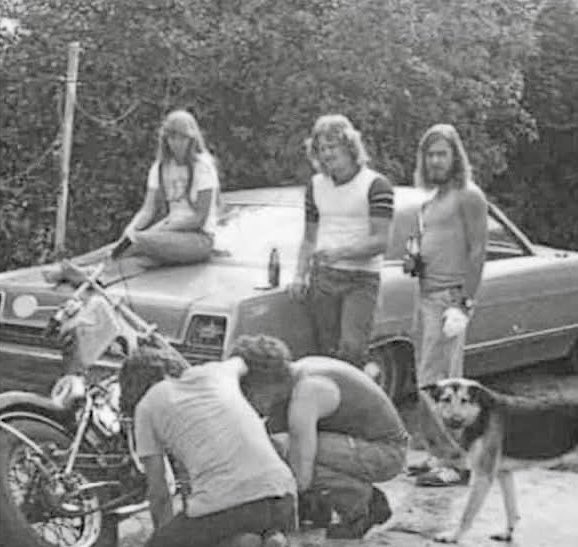
There’s a generation a lot of people forget exists. We were born at the tail end of the Boomers, but we are not culturally the same as people born in the 40s and early 50s. We are Generation Jones.
And honestly, it explains a lot.
We grew up in a world that still felt fundamentally analog, but we were young enough to be dragged headfirst into the digital revolution. We are the bridge generation between rotary phones and smartphones, between slide rules and AI, between Walter Cronkite and algorithm driven media.
We remember when there were only a few television channels and the entire country watched the same thing at the same time. We also adapted to the internet, email, forums, social media, streaming and now artificial intelligence. We lived before and after the technological singularity hit everyday life.
That is not a small thing.
People born in the 40s came of age in a post World War II America that was still industrial, deeply hierarchical and institutionally stable. Their formative years were shaped by the Cold War, Vietnam, the civil rights era and a society where information moved slowly.
Generation Jones came later. We inherited the aftermath of all of that.
We were the kids who watched Watergate destroy blind trust in government. We watched manufacturing begin to collapse. We saw divorce rates explode. We were the first truly latchkey generation in massive numbers. We learned independence early because many of us had to.
We grew up with one foot in old America and one foot in whatever this new thing was becoming.
We played outside until the streetlights came on but we also learned DOS commands. We learned cursive and keyboarding. We had card catalogs and Google searches. We went from vinyl records to cassette tapes to CDs to MP3s to streaming in one lifetime.
We remember maps. We remember memorizing phone numbers. We remember life before GPS and before every human interaction became filtered through a screen.
And because of that, I think Generation Jones developed a very unique perspective. We are adaptable because we had no choice but to adapt. We learned technology as adults instead of being born into it. We remember a slower world but were forced to survive in a rapidly accelerating one.
That creates a very different mindset than either older Boomers or younger Gen X and Millennials.
A lot of us also reject the caricature people now associate with “Boomers.” We were not buying houses for the cost of a sandwich in 1965. The interest rate on my first house was over 14% and that was after buying down a point. Many of us got hit by recessions, outsourcing, pension collapses and economic instability just like younger generations did. We watched promises evaporate in real time.
We understand older generations because we were raised by them. We understand younger generations because we had to evolve alongside them.
That’s why the Jones generation often feels culturally homeless. We are rarely discussed, rarely defined and usually lumped into categories that don’t actually fit us.
But we exist.
We are the human transition point between the industrial age and the digital age.
And frankly, there will probably never be another generation quite like us again.