This is bigger than it seems for the AI agents.
S3 Files lets you mount any S3 bucket as a native NFS on any container or lambda with ~1ms latency via EFS under the hood.
Why it matters for agents: no more copying data or bridging object <-> file abstractions. Agents can now read/write S3 directly as a mounted filesystem. Multiple agents can share the same mount with close-to-open consistency. Long-term storage becomes the same as the short-term storage.
Agent runtime bootstrap and teardown become trivial and instant while your data stays durable in S3 with auto bi-directional sync.
Announcing Amazon S3 Files.
The first and only cloud object store with fully-featured, high-performance file system access.
Learn more here. https://t.co/rNuWa5Rsi2
@Carlos_A_Wong This requires EFS under the hood which might require a heavy extension on minio side. LocalStack is likely more suited to achieve it faster. But, hopefully minio figures out a way to do this at a good enough latency.
@yorkeccak@claudeai Are you manually setting the CLAUDE_CODE_OAUTH_TOKEN somewhere? That's when you usually see this and usage along with other user-specific functionality also stop working. You will also see this if you have the Anthropic api key set somewhere in the environment.
@trq212 It still hangs in between very often. Hoping this release fixes that as well.
Do you have plans for a more native Github CLI or integration support soon? That would be a game changer for PR reviews/opening and moving faster!
@odysseus0z They allow custom "environments", but you can only add your environment variables to it 😅. Maybe on the roadmap. It will be very cool to have.
Claude Code on web/iOS is a big productivity unlock for small changes. But for bigger changes, the biggest blocker for me was not having the gh cli. Can't bring in GitHub context - no PR reviews, no issue management, no fine-grained operations. You end up pulling locally anyway which defeats the whole point.
Custom environments fix this: `gh auth token` → create new environment → network access "Full" → add GH_TOKEN env var. Remote session installs gh at runtime, picks up the token. Done.
GitHub-related skills now work from the browser/phone. No more local pull as an extra step.
@odysseus0z Yup, that's one way. Also, if you are running in full access environment, and if your skill mentions this in the setup, it is able to install it in the local container it is running on.
@trq212 Would it be possible to ask Claude to spawn a subagent with context:fork instead of specifying it beforehand? This can become really powerful for managing context more efficiently during sessions.
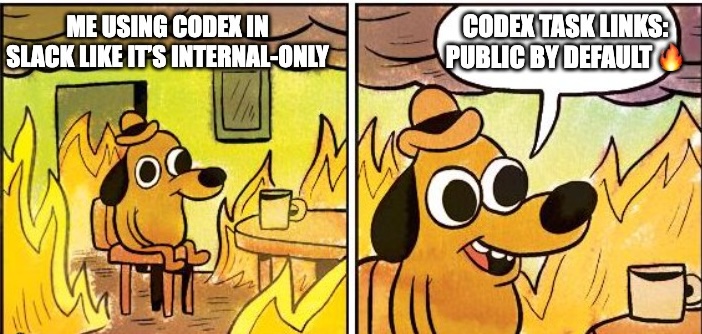
> opened codex web
> codex asks to integrate with slack
> me: why not? i can delegate all things directly from slack
> started a task from a slack thread
> codex returns the task link
> coworker opens the task link without any auth and is able to see everything
> tried the link in the incognito mode
> link still opens up with all of the code/details for anyone out there to see
> tried for 30 min to find a setting to disable this.
> found nothing
> manually disable links so far one by one
> disables codex in slack :(
> back to claude/codex duo in tmux
Announcing Worktrunk! A git worktree manager, designed for running AI agents in parallel.
A few points on why I'm so excited about the project, and why I hope it becomes broadly adopted 🧵
@thsottiaux Recent auto-compact changes might be the culprit here.
I noticed severe degradations usually after auto-compact runs and minor degradations from mid-session mini-compactions. Codex starts solving tasks it has already solved, drops tasks in the todo list, and gets confused.
📢 As promised ✨, we're open-sourcing LMUnit! Our SoTA generative model for fine-grained criteria evaluation of your LLM responses 🎯
✅ SoTA on Flask & BigGbench
✅ SoTA generative reward model on RewardBench2
🤗 Models available on @huggingface: https://t.co/rHe2Xl3wHH
💻 Github repo: https://t.co/Q7vVMG8EWH
📄 Paper: https://t.co/nonydlCszX
✍️ Blog: https://t.co/epyyUyp6hd
See more details in the quoted tweet👇
Tired of seeing O3 hallucinate? 😵💫
Today, I am excited to share how we built the least hallucinatory LLM in the 🌍
Our GLMv2, developed at @ContextualAI, just claimed 1st place 🥇 on the FACTS Grounded leaderboard by Google DeepMind — outperforming Gemini-2.5-pro, Claude 4, and O3 by 18%. 🤯
More details about our SFT and post-training recipe below 👇
1/N
Historically, unstructured data has dominated the spotlight in AI, while the mission-critical structured data that drives most enterprise workflows has remained under-leveraged, with few proven recipes for AI workloads.
Today, we’re changing that by fully open-sourcing Contextual-SQL, a state-of-the-art Text-to-SQL pipeline which ranks highly on the BIRD benchmark and you can run entirely on-prem.
A surprisingly simple pipeline delivers these results by leaning on two core ideas:
📖 Context beats parameters
DDL → mSchema (table + column comments) → mSchema + one few-shot example lifts execution accuracy from 54.7 % to 62.5 %. Before reaching for a larger model, enrich your schema docs and drop in a golden demo query.
📈 Scale at inference
Spin up 1000+ diverse SQL candidates in parallel, filter invalid queries with a fast sqlite3 check, then rank what’s left using a lightweight reward model built on the same Qwen base plus log-prob confidence. That single trick bumps pass@1 to ~73% -- cheaper and cleaner than fine-tuning.
The whole flow is just five step: generate → filter → rank → pick → run, and lives on GitHub. Fork it, point it at your schema and ship a private text-to-SQL solution.
For a deeper dive, code, and benchmarks, see Sheshansh’s thread and the full blog post below.
Excited to release Contextual-SQL!
🏆#1 local Text-to-SQL system that is currently top 4 (behind API models) on BIRD benchmark!
🌐Fully open-source, runs locally
🔥MIT license
🧵