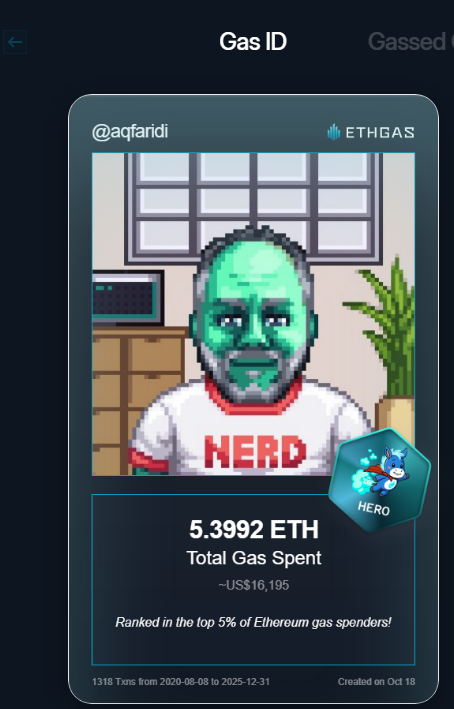
Just unlocked my Gas ID via ETHGas 🪪
I'm a Hero Jack with 5.3992 ETH spent on gas since Beacon Chain - now fueling my climb to the Gasless Future and earned 3500 Beans already.
Reveal yours at https://t.co/YLt4bdodNb
@ben_cascade I have 2 simple queries for cascade : where can I find more about kevin (cofounder of cascade) ? There is no information available.
why they are doing pre-allocation Points mining without Testnet launch of product ?
Thanks.
@rainyo @cascade_xyz I have 2 simple queries for cascade : where can I find more about keven (cofounder of cascade) ? There is no information available.
why they are doing pre-allocation Points mining without Testnet launch ?
Privacy matters: (another very long tweet)
I'm trying to explain the difference between TEE, ZK, MPC and FHE. If we're talking privacy, security and blockchains, this is important to understand.
Last time I explained TEE, today I'll explain ZK:
📚
ZK stands for Zero Knowledge.
Among the technologies I’m surveying (TEE, ZK, MPC, FHE) it's the most mature and battle tested one in blockchain settings.
- @Zcash has been using ZK for privacy since we launched it in 2016 (the whitepaper we wrote on which it's based is from 2014).
- @StarkWareLtd has settled over $1.4T on STARK technology since 2020, scaling Ethereum and Bitcoin, and saving users over $1B in transaction fees.
Why am I mentioning this?
Because no other technology surveyed here is as battle-tested and used as ZK.
ZK has two super-powers: Privacy and Scalability.
How does it work?
There are two types of entities: A ZK prover and a ZK verifier. There is a separation of powers between them.
1. The prover does the heavy lifting -- it collects the data about all relevant txs, processes them, updates the state of the system based on these txs, and spits out a statement, and a proof.
- A typical statement says "I, the prover, have started with state A, processed 1,000,000 transactions, and based on those, reached state B".
- The proof is a short sequence of numbers and hashes that *proves* the integrity of the whole statement.
2. The verifier checks the proof to see if it's valid for that particular statement. The verifier typically sits onchain.
The way a verifier works is by using math and cryptography, and I won’t explain it here. But suffice to say that the theorems we’ve proved about ZK over the years say that the verifier always accepts true statements and never accepts false statements (more precisely -- a malicious prover who wants to convince a verifier to accept a false statement has to do a similar amount of work to finding a collision in a cryptographic hash function, which cannot be done before our Sun cools down).
Once the verifier checked the proof, the statement can be accepted.
ZK is really good for allowing a single user to shield their data, and for scaling blockchains.
Privacy is what we used it for on Zcash, and Scalabilty is what we (and, following us, others) use it at StarkWare.
Note:
ZK also has a safe, ergonomic and efficient smart contract language (Cairo). Developers can write and execute any smart contract offchain and guarantee its integrity onchain. You can write programs in Cairo (and in other languages) that you can prove in ZK.
Challenges:
- When it comes to UX and composability of smart contracts, it gets messy.
- When there’s a computation that involves confidential data from more than one user, ZK isn’t good at solving it.
For that you have to use a generalization of ZK called secure Multi Party Computation (MPC, I'll explain that too).
Not impossible, but requires work.
Next time: MPC.
The END.