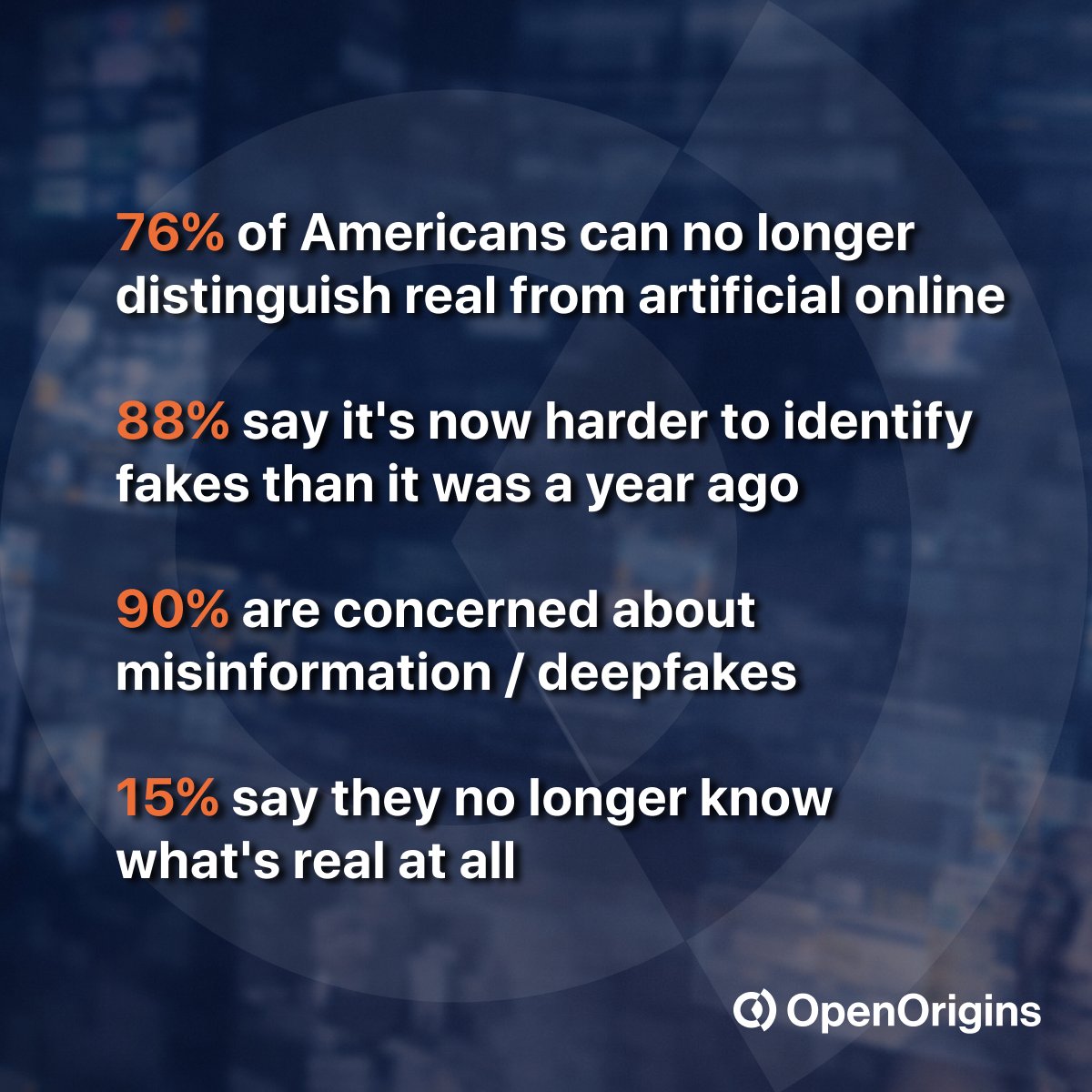
People don’t trust what they see online anymore.
Not because we got worse at spotting fakes, but because synthetic media has gotten better than the systems we use to detect and/or verify it.
The internet was not built to prove origin.
Introducing OpenOrigins Source, a new mobile app that gives creators, journalists, and platforms the ability to prove their photos and videos are real from the moment of capture.
The free app targets the surge of generative AI images and deepfakes that are now flooding social media channels with images and videos that are virtually indistinguishable from reality.
Your content is only as valuable as the trust people place in it.
Download on iOS or Google Play today.
https://t.co/v48FdwuE1u
Here's a nice Valentine's Day statistic - according to an FBI report cited in this article, Americans lost a staggering $672 million in romantic scams in 2024. AI-produced deepfakes are reportedly driving this number up fast.
The article goes on to list the standard precautions for spotting deepfakes, but when a coin flip is basically twice as accurate at spotting deepfakes as a human, well... good luck.
Another great use case for the trust lane and cryptographically authenticated proof of origin.
From @WLWT
https://t.co/Paoal6bFpR
Great article @a16zcrypto AI needs blockchains, but the bottleneck has always been consensus at scale. We’ve been working on this problem for some time and are pretty confident we've solved for it with a new, novel decentralized data structure and consensus infrastructure @OpenOrigins
Full @BBCWorld segment from today's coverage featuring @BBCMaryam and @OpenOrigins CEO and Founder @hu_manny_ty.
Listen to featured guest Dr. Manny Ahmed address the growing impace of AI slop in social media.
Check out this expertly written in-depth article from @BBCNews by @joetidy featuring @OpenOrigins CEO and Founder @hu_manny_ty.
For better or worse, AI-generated synthetic media is here to stay. The question is, what are we doing to ensure trust maintains a durable, verifiable lane on the Internet? https://t.co/7l8C9ZK6Tn
This opinion piece by @LloydMathias gets to the heart of the problem. Platform moderation reacts after content spreads, and regulation lags even further behind. What’s missing is verifiable origin.
If you can verify who originated a piece of media, you'll be able to judge credibility, assign accountability, and/or stop the coordinated abuse.
It's the difference between a reactive and proactive strategy.
https://t.co/IxO1DZSzaj
Who’s better at identifying high-quality, photorealistic deepfakes — a human, or a coin flip?
Fact: Humans detect high-quality deepfakes only about 25% of the time. Essentially, we're twice as wrong as a coin flip when it comes to detecting high-quality deepfakes.
If your company's synthetic media strategy relies on human judgment, you might as well pick up a roll of quarters. Or better yet, let's talk about how to prove the origin of authentic content in the first place.
I love @EthereumDenver. This will be my 5th consecutive trip to Mile-High for what I consider to be one of the top 3 crypto conferences in the world. It's also the conference with the most exciting weather, except that one time Dubai flooded. You never know what you're going to get.
But one thing is for certain at ETH Denver - you're going to be in the company of the best and brightest minds in crypto, and there will be multiple mind-blowing achievements on display.
This year, I'm particularly excited to be representing @OpenOrigins. Our mission is to build a trust lane for the internet, enabling every digital asset and interaction to prove its authenticity independent of where it lives, how it is shared, or who controls it. I love our mission, and I will be looking for partners and builders who want to join us on our journey. I'll be joined by CEO and Founder, @hu_manny_ty, and President and Co-Founder, @ariabelson.
As always, it will be great to connect with old friends and make new ones. I've always said that crypto is the most social-driven industry I've ever worked in. Which makes sense since most of us work remote and conferences are typically our only chance to meet colleagues, customers, and partners in person. It's also pretty awesome to network and not have to explain what crypto is.
Hope to see some of you there!
This is the problem we’re working on at OpenOrigins: making it possible for people to verify the origin and integrity of digital media before real-world consequences follow.
@6abc and @chadpradelli
https://t.co/lssqLnUr4Q
Topping this week's "not so nice" list is a story about scammers using AI-generated voices to impersonate pastors to target religious communities for financial fraud. It's a reminder of a couple of cold, hard facts: 1. criminals have zero morals when it comes to scams, and 2. these attacks work because they exploit existing trust. When belief replaces verification, even close-knit communities are vulnerable. Trust > Trust Me.
Published by @WIRED | By @mattburgess1
https://t.co/Dki4Pvh07V