BREAKING EXCLUSIVE: I have come across an internal letter from Kisumu’s politically connected Chatthe Group to the Kenya Sugar Board that exposes a textbook blueprint for regulatory capture—disguised as "localisation" policy.
On the surface, Chatthe Group proposes refining locally produced sugar instead of importing raw sugar. Look closer at the fine print, and their demands would crown a single company the undisputed gatekeeper of a critical industrial input:
A full 25% import duty on industrial refined sugar ▪️ Scrapping the Duty Remission Scheme ▪️ A non-creditable Sh40/kg excise duty on imports ▪️ Strict restrictions on licensing rival refineries ▪️ Merging Kibos White Sugar Factory and Kibos Refinery into one operation
Kenya has a legitimate interest in boosting local refining—especially with Parliament already probing the alleged diversion of imported industrial sugar (claims Kibos/Chatthe deny).
However, industrial policy is not the same as handing one conglomerate a state-protected monopoly. Merging Kibos’ operations while shutting out new refiners and pricing out imports doesn't "level the playing field." It erects a private tollgate over an essential input.
If the government accepts the proposal by the group,, Kenyan beverage, confectionery, and pharmaceutical manufacturers will be left with zero bargaining power—forced to absorb higher costs, supply bottlenecks, and lower quality standards from a single dominant supplier.
This fight is already boiling over: the High Court recently certified as urgent a Kenya Association of Manufacturers (KAM) petition challenging the Finance Act 2026 hike of industrial sugar excise duty from Sh7.50 to Sh40/kg, warning it threatens jobs and competitiveness.
Taxing imports doesn't automatically serve the public interest when one firm controls the domestic supply. True localisation builds a competitive industry; regulatory capture just enriches a monopoly at the expense of Kenyan manufacturers and consumers.
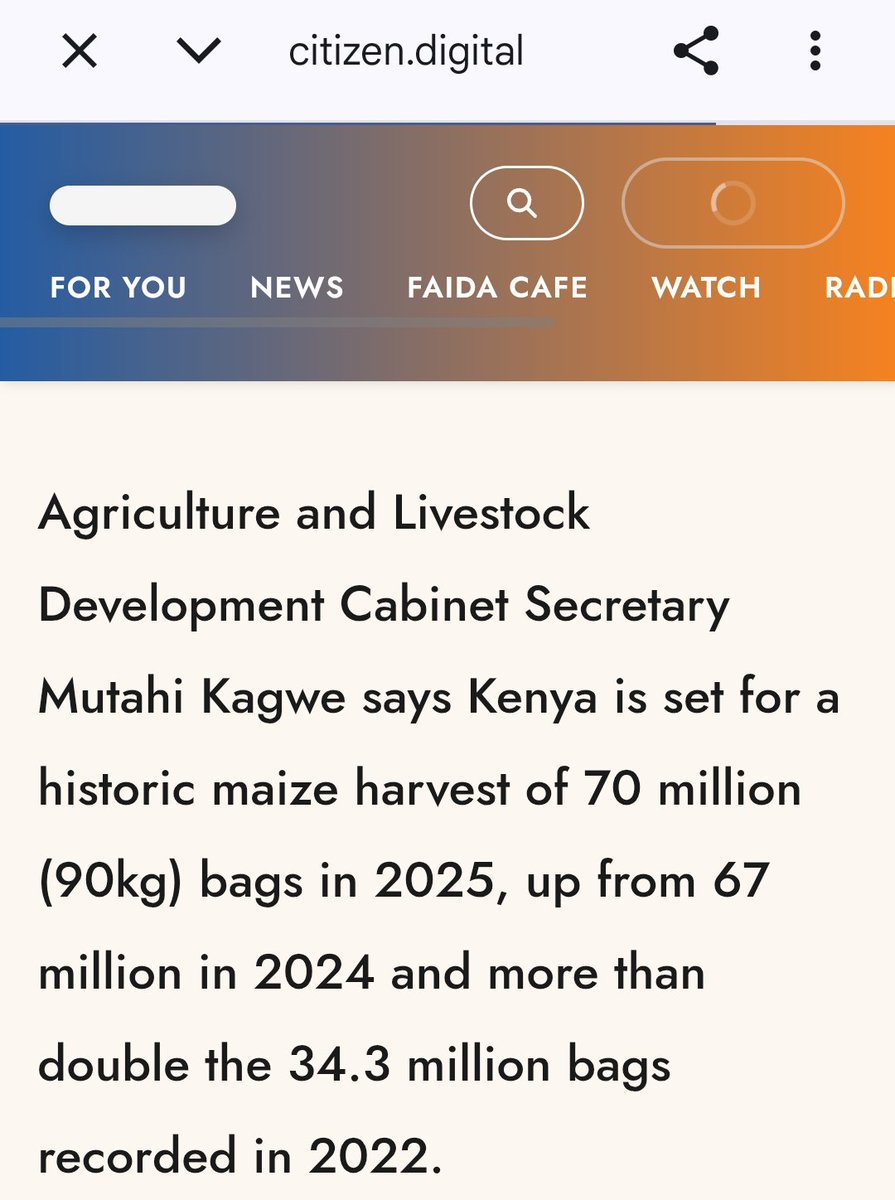
@WehliyeMohamed@DonaldBKipkorir I am more worried about the discrepancies between the figures presented by Ruto, his officials and KNBS. These are not minor statistical variations.
They point to a deliberate pattern of misrepresentation, with the regime repeatedly advancing inflated production figures.
@LegisLady Highly recommend that everyone watches interviews done by @otienowill@OkiyaOmtatah@JimiWanjigi on debt. Sit and watch as many of them as possible! You’ll sit and think straight before making a decision on your 2027 vote
It is only in General Elections year that Maa leaders wear tribal clothes …. For the other four years, they are in suits & helicopters! The cyclical hoodwinking of Maa Community once in every five years is very cynical. Maa Community remains behind in every development indicator. But they keep electing those that “become like them only on elections year”!
This one was Hot, ati the only hustler amepewa kazi na Ruto ni Gaucho a goon😂, Affordable thinking, Wanjiku Thiga whueh, ati Hell is an understatement,ati I don't think even the devil Is proud of Ruto, Walubengo cooked them soo hard 🤧
We now need a public accounting of the commitment fees paid, the legal status of the procurement award, any termination liabilities, the total funds already disbursed, and the rationale for abandoning a concessional JICA-financed project in favor of an alternative model.
The Mombasa Gate Bridge was designed to connect Mombasa Island with the South Mainland across the Likoni Channel, relieving or replacing reliance on ferry services.
This setback fits a familiar pattern of Japanese concessional financing: standard procurement begins, late changes to commercial terms are introduced, and a diplomatic dispute over project control follows. A similar rift occurred in 2015 over the concession for the Japanese-financed second container terminal, which ultimately required a fresh tender after the original process collapsed. In the case of the Mombasa Gate Bridge, the National Treasury has now directed the cancellation of the JICA financing arrangement altogether.
Likoni's transport infrastructure has a history of high-cost failures. During the COVID-19 pandemic, former President Uhuru Kenyatta commissioned the Sh1.9 billion Liwatoni Pedestrian Floating Bridge in December 2020 to ease congestion at the crossing. However, the bridge was shut down on July 1, 2023—less than three years later—after the Kenya Ports Authority claimed it obstructed shipping lanes and interfered with 24-hour port operations.
Likoni residents are once again left facing longer commute times and severe ferry delays. While the government argues that completing the Dongo Kundu bypass eliminates the need for the bridge and solves long-term mobility issues, the fact that a Sh1.9 billion public asset was rendered obsolete within three years remains a critical failure of planning and oversight
Mr 6 Months, your lies and deception can no longer fool the people of Kenya. Not a minute more, ndugu.
Yesterday, I called you out for going to cheat my cousins in the Gusii Nation. Even tomorrow, I know the lies you are going to spread. The only thing you are doing is an old script of memorizing names of villages and roads in Kisii and Nyamira. This is an old tired script you used in 2022. What a horrible playbook!
In four years, you have done nothing for them. No roads, no water, no electricity, no airport, nothing.
ZERO!
All you have are more lies and handouts. RiggyG is not a road in Kisii or Nyamira. Rigathi is not a water project. Gachagua is not an airport. The truthful man is not a rural electrification project.
I am sorry you have nothing to tell my cousins. Maybe you should re-launch the cancer hospital you have launched five times, two of them in my presence.
Leave DCP aspirants alone, or you will get another egg in the face, just like when you tried to con the widow and children of my late brother, Governor Gachagua.
I told you in advance that I would teach you real politics.
The half dose I gave you in Olkalou was just a dress rehearsal.
I am preparing the full dose to administer intravenously on 10th August 2027. You will not believe the lethargy. It will be cruel, fast and furious.
We shall apply a double Olkalou template in all 290 constituencies across the country. You will have no escape route to rig the elections, intimidate any public servant, or misuse our police service or any state agency. For your information, they are also waiting for you. Every time they look at their payslips or try to access medical care, they vow to retaliate at the ballot on 10th August 2027.
You shall vacate State House in shame and humiliation.
That is my promise to you and the country!
Adios!
Jaindi Kisero
I have come across a letter from the National Treasury directing the state department of roads to immediately cancel all project-related commitments; including contracts procurement processes; consulting arrangements; and any other obligations on the multi billion Japanese funded Likoni Bridge project.
This development is a statement of the increasing political influence of Chinese contractors and the strong links with incumbent elites.
It is a big anti climax. First, the project has been running since 2019. Secondly- designs were done and consultants are already in place. The first tranche of the loan was disbursed. Advance payments flowed to consultants. A procurement competition was run to its conclusion. A winner emerged. And then — nothing. For nearly two years.
I am inclined to agree with a cynical opinion of an insider who has been following the shenanigans around the Likoni Bridge project for a long time who says ‘when they are unable to get a good cut or backhander on a project, they turn to the Chinese”.
For sometime now and to set the stage for cancellation of the deal with the Japanese; a new narrative was floated within government circles: that the project is too expensive and the financing model should be rethought. That Kenya could instead mobilise domestic resources—pension funds and institutional investors—through an infrastructure fund model. That a securitisation structure, possibly involving a Chinese contractor, could deliver the same project more cheaply.
Each argument is very controversial. Pension fund money carries market return expectations — a far higher cost of capital than 0.1 percent interest, the 12-year grace period, a 30-year repayment window, and an outright grant element worth Sh 6 billion which the Japanese had committed.
Yes, a securitisation transaction with a Chinese contractor may be an option. But it embeds financing costs inside the construction price, making it opaque and almost always more expensive in aggregate. Do we really want to hand back the Sh 6 billion grant element on the Japanese loan?
Then there is the diplomatic cost, which is being ignored. Whem the Jpanase foreign Affairs Minister, Mr Toshimitsu Mogei visited Kewnya in May,the Likoni brifdge wasa top agenda item. Japan helped author the Mombasa master plan. Japan is funding the ongoing rehabilitation of Mombasa Port. Japan designed the Dongo Kundu Special Economic Zone as the flagship of Kenya's entire SEZ programme — the first domino in a sequence intended to include Naivasha and Kisumu.
Cancel this credit, pivot to a Chinese deal, and we must look Tokyo in the eye and explain ourselves. We must be prepared for the consequences at the port, at Dongo Kundu, and in every future ODA conversation with an ally cultivated over decades — all to spare someone the inconvenience of a transparent procurement outcome they did not control.
Grand corruption does not always arrive with a smoking gun. Sometimes it arrives as a memo recommending delay. Sometimes it wears the language of fiscal prudence and alternative financing mechanisms. Sometimes it sits in a procurement committee and does absolutely nothing.
Suddenly, there is so much fresh milk in the supermarkets ..
Affordable Housing workers must have gotten better alternative to milk. Thank God for their change in taste!
How does Nairobi United, a team with just two titles, Division one trophy and Federation Cup victory, land a staggering Kshs 380,000,000 million sponsorship from a betting firm under Kenya Revenue Authority investigations for fraud and tax evasion?
What business is SportyBet doing with Nairobi Governor Johnson Sakaja that is worth Ksh. 126m per season in sponsored deal with Nairobi United?
What optics are these? Is Nairobi Governor Johnson Sakaja just laundering money through SportyBet Kenya and Nairobi United though his foundation?
How profitable is SportyBet Kenya that is can afford a staggering individual club shirt-sponsorship contract in Kenyan Premier League (KPL) history—even surpassing what title sponsors like SportPesa distribute to the ENTIRE LEAGUE ANNUALLY?
Where is the Kenya Premier League "Financial Fair Play" policy? As much as this suspicious deal injects the much-needed liquidity into Kenyan football, it stinks of massive corruption and money laundering. Nairobi United is currently winless after five rounds of the 2026/27 season and this deal attempts to offer a marketing and brand mouth-to-mouth resuscitation to a club whose book and commercial value is unknown. SportyBet Kenya is basically attempting to brand Nairobi United as a high-value outfit, worthy of a multimillion shillings investment and urging other sponsors to raise their financial stakes across the league.
President William Ruto recently confirmed co-ownership of the team, through his son's investment arm, by boosting the club's liquidity through a KSh 10 million personal investment. Additionally, the team also has a front-of-shirt partnership with Hass Petroleum reportedly valued near KSh 100 million per season.
Does this axis of William Ruto and Johnson Sakaja explain a record-shattering KSh 380 million, three-year deal that redefines the financial landscape of local club footbal?
Addendum
Sporty Group, which owns SportyBet Kenya, is the parent multimedia and technology company behind SportyFM. In Kenya, SportyBet Kenya is owned by
Dreamhub Technology Limited, registered a private company in Kenya. Anyone wishing to see the local shareholders can query their Company Number: PVT-8LU7YAXP.
Wanna read more about Dreamhub Technology Limited? Check out Constitutional Petition E423 of 2025 (Dreamhub Technology Limited v Betting Control and Licensing Board & another [2026] KEHC 3021.
MBADI SHOULD NOT BE A MINISTER IN OUR GOVERNMENT
Very Sad that our Finance Minister Mbadi is still in office when the only policy he espouses when he speaks in Dholuo is asking the Luo Nation to lock out Kikuyu. Why hasn’t EACC, DCI & NCIC not summoned him? How can a Minister be preaching tribal hatred every time he is in his village?
Mbadi doesn’t deserve to be our Minister as he has shown he doesn’t want Kikuyus!
Malavida Enterprises was registered on 21 October 2026. It opened a bank account on 27 October 2026 and received a Borabu NG-CDF cheque of KSh 1,070,000 on 29 October 2026. KSh 970,000 was withdrawn in cash immediately
Tiasenya Enterprises was registered on 27 October 2026. It opened a bank account on 30 October 2026, it received KSh 2,900,000 on 4 November 2026.
Immediately KSh 2,400,000 withdrawn in cash.
Tiasenya is Nyasetia read backwards. Jonathan Ongera is a brother to the deputy accountant at Borabu NGCDF office.
Rigathi Gachagua is the King or Kingmaker of the next General Elections …. He controls over 6m solid votes!
Only President William Ruto, Kalonzo Musyoka & Edwin Sifuna understand this.
Anyone who doesn’t understand the raw power of Gachagua is a political moron! Abusing Gachagua is like a piglet tickling the b*lls of a rained lion!
Answer the people!. From carwash to Nyalenda, Kisumu deserves explanation not political silence. Joshua Oron you're always engaged in alot of political fights. You should answer this.