As reality catches up to our imagination, we'll see the contextual fusion of multiple imaging data types, and all at once, the whole patient picture will be formed before you. #AugmentedReality#MixedReality#SpatialComputing
@EMostaque Through creativity. Many of the products and markets that exist today are a result of having more time than we know what to do with in the aftermath of the agricultural revolution.
A “ready player one” type scenario isn’t out of play here with proper blockchain integration.
@hubermanlab Hey Andrew - don’t comment often unless it’s important. I sleep on a Tempur-pedic bed and I find it’s often too soft/throws my spine out of alignment vs sleeping on the floor w a blanket underneath. I feel this is largely under discussed! Any thoughts helpful
Consider a young but bright kid, who's about to play chess for the first time after studying the rules, facing Stockfish 15 as an opponent.
"Why are you so sure I'll lose?" asks the kid, who happens to be a boy. "The game AI and I start with the same pieces. We both know the rules of chess. I get to move first, which seems like a big advantage."
"Stockfish 15 ranks at ELO 3700 and world champion Magnus Carlsen ranks at ELO 2882," you reply.
"What do those numbers even mean?" says the kid (who really is quite bright).
"Interesting question," you say. "I'd say—it measures the player's ability to achieve their desired outcomes, against the efforts of an opposing player, with equal resources, under equal rules. By choosing *which* move to make."
"That sounds kind of weird and mystical and abstract," says the kid. "Can you tell me *how* Stockfish is going to beat me, when it doesn't have any more or better chess pieces than I do, or any better knowledge of the rules?"
"No human being could reliably predict how Stockfish will defeat you," you reply, "even if we knew exactly which moves you'd make yourself in every situation. If I could predict exactly where Stockfish 15 would move, I could defeat Magnus Carlsen just by making the moves I'd predict Stockfish would make. Maybe if your moves have sufficiently straightforward vulnerabilities there'll be an obvious way to exploit those, as seen by a human grandmaster; but Stockfish can search more moves than any human can, better than we can, and it might find an even better way to defeat you."
The kid rolls his eyes at all this worshipful talk of Stockfish and how it's better than he is. "Have you ever seen Stockfish play?"
"Actually, no," you reply honestly. "I'm nonetheless *very* confident in its ability to defeat you."
The kid rolls his eyes again, and starts by moving his queen's bishop's pawn, so he can get his queen out onto the board and start capturing enemy pieces—as soon as there's one that's not defended under the chess rules, that is. "How about if I move my rook over here?" the kid says, a few moves into the game. "Then the AI will try to take it with its queen, and I'll come in and grab the queen. How will the AI win after I've got its queen?"
"Okay, now you're failing at putting yourself in the AI's shoes and asking how to win from its position, even using *your own* intelligence," you tell the kid. "You're imagining the chess AI as doing things that you wouldn't do in its shoes; *you* think the AI loses if it grabs for your rook, but you're not imagining the AI as knowing that. You're evaluating everything from the perspective of how it could turn out well for you, but not from the perspective of an opponent who sees everything you see and wants you to lose."
"Oh," he says, "so you're saying the AI can read my mind? That just sounds like magic."
"Well, *this* AI can't read your mind," you say. "What I'm saying, rather, is that it can think of at least everything you can, and probably a lot more. So any time you ask what Stockfish sees in the chess game's state, you have to assume it sees *at least* what you see. There's a learnable mental motion for it, like not just running out to put your life savings into Microsoft stock as soon as it occurs to you that Microsoft makes a lot of money selling Windows, because you realize that the broader market already knows this and the price of Microsoft stock already takes into account their Windows revenue stream."
The kid is now ignoring you. He makes his moves, quickly by chess standards, though the kid doesn't seem to realize he's moving fast...
The game ends quickly. Faster than you expected, even having some abstract idea of Stockfish's cognitive abilities.
"I see what I did wrong," says the kid. "Let me try again, this time I won't—"
"Sorry," you say, putting the chess board away. "It's the nature of this game that you only get one try at playing it, ever."
In 1985 an astronaut noticed this physical behavior of a handle, that turned out to be the proof of a theorem: the tennis racket theorem (also dubbed the Dzhanibekov effect)
[read more:https://t.co/o1UHtQgCyt]
[video, HD: https://t.co/ra15T3YmW4]
In 2000, at the depth of the dot com crash, Reed Hastings and I tried to sell Netflix to Blockbuster for $50 million dollars. They laughed us out of the room.
Today, the company they could have bought for $50 million has a market cap north of $150 billion. And the company that once had 9,000 stores, is down to a single one.
But what lesson to take from this?
That it’s possible for a handful of people, with no prior experience in the video business, to take down a 6 billion dollar category leading company? Sure.
But I think the more important lesson - a lesson that Blockbuster learned too late - is simply this:
If you are unwilling to disrupt yourself, there will always be someone willing to disrupt your business for you.
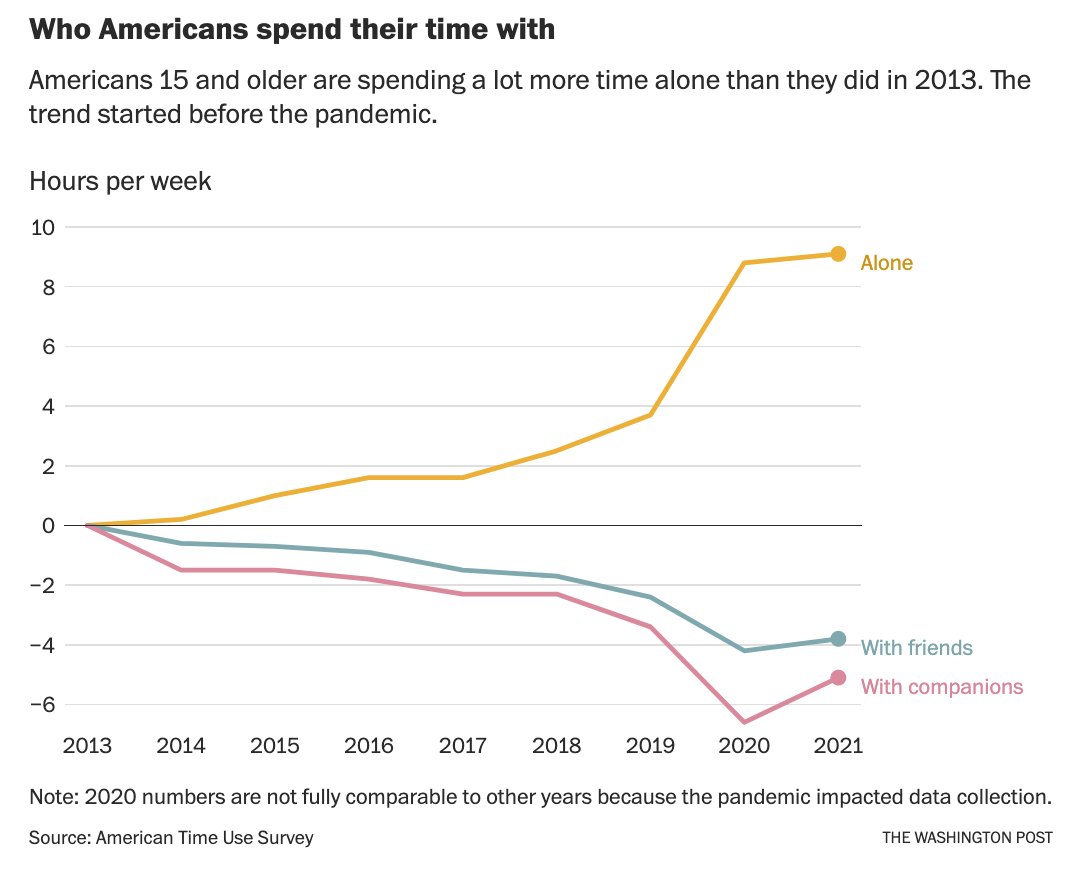
There is a 100% chance that this graph is a core reason for America's surge of anxiety and depression.
Time spent with other people has plummeted—for every age group, ethnicity, gender, geography, and income level.
https://t.co/trjGX8kYKo
You don't protest, so you think the Public Order Bill - the most repressive legislation of the modern era - doesn't affect you?
If so, I'm sorry to say that you couldn't be more wrong.
*Please* watch this. You need to know.
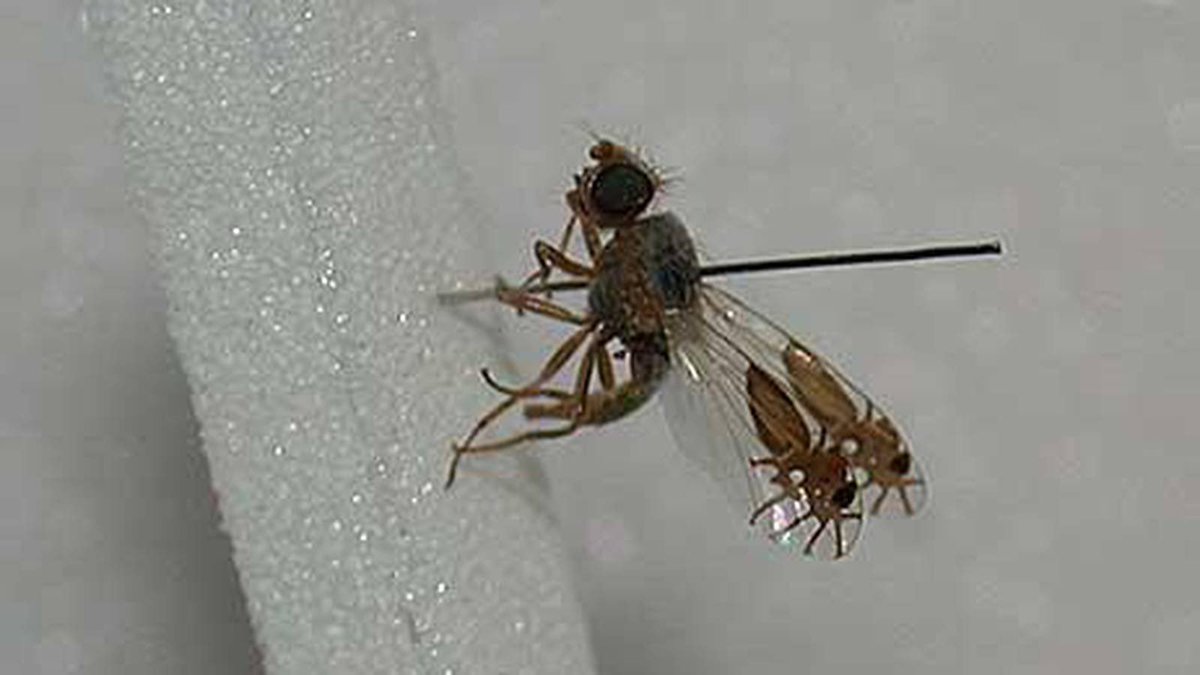
Look at the wings of this fly
It’s called Goniurellia tridens, each wing has a detailed image of an ant, flashing its wings gives the appearance of ants walking
Most of its predators would want to avoid a confrontation with the stings of ants 1/🧵
📸 https://t.co/ewQJvzEm2I
Despite their extremely futuristic appearance, skeletonics extend the movement of a humans arms and legs without the aid of any motor and it's not powered by electricity
[source, full video: https://t.co/5DdGGoeO8J]
[read more: https://t.co/ds9fdaceJd]