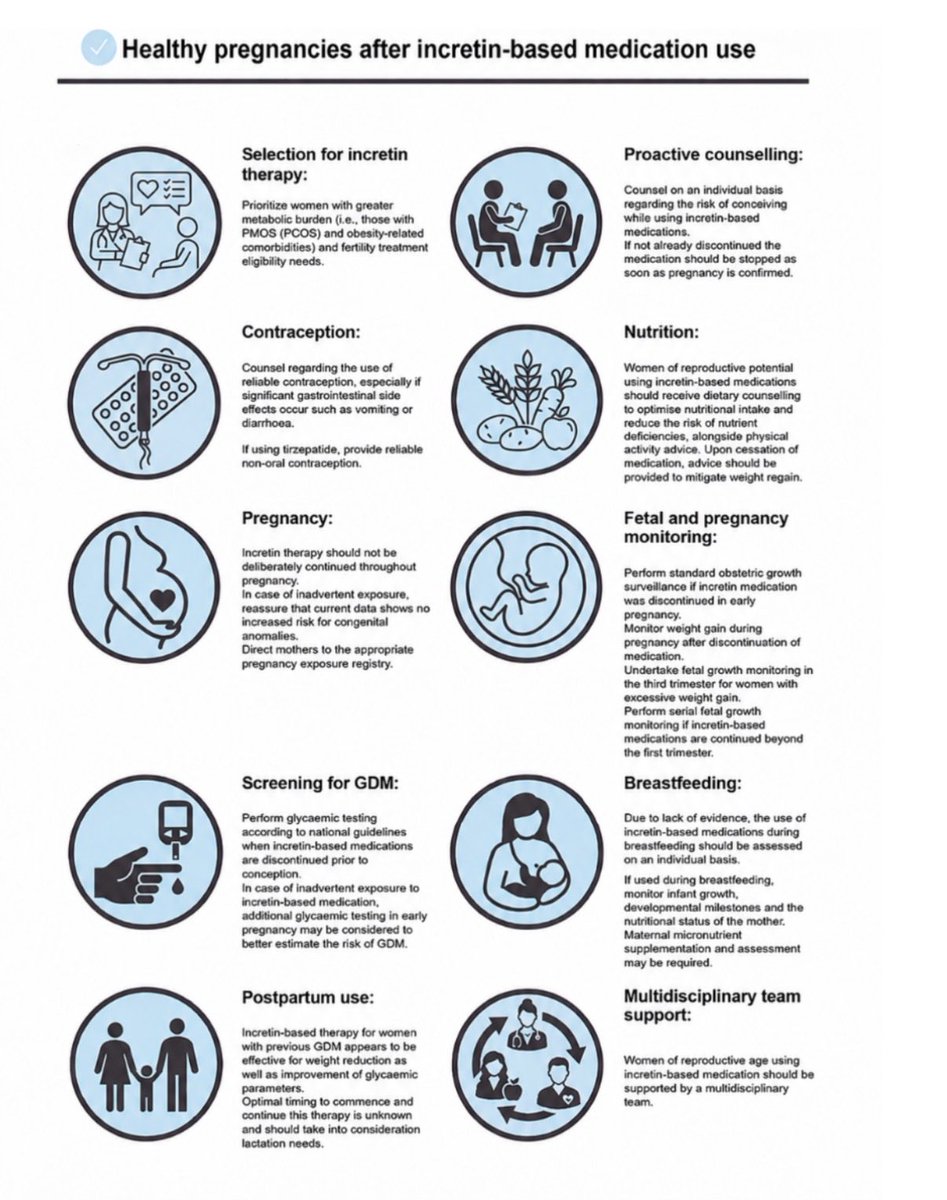
Incretinas y reproducción: nueva revisión + guía de consenso en Obesity Reviews.
34 estudios. Evidencia para 18 de 32 preguntas clínicas.
~1.500 embarazos expuestos, sin aumentar las malformaciones congénitas.
Los bebés GLP-1 ya están aqu��; la evidencia llega detrás.
🔗 https://t.co/08B1srUGUd
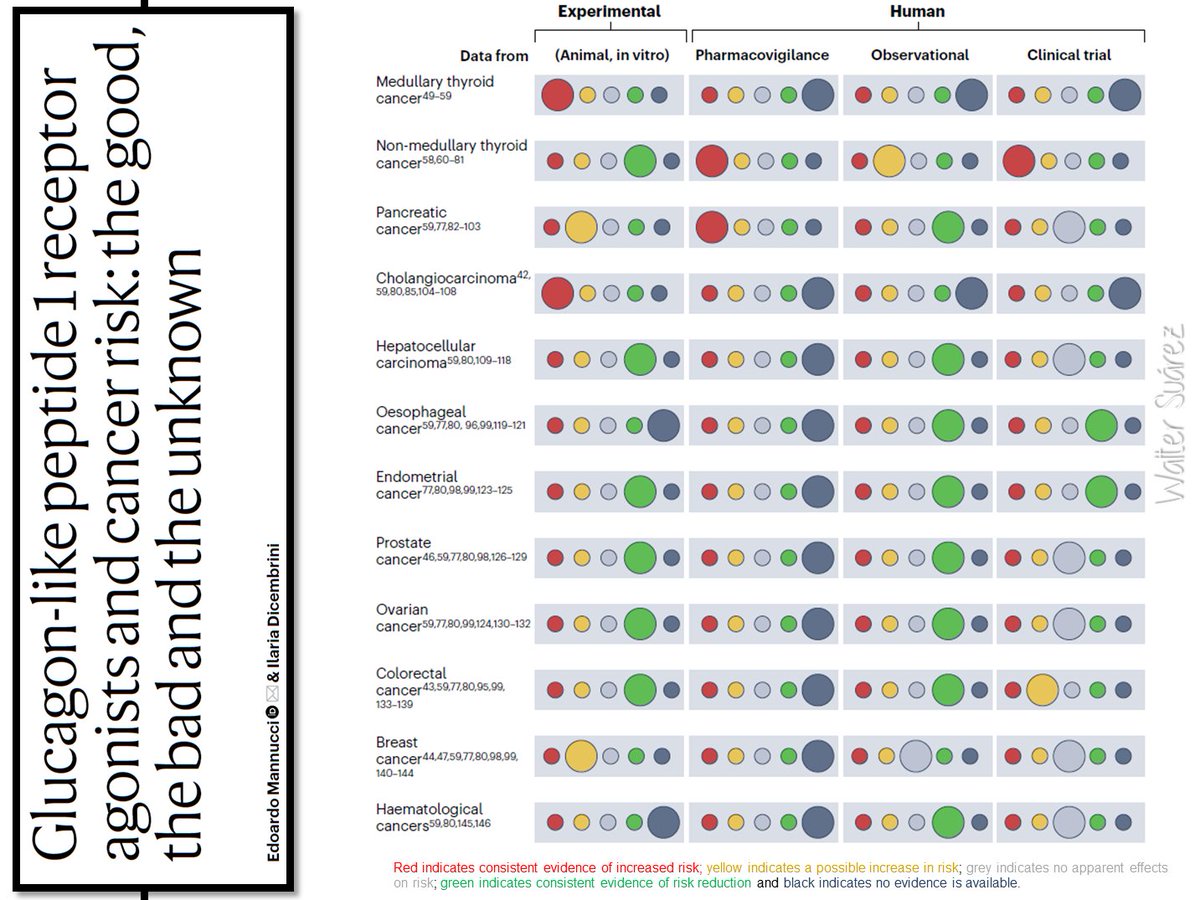
Ozempic ralentiza la progresión tumoral y mejora la supervivencia
En cánceres como pulmón, mama, colorrectal e hígado, las personas que tomaron GLP-1 tuvieron entre un 38% y un 50% menos de probabilidades de desarrollar cáncer en estadio IV
https://t.co/U8P3sSabdm
Lilly just proved it can make its own $36.5 billion per year drug obsolete. And that's the entire strategy.
Tirzepatide (Zepbound/Mounjaro) became the world's best-selling drug in Q3 2025, passing Keytruda at $10.1 billion in a single quarter. Combined 2025 sales: $36.5 billion. Lilly owns 60%+ of the U.S. obesity market. And today they released the data that makes tirzepatide the mid-tier option.
The pharmacology is why. Semaglutide (Wegovy) hits one receptor: GLP-1. Suppresses appetite, slows gastric emptying. Ceiling: about 15% body weight loss. Tirzepatide adds GIP, a second receptor that potentiates insulin response and amplifies GLP-1 signaling. Ceiling: about 22%. Retatrutide adds a third: glucagon. And glucagon does something the other two hormones cannot. It directly mobilizes fat stores and increases basal metabolic rate. You're simultaneously eating less AND burning more. That's why the jump from dual to triple agonist is so large. 28.3% average weight loss at 12mg over 80 weeks. 70.3 pounds. 45.3% of patients crossed 30% weight loss, which matches gastric sleeve outcomes.
Run the bariatric surgery math. Average gastric sleeve costs $20,000 to $25,000 in the U.S. Roughly 250,000 procedures per year. Retatrutide delivers equivalent weight reduction with a weekly injection and no surgical risk. The 4mg dose alone hit 19% weight loss with fewer dropouts than placebo (4.1% vs 4.9%), which means the lowest dose already performs at current-generation tirzepatide levels with better tolerability.
The part that should concern Novo Nordisk: Lilly now owns the three most important data points in obesity pharmacology. The best-selling drug on the market (tirzepatide), its oral successor (orforglipron, FDA submission done), and now the clinical proof that a triple agonist can reach surgical-grade outcomes. GlobalData forecasts retatrutide at $15.6 billion by 2031. Given that tirzepatide blew past every forecast within 18 months of launch, that number is probably conservative by half.
Morgan Stanley pegs the global obesity drug market at $150 billion by 2035. Lilly is building the pipeline to capture the majority of a $150 billion annual market, and the closest competitor just watched its flagship product lose a head-to-head study to the drug Lilly is already planning to surpass with retatrutide.
The obesity drug market went from $10.5 billion in 2021 to $36.5 billion for a single molecule in 2025. Retatrutide is what happens when a company decides to make its own blockbuster obsolete before anyone else can.
Eli Lilly released retatrutide Phase 3 data yesterday. 28% weight loss in 80 weeks. The most powerful obesity drug that’s ever been tested.
And today the cancer signal drops.
12,112 patients. Seven tumor types. GLP-1 users had half the lung cancer metastasis rate (10% vs 22%). Breast cancer: 43% cut. Colon cancer five-year mortality in a separate study: 15.5% vs 37.1%.
Cancer joins a list that already includes heart disease (SELECT, 20% MACE reduction), kidney failure (FLOW, 24% slower decline), sleep apnea (SURMOUNT-OSA, FDA-approved), addiction (BMJ, 600K veterans, 18-25% reduction across substances), and liver disease (86% fat clearance).
Tumors express GLP-1 receptors. Activate them and NF-kB drops, apoptosis rises. The drug isn’t just shrinking fat. It’s talking directly to the cancer.
One drug class. Designed for blood sugar. The biology keeps finding uses the designers didn’t predict.
Eli Lilly just released Phase 3 data for retatrutide, their next-generation obesity drug. 2,339 patients. 80 weeks. The biggest trial in the field.
8 things worth knowing:
1️⃣ It beats every obesity drug on the market. Wegovy (semaglutide): 15% Zepbound (tirzepatide): 22% Retatrutide: 25%
2️⃣ You don’t need the highest dose. The lowest (4mg) already outperforms Wegovy. 18% weight loss with one dose increase. Fewer people quit than on the sugar pill.
3️⃣ At two years, weight was still dropping. No plateau. Patients with BMI over 35 lost 84 pounds. 30% of their body weight.
4️⃣ Some patients stopped taking it because they lost too much weight. That’s never happened with an obesity drug.
5️⃣ It works differently. Ozempic and Zepbound suppress appetite. Retatrutide does that too, but its third receptor (glucagon) flips your metabolism toward burning stored fat. In Phase 2, ketone bodies rose 2-3x, confirming the body was switching fuel sources.
6️⃣ It causes a side effect no other obesity drug does: tingling and numbness (12.5%). New receptor, new trade-off. Worth watching.
7️⃣ In a separate study, it cleared 86% of liver fat. 93% of patients reached normal levels. 1 in 3 adults have fatty liver disease. No approved drug comes close.
8️⃣ Two-thirds of patients on the highest dose were reclassified out of obesity entirely. They started at BMI 40. They finished under 30. That’s not just weight loss. That’s a medical reclassification.
@US_FDA filing expected late 2026.
I'm going through the retatrutide phase 3 data, and the cardiometabolic numbers are more interesting than the weight loss:
- 24.1 cm off the waist on 12mg (9.5 inches)
- significant drops in systolic blood pressure
- triglycerides down
- non-HDL cholesterol down
- hsCRP down (a key marker of inflammation)
I'm giving it a few years before people realize GLP-1s are more than just weight loss drugs.
https://t.co/5bQSMcQXnP “Un triunfo sin precedentes que amenaza a la cirugía bariatrica” #Retatrutide (triple agonista de GLP1/Glucagon/GIP) consigue pérdida de peso de 28,3% (80sem) y 30,3% (104sem) en aquellos pacientes con IMC>35 en estudio TRIUMPH1 @LillyDiabetesIn
Hagenaars et al. publican en JAMA Health Forum algo que me ha hecho pensar. Enmarcar la obesidad como enfermedad individual (y hablar de GLP-1 en público) erosiona el apoyo político a medidas estructurales como impuestos al azúcar o regulación de ultraprocesados. Y parte de su argumento me incomoda porque tiene sentido.
Pero hay algo que no puedo ignorar. Mis pacientes existen ahora, con un cuerpo que no responde a "espera a que cambie el entorno alimentario", "espera que te soluciono otros problemas", vamos a esperar a la próxima revision" … Además, hablar de GLP-1 no es solo hablar de un fármaco. Es explicar por qué el hambre no es falta de voluntad, por qué el cerebro regula el peso de formas que escapan al control consciente. ¿Qué los profesionales que atendemos a personas que viven con obesidad hemos sido tímidos denunciando el poder de la industria alimentaria? Sí, ahí les doy la razón. Pero la solución no es que los profesionales nos callemos en público. Es aprender a enmarcar mejor el mensaje y señalar al sistema que nos trajo hasta aquí. No es una dicotomía. Es una responsabilidad compartida.
https://t.co/zBGyaB7Iwc
🚨 El síndrome de ovario poliquístico (PCOS) tendrá un nuevo nombre.
Un consenso global publicado en The Lancet propone cambiar PCOS por:
🩺 PMOS = Polyendocrine Metabolic Ovarian Syndrome
📌 El nuevo término busca reflejar mejor su impacto endocrino, metabólico y reproductivo.
Nuevo estudio en JAMA Network Open: los aGLP-1 se asociaron con menor mortalidad y recurrencia en cáncer de mama.
Resultados prometedores, aunque observacionales.
https://t.co/ERiauFgmrj
HIPERINSULINEMIA COMO CAUSA DE OBESIDAD Y ENFERMEDADES CARDIOMETABOLICAS
Revisión narrativa que aborda la cuestión.
¡¡¡A leer, zagales!!!
Link en mi bio
o
https://t.co/k7BPZlSAbB
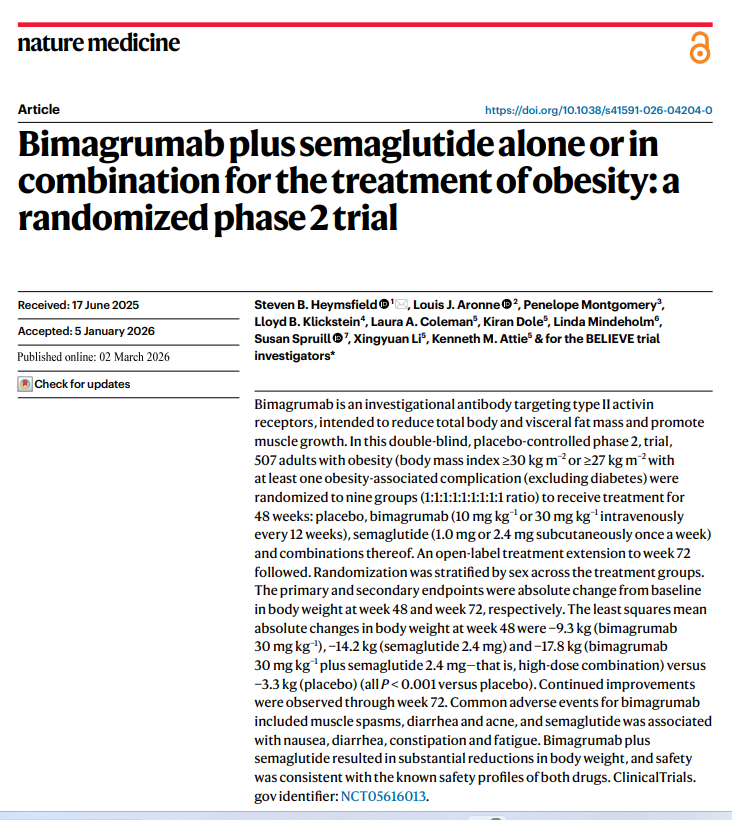
BELIEVE it or not… this obesity trial suggests we may finally separate fat loss from muscle loss.
In the BELIEVE trial (Nature Medicine):
🔹 Semaglutide alone → ~15.7% weight loss
🔹 Combination therapy → ~22% weight loss (~24 kg)
🔹 Total body fat ↓ ~46%
🔹 Visceral fat ↓ ~58%
🔹 Lean muscle largely preserved
For decades, weight loss meant losing muscle + metabolic reserve.
This approach targets appetite AND muscle biology simultaneously.
If confirmed in outcomes trials, this could reshape how we think about:
❤️ cardiometabolic disease
💪 sarcopenic obesity
🫀 surgical risk & frailty
We may be moving from weight loss → body composition medicine.
#Obesity #CardioMetabolic #GLP1 #Semaglutide #Longevity #HeartHealth #PreventiveMedicine #NatureMedicine #MedTwitter #Cardiology #Endocrinology #DigitalHealth #FutureOfMedicine #HealthyAging #PrecisionMedicine
I wouldn't call 23% a miss.
SURMOUNT-1 data reminds us that tirzepatide did not work for weight loss in ~10% of people.
All of my patients who didn't see significant #weightloss with tirzepatide will be trialed on CagriSema. Amylin introduces a different mechanism.
The differentiation here will unmask the heterogeneity of #obesity