Science Lead @temple. Biomed Scientist in #longevity. Mentor & Investor in Health startups. Past CTO @BioVivaScience, Researcher @CASMIORG, Founders Health.
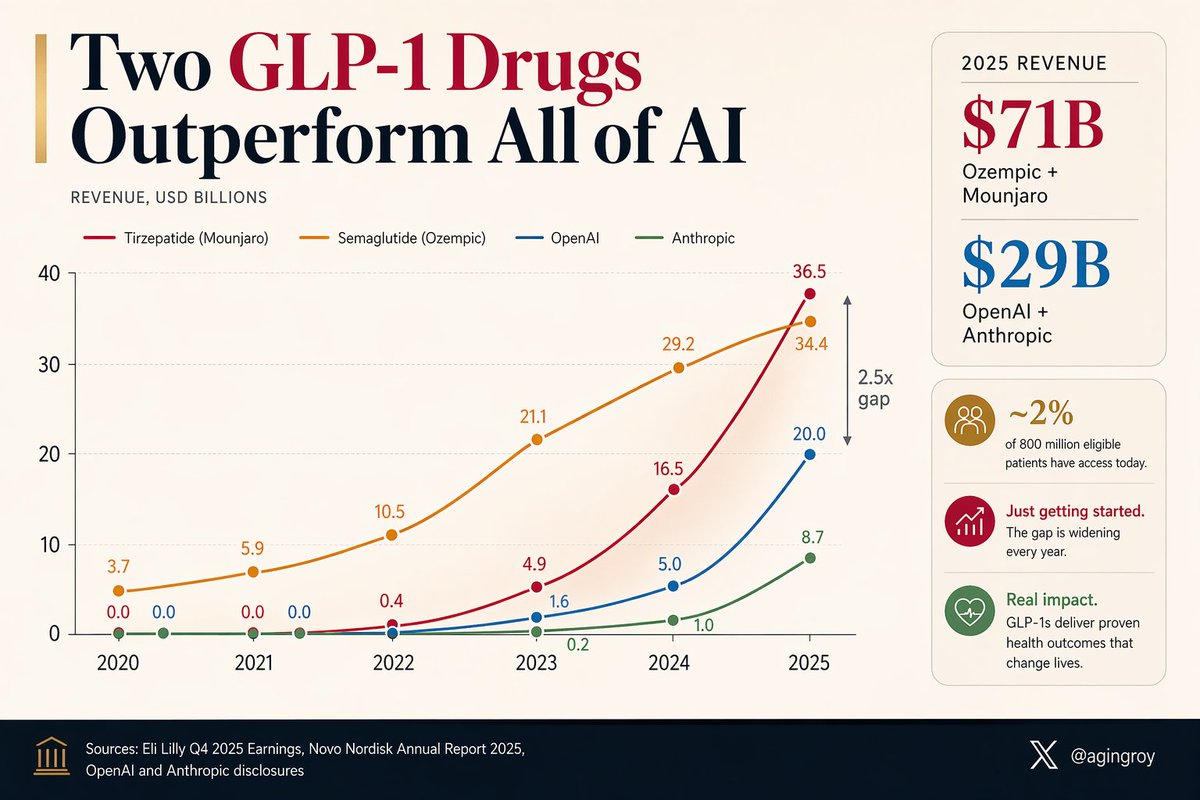
A weekly jab in the belly is generating more revenue than the entire AI industry.
Ozempic + Mounjaro: $71B in 2025.
OpenAI + Anthropic: $29B.
And they've barely started. ~2% of the 800 million eligible patients can currently access them.
h/t @DrSamuelBHume
Sources and Notes
1. THE PAPER
- Yadav, Sinha and colleagues at Sanford Burnham Prebys, the National Cancer Institute and the NICHD, Nature Aging, published 31 August 2026. They built PathStAR, which scores how tissue structure changes with age from routine pathology slides, without being trained to predict age.
https://t.co/v9F5K3rYMk
- Free full text. The image uses Fig. 4d (coronary artery against tibial nerve), CC BY 4.0, figure credited in part to BioRender (Alvarez, K.).
https://t.co/2YhJWAxLrG
· · · · ·
2. THE DONORS
- 25,306 post-mortem biopsy slides from 40 tissues in 970 donors aged 21 to 70, from the US GTEx tissue bank. 16,808 slides came from men and 8,498 from women, so about a third from women. Most samples come from donors over 45.
https://t.co/nXxKd6fh82
· · · · ·
3. WHAT THEY FOUND
- Vascular tissue, including the tibial and coronary arteries, had its highest structural aging rate in the 30s. In Fig. 4d the coronary rate at age 35 is about 0.24, almost twice its rate at 55 (about 0.13). The curves cover ages 30 to 60 and 15 of the 40 tissues.
- The pattern held after removing donors with systemic diseases. In the pathology notes, early plaque rose most steeply from the 20s to the 30s, then plateaued.
- The uterus and vagina changed fastest in the early and middle 50s, around menopause. The ovary had two peaks, at 35 to 40 and at 55 to 60.
- A 2025 Cell study of 516 samples from 13 tissues, which measured proteins and also examined tissue histology, found blood vessels among the tissues that age early.
https://t.co/F8U2Eg1zGB
· · · · ·
4. LIMITS
- Each donor was sampled once, after death, so these are averages across people rather than one person followed over time.
- The score measures change in structure. The authors say some change may be adaptation or neutral, and the paper doesn't test how well the arteries work.
- Ages are pooled in 10-year windows, and GTEx donors vary in health, ventilator use and time to sampling. Post-mortem factors explained under 10% of the rates in almost all tissues.
- Brain arteries weren't studied. Two authors, Yadav and Sinha, are named inventors on a related US provisional patent application. Funding came from a Sanford Burnham Prebys start-up fund and the NIH Intramural Research Program.
At 35, you may feel young, but the arteries feeding your heart may already be changing almost twice as fast as they will at 55.
That comes from a study of more than 25,000 microscope slides from 970 adults ages 21 to 70. Researchers at Sanford Burnham Prebys and the NIH used an AI model to measure how 40 tissues change with age.
The coronary arteries changed fastest in the 30s. Pathologists' notes also showed early plaque rising most sharply between the 20s and 30s.
The bigger lesson: organs do not age on the same schedule. The uterus and vagina changed most in the 50s, around menopause.
This was an average across people, since each donor was seen only once, after death. Brain arteries were not included.
Your body does not age all at once. Your arteries start earlier than you think
@solidsource67 In this case the FDA had already said yes. It approved the drug in July 2025. What was missing was a company selling it here, and AstraZeneca now has the rights and says US sales start this quarter.
Americans are flying to Shanghai for a lung cancer pill that the FDA approved 15 months ago.
Max Doppelt did it for his mother. Her lung cancer had spread to her brain. The drug most likely to help her, sunvozertinib, had been sold in China since 2023 but was unavailable in the US. So he flew over and came home with 26 boxes. Nineteen months later, she is alive and still working. He says at least 30 Americans have made the same trip.
In the trial behind the US approval, the pill shrank tumors in 46 out of every 100 patients whose cancer had worsened after chemotherapy.
The holdup is business, not medicine. Dizal, the Shanghai company that makes it, had no US sales network, according to US oncologists in May. AstraZeneca licensed the drug in July for $600 million and says US sales will start this quarter.
An @FDA approval helps American patients only when a company actually sells the drug here.
In January 2025 my mom’s lung cancer spread to her brain. The drug with the best chance of helping her was approved in China but not here.
A doctor told me, almost as an aside, that if she were Chinese she could buy it at a pharmacy.
So I flew to Shanghai and came home with 26 boxes in my luggage. That was 19 months ago. My mom is still here, still working, and in her words has had an amazing three years.
The drug was approved in China in 2023. The FDA approved it in July 2025. It still is not for sale here. I know of at least 30 Americans who have made the same trip.
I have been scared to tell this story because I worried it could cost my mom access to the medicine keeping her alive. But the problem matters more than my silence. These drugs need to be developed and available here, and that means FDA reform.
Art Allen at KFF Health News told our story this week. It also ran in The Washington Post.
https://t.co/tHKV3L004L
@soychemist China has a lot of early ones going. The furthest along I can find is Moderna and Merck's personalized mRNA vaccine, now in four phase 3 trials in melanoma and lung cancer, the biggest with about 1,100 patients.
That makes sense; it's wise to think ahead about your next treatment option before you need it. And if it's only sold abroad, the FDA can allow up to a 3-month supply for personal use when there's no effective treatment available here, as long as you name your US doctor. I hope the second pill gives you years of relief.
Sources and Notes
1. THE DRUG
- KFF Health News (20 Oct 2026) names the drug Max brought back from Shanghai: sunvozertinib (Zegfrovy), made by Dizal. Max told KFF he knows of at least 30 Americans who have made the trip.
https://t.co/Hy0s1AF8lO
- China approved it on 23 Aug 2023 for lung cancer with EGFR exon 20 insertion mutations after platinum chemotherapy.
https://t.co/cWs3u1rhE8
- FDA accelerated approval, 2 Jul 2025: confirmed response rate 46% (95% CI 35 to 57) in 85 patients on 200 mg, median response 11.1 months (WU-KONG1B).
https://t.co/fX5LQDgV1U
2. WHY IT ISN'T SOLD HERE YET
- Ou, Nagasaka and colleagues (May 2026) describe it as approved but largely unavailable in the US, citing no US commercial presence, China-based manufacturing and tariffs.
https://t.co/sJaz8IS5MS
- AstraZeneca licensed worldwide rights in July 2026 ($600M upfront, up to $900M in milestones; closed 1 Sep) and says it will launch in the US in Q4 2026. An AstraZeneca spokesperson told KFF availability is expected by the start of 2027.
https://t.co/TlVcC8lCXT
3. BRINGING DRUGS HOME
- FDA's personal importation policy allows discretion for up to a 3-month supply of a drug for a serious condition when no effective treatment is available in the US, with a US doctor named. It isn't a license.
https://t.co/GmoBgE0YMl
4. LIMITS
- The approval is accelerated, based on tumor response in a single-arm trial. A phase 3 first-line trial (WU-KONG28, NEJM) showed progression-free survival of 10.3 vs 7.5 months against chemotherapy.
https://t.co/dI8YFc0dNc
I lead science at Temple, so here's the simple version and the careful one.
If you’re skeptical, that’s fair. A lot of health wearables make big claims. We want to be more measured than that: show what the device can track, what it can suggest, and where we still need more validation.
Put a small patch, the Temple device, on your temple, the spot between your eye and your ear, and it starts showing you how you're doing. Your heart. Your sleep. Your temperature. How stressed or calm you are, live.
Then the part I'm proudest of. That spot sits on a strong pulse coming up from your heart, right next to your brain, so Temple can show you how the blood flow to your brain rises and falls through your day, as you work, exercise, rest and sleep.
We're only getting started.
Most of the cholesterol in your blood test never reaches your brain. The brain makes its own and holds about a quarter of all the cholesterol in your body.
That matters because this post is not really about a blood number. It is about where brain cholesterol goes and what happens when that system breaks.
In a Scripps-led study, researchers switched off single genes in millions of mouse brain cells, and an OpenAI model helped interpret the results. When DCTN1 was switched off, neurons increased the genes they use to make cholesterol.
DCTN1 is the gene disrupted in Perry syndrome, a rare inherited brain disease with parkinsonism, and the model pointed to a simple explanation: cholesterol delivery inside those neurons may have failed, so the cells tried to make more.
That fits older brain biology. Astrocytes make cholesterol for neurons and deliver it through APOE. In people of European ancestry, one copy of APOE4 roughly triples the risk of Alzheimer’s disease, while two copies raise it about 15-fold.
The DCTN1 idea is still only a preprint, with no lab test yet. But if it holds up, the takeaway is clear: in the brain, cholesterol is not just about how much there is. It is about where it goes.
GPT-Rosalind surfaced a new lead for drug discovery: could restoring cholesterol transport protect neurons from degeneration?
DCTN1 is a gene linked to Perry syndrome, a rare neurodegenerative disorder. In mouse-brain data, disrupting it increased expression of genes involved in making cholesterol. GPT-Rosalind suggested a possible explanation: cholesterol may not be reaching where neurons need it.
That gives scientists a specific mechanism to test and, if confirmed, a direction for developing new treatments for neurodegenerative disorders.
With @perturbai_tx and @scrippsresearch, a team of thousands of GPT-Rosalind agents worked in parallel, connecting gene-expression results from millions of mouse brain cells with scientific literature in just 32 minutes. We’re now expanding this collaboration to identify new drug targets.
https://t.co/oHdF3ELsMj
Temple is completely non-invasive. It rests on your skin, and nothing goes into your body. It sticks on with clinical-grade tape, the same kind clinics use daily on sensitive skin, and it goes on and comes off about as easily as a pimple patch. The light it uses, green, red and infrared, is the same kind smartwatches and rings already shine on wrists and fingers around the world. Temple reads it from a better spot.
On radiation, Temple talks to your phone over Bluetooth, the same gentle, low-power radio your wireless earbuds use, and it stays switched off most of the time. Even when it's on, the power is so low that it sits below the level where US regulators ask for radiation testing on wearables.
So it's a soft patch and a little light. In return, you get a daily look at your heart, your sleep and your brain.
There's a drug that does roughly that, though it isn't an amino acid. Clascoterone blocks the DHT receptor in the scalp, and in two phase 3 trials in 1,465 men it grew more hair than the same liquid without the drug. A US filing is planned for early 2027. And minoxidil isn't poison. Rubbed on, it causes less body hair and fewer headaches than the pill, though more scalp itch. I ranked the options here: https://t.co/RNiEOjuVcR
2025 meta-analysis of 33 RCTs finally ranked every hair loss treatment. Dutasteride crushed finasteride with a 96.3% probability of being #1.
6 treatments ranked by hair density at 24 weeks:
1. Oral dutasteride 0.5mg
SUCRA 96.3% for total hair density. Significantly more effective than every other monotherapy except sublingual minoxidil. It blocks both types of the enzyme finasteride only partially inhibits.
2. Oral minoxidil 5mg
SUCRA 93.2% for terminal hair density. The oral version of the topical most men already use. Growing evidence, off-label but increasingly prescribed.
3. Finasteride + minoxidil combo
SUCRA 80.2% in males. The only combination that showed statistically significant improvement over minoxidil alone. +29.7 hairs/cm2 at 24 weeks.
4. Topical minoxidil 5%
Most effective topical monotherapy. FDA-approved. Decades of safety data. Still the baseline treatment most dermatologists start with.
5. Oral finasteride 1mg
Most prescribed FDA-approved oral treatment. Effective, but the NMA ranked it well below dutasteride and oral minoxidil for density gains.
6. Sublingual minoxidil 5mg
SUCRA 92.2% for terminal hair density. Emerging route that avoids topical mess and first-pass liver metabolism. Limited availability.
The ranking nobody expected: a $0.50/day generic (dutasteride) outperformed everything.
The hair-loss pill all over your feed is a 47-year-old blood pressure drug.
It is minoxidil, the stuff in Rogaine. Veradermics made a slow-release tablet, and in a trial of 536 men it grew about four times as much new hair as a placebo in six months. The catch: extra body hair in 9% of men on the higher dose.
Dermatologists already prescribe plain minoxidil tablets off-label, and no trial has put the new pill up against them. The women's trial reports next year.
If you are losing hair, ask your dermatologist about the old tablet now instead of waiting for the new one.
JUST IN: Veradermics announces its experimental hair-loss pill significantly increased hair growth in over 500 men, with no serious side effects reported in a late-stage study.
Temple reads your health from one spot on your temple.
I lead science at Temple, so here is why that spot matters.
Your temple sits over a branch of the carotid artery, the big vessel in your neck that carries blood from your heart to your face and brain. The pulse there is strong. It is also the same artery forehead thermometers use to estimate core temperature. And just behind it sits your brain, only 2% of your body weight, but using about 20% of your oxygen.
From that one small patch, Temple tracks your heart, sleep, temperature, and how wound up or settled your nervous system is. You can see that last one live. We call it Entropy, and it rises in a sprint and falls when you meditate, even when your heart rate barely changes. That is how Deepinder finally saw progress after more than a decade of trying to meditate.
Then comes the part that used to need a hospital: blood flow to your brain, rising and falling through the day. In our first study, when people lay down, heart rate dropped while blood flow in a main brain artery rose, and Temple's brain reading moved with the artery, not the heart.
That flow slowly declines with age, and exercise helps hold it up. In a study of 307 men aged 18 to 79, endurance athletes had about 17% faster blood flow in that brain artery, roughly 10 years younger by that measure. Now we are learning which habits move it most. The goal is to catch a slide in brain health early enough to change it.
We tested it against the brain ultrasound doctors use before it went on sale, and the studies are public for anyone to read.
And we're only getting started. We've worked with scientists at Boston University and the Salk Institute, and right now teams at universities around the world are helping us build the next health features. The aim is to make Temple the most useful thing you've ever worn for your health.
Sources and Notes
1. THE TWO PAPERS
- Bilal, Mehra, Rogers and colleagues, Cleveland Clinic and IBM Research, Nature Communications, August 2026. An AI read 9,608 full overnight sleep studies from 9,297 sleep clinic patients and sorted them into five groups, then followed them in medical records. The image is their Figure 2A, CC BY 4.0, with plain labels and notes added.
https://t.co/lFra8AYMCD
- Thapa, Mignot, Zou and colleagues, Stanford, Nature Medicine. SleepFM learned from about 585,000 hours of sleep recordings and was tested on 5,019 Stanford sleep clinic patients.
https://t.co/md7wz0fkGH
- Rachel Rowe's Nature News and Views on both, 12 October 2026.
https://t.co/l0rqKiMqaN
· · · · ·
2. WHAT THE AI READ
- Cleveland used 14 channels from in-lab sleep studies, including brain waves (EEG), heart rhythm (ECG), oxygen, airflow and breathing effort. Blanking the brain-wave or heart channels moved many patients into different groups.
· · · · ·
3. THE CLEVELAND NUMBERS
- 7,043 patients and 544 deaths in the death analysis. After adjusting for age, sex, BMI, other illnesses and the breathing-pause count (apnea-hypopnea index), the highest-risk group died at 2.38 times the rate of the lowest (95% CI 1.73 to 3.28). Leaving out patients prescribed CPAP, it was 1.76 (1.12 to 2.78).
- Compared with people with normal counts, people with mild, moderate or severe apnea by that count didn't die more often. Mild (0.71) and moderate (0.52) groups had lower death rates, and severe was 0.77 (0.58 to 1.02).
- The 6 in 100 and 18 in 100 by year 6 are read from Figure 2A, whose curves are weighted so the groups match on age, sex and other factors. Median follow-up was 4.4 years, so the later part of the curves rests on fewer people.
- In the Sleep Heart Health Study, a community group recorded at home, the highest-risk group died at 1.58 times the rate (1.07 to 2.32).
· · · · ·
4. THE STANFORD NUMBERS
- The C-index asks, for two patients where one died sooner, how often the model ranks that one higher. 0.5 is a coin toss. SleepFM, which saw the night plus age and sex, scored 0.84 for death (0.81 to 0.87). A small neural network given only age, sex, BMI and race or ethnicity scored 0.79 (0.75 to 0.82).
- For stroke, the four-fact model scored about the same as SleepFM's 0.78 (Supplementary Figure 11).
· · · · ·
5. LIMITS
- Both main groups were people sent to sleep clinics, who are sicker than the general public. Neither paper tested a watch, ring or headband, and no trial has tested whether acting on these scores helps.
One night of sleep can hint at how long you might live.
When doctors suspect sleep apnea, they send you for a sleep test. You spend the night wired up in a clinic, and the main score is simple: how many times an hour you stop breathing.
At Cleveland Clinic, that number did not predict who was more likely to die. An AI that read the rest of the night did. Using brain waves, heartbeat and breathing, it sorted about 9,300 patients into five risk groups.
Six years later, about 18 in 100 in the highest-risk group had died, versus 6 in 100 in the lowest. Even among people the same age and weight, with the same number of breathing stops, the highest-risk group still died at more than twice the rate.
Age, sex and weight do much of the work. At Stanford, a similar AI looked at pairs of patients where one died first and picked the right one 84 times out of 100. A simple model using only age, sex, weight and race got 79.
Both studies looked at people referred to sleep clinics, and neither tested a smartwatch or ring.
The wait is over.
Temple Batch 01 pre orders open November 1. Each @temple is hand-made to order and delivered to you within three months of your purchase.
If you wake up at night to pee and wonder when it is too much, one big Finnish survey puts the line at two.
This post has a million views and no numbers. In adults aged 18 to 79, one trip rarely bothered people, and quality of life dropped meaningfully from two on. Twice is common after 70. Roughly a third to over half of older adults do it, and up to about 1 in 6 adults aged 20 to 40.
Sometimes the cause is a blocked airway. In sleep apnea, breathing in against a closed throat is thought to stretch the heart, which releases a hormone that makes the kidneys pass more salt and water. In a small before-and-after study, 40 people with apnea who stuck with CPAP for three months went from 2.1 trips a night to 1.2.
Two or more trips is linked to about 27% higher risk of death in observational studies, or 1.6 extra deaths per 100 people over five years at 60. It is likely a marker of other illness.
If that is you, keep a three-day bladder diary for your doctor, and mention if you snore or wake up unrested.
86.7% skin cancer cure rate? Not quite. That headline comes from 13 spots out of 15 at one clinic in Boise, Idaho.
In a 2022 trial, two researchers there brushed vitamin C dissolved in DMSO, a solvent that soaks through skin, onto basal cell cancers twice a day. At 8 weeks, biopsies found no cancer left in 13 of 15, while a prescription cream cleared 8 of 14. In a second, not yet peer reviewed study, 15 of 27 squamous cell cancers confined to the skin's top layer cleared. That's the 56%.
Basal cell is the most common cancer in America, but it's also among the most curable. In a UK trial of 501 patients, surgery still worked for 98% of those followed to 5 years. With 15 and 14 spots, vitamin C's edge could be luck.
The squamous study only reports to 12 weeks, far too soon to know whether cancers come back. If a bigger trial holds up, a simple brush-on could spare some people surgery.
Until then, if you have a diagnosed spot, ask your dermatologist about treatments with at least 5 years of results.
This is crazy… Vitamin C in DMSO ELIMINATED the MAJORITY of the two most common skin cancers within 12 weeks.
2 studies brushed the inexpensive solution on cancer lesions twice daily:
86.7% of BASAL CELL SKIN CANCERS ELIMINATED
56% of SQUAMOUS CELL SKIN CANCERS ELIMINATED
Flatter peaks are the point. The six-month trial reported no heart events and no differences in blood pressure or heart rate versus placebo. But ankle swelling was still 4.5% vs 0.6%, and the lower-peak data come from a 10-person company study that I cannot find published. I would want a proper head-to-head against plain tablets before calling it settled.
@DrakeBrady1012 Mostly, yes. On the twice-daily dose, 9% got extra body hair and 4.5% some ankle or leg swelling, vs 0% and 0.6% on placebo, with no heart safety signals in six months. This trial didn't test it against the plain tablet, though.