Another great research piece by @_DimensionCap@bauer_lesavage on Training Data for Bio AI.
Models will only be as good as the underlying data, and the biology they learn will be constrained by the limitations of that data.
We need to think deeply about scaling the best quality data to solve human bio with AI. Our thesis from day 1 at @NOETIK_ai.
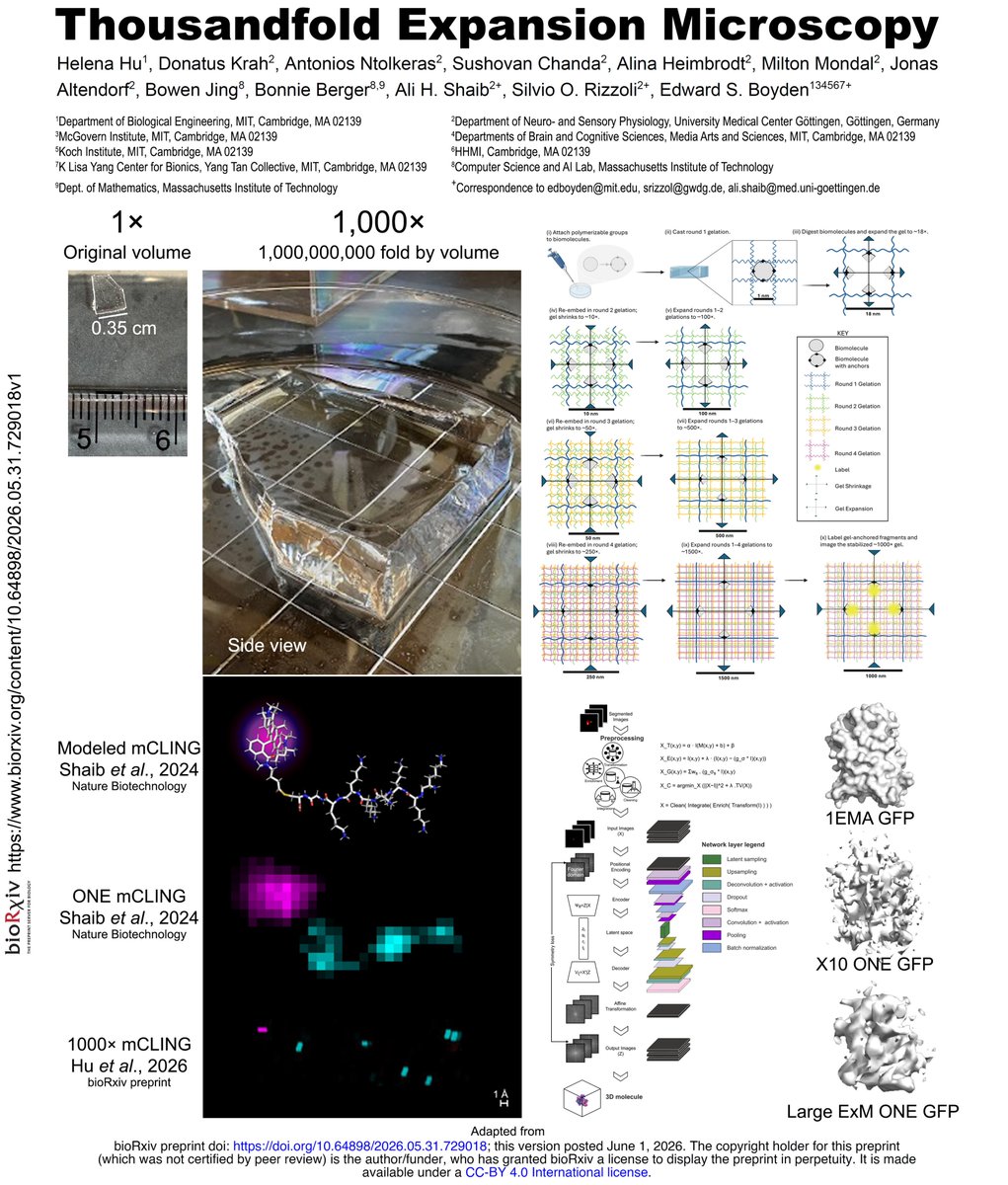
Hello world, meet 1,000× Expansion Microscopy.
1,000,000,000× expansion by volume! A gel that starts at a few centimeters will then expand to the volume of an Olympic swimming pool. https://t.co/E43kxx4O5M
In our new bioRxiv preprint, work carried out between MIT and UMG, led by Helena Hu in collaboration with scientists from the labs of @eboyden3 Ed Boyden, Silvio Rizzoli, and myself, we present Thousandfold Expansion Microscopy.
By enlarging biological specimens across multiple rounds of expansion, molecular-scale features, as small as the distances between adjacent amino acids, can be visualized with conventional optical microscopes.
Democratizing super-resolution microscopy.
A new cancer drug works like a molecular handcuff. One arm grabs a passing immune cell. The other grabs the tumor. It clamps them together and forces the kill, whether the cancer agrees to the meeting or not.
That trick cleared blood cancers a decade ago. Blinatumomab still does it in leukemia.
Solid tumors blocked it for one reason: the old handcuffs could only grab a protein sitting on the cell’s surface, and solid tumors hide their tells inside the cell.
This one reads the inside. Its grabbing arm is built from a T-cell receptor, so it spots the scraps of internal proteins that every cell puts on display. In a phase 1 study, 61 patients, it shrank head and neck, melanoma, and lung tumors that surface-only drugs never reached.
Solid tumors are most cancer. This is the first handcuff that fits them.
For those of you who think macrophages do almost everything, rethink “almost.”
They are programmable cells, recruited into whatever new function evolution needs.
https://t.co/tz6VrVQWpw
We built a joint experimental and computational platform for scalable multi-modal single-cell chemical screens — profiling RNA, protein (including phospho-signaling), and chromatin accessibility responses to thousands of small molecule perturbations in parallel. https://t.co/M5x4CNLCTA
So let's help where we can now, and invent ways to measure things where we can't. A mechanistic model of a cell is probably going to be pretty bad right now, since we can't possibly measure all of the important aspects. (n/n)
Physical dynamics of proteins in an intact tissue measured over time, driven by cytoskeletal interactions.
Biology like this is why virtual cell efforts are woefully incomplete. Nobody is able to detect this kind of stuff at scale! (1/n)
💥 🚀 New preprint! 🎉🥳
How do hundreds of organelles organize themselves into near-perfect patterns inside a cell, without a blueprint? We dive deep into how basal bodies (BBs) self-organize in MCCs - and how actin actively tunes their dynamics into order 🍪
🧵👇 (1/17)
Being thoughtful about what we can model from existing measurement modalities is going to be how we help patients in the near term, and we should also be thoughtful about what technologies to build to measure things we can't model yet.
💥 🚀 New preprint! 🎉🥳
How do hundreds of organelles organize themselves into near-perfect patterns inside a cell, without a blueprint? We dive deep into how basal bodies (BBs) self-organize in MCCs - and how actin actively tunes their dynamics into order 🍪
🧵👇 (1/17)
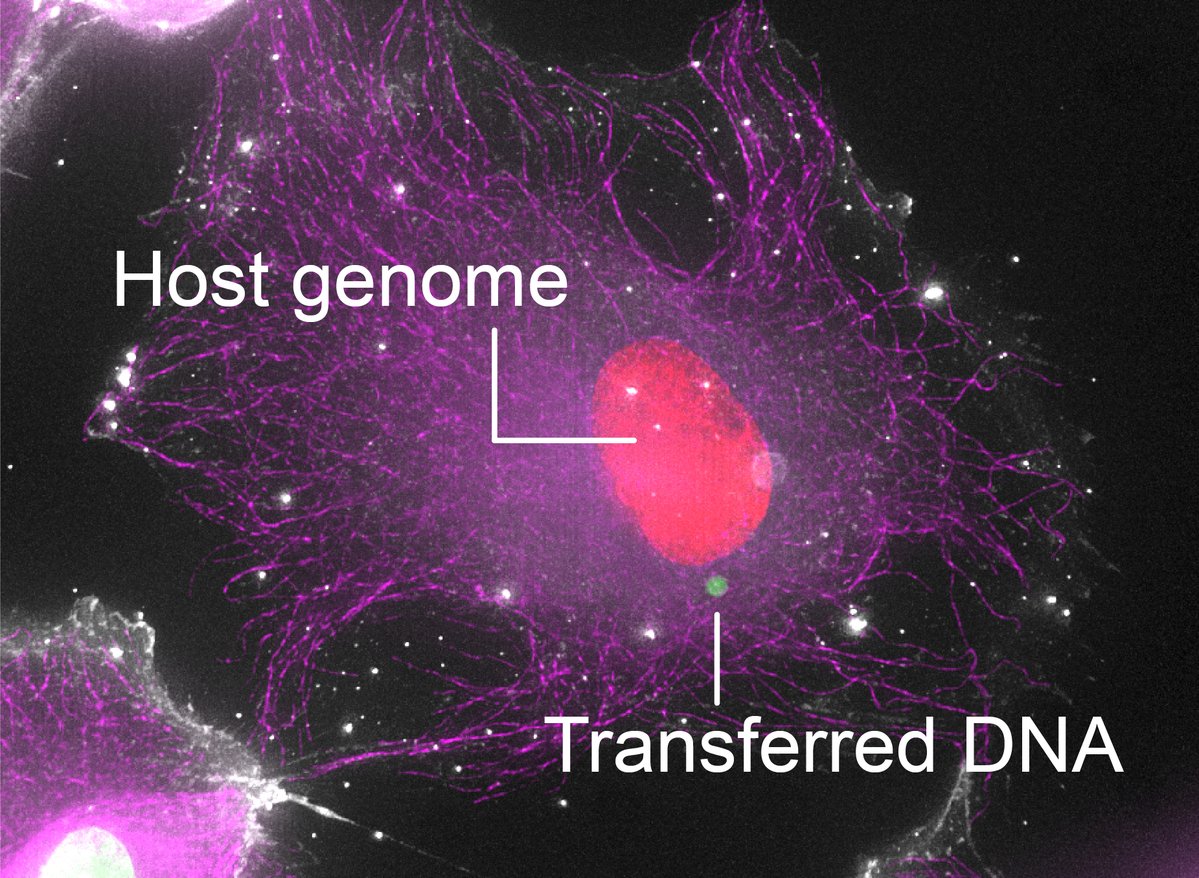
Excited to share our latest paper, out today @CellCellPress. We found that large pieces of the human genome can transfer between cells upon direct contact, endowing recipient cells with heritable phenotypic changes. (1/7)
https://t.co/SbshGhofN0
The bitter lesson in 26 words:
Don’t be distracted by human knowledge, as AI has been historically.
Instead focus on methods for creating knowledge that scale with computation, like search and learning.