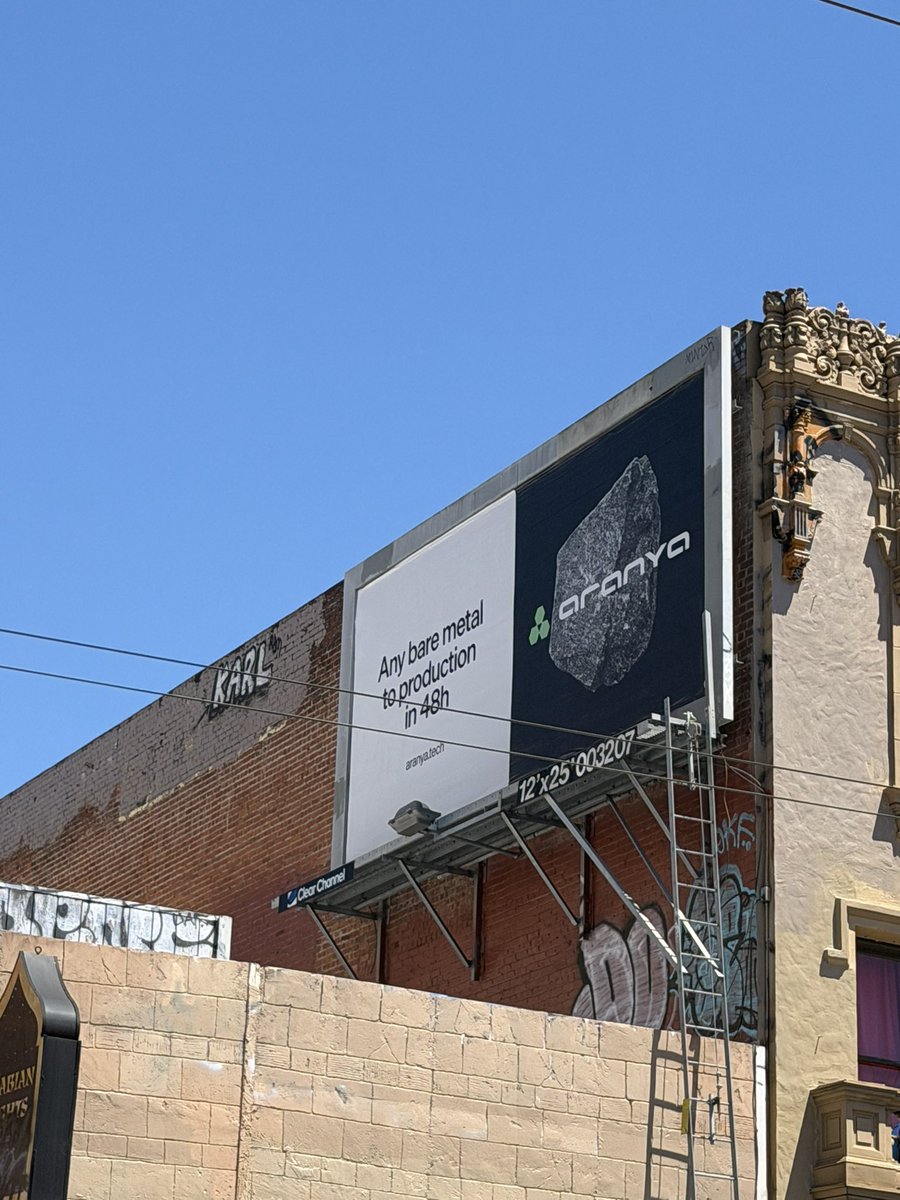
Yesterday, we announced our raise. Now it's time to celebrate.
We're throwing a launch party in San Francisco.
In one year, we raised $11M and now operate over $500M of compute. This is the part where we stop posting about it and get everyone in a room.
Food, drinks, founders, engineers, investors, and anyone who’s lost a week to a cluster.
September 23rd, 2026 @ 6PM. Space is limited so RSVP.
https://t.co/xGcy62foJz
Fired up about what Aranya is building. Christian is one of the few deeply technical engineers that know how to build great distributed GPU infrastructure. Him and the team (Aryamika and Sasivarnan) are so well positioned for this moment. Keep an eye out!
Bare metal to production in under 48 hours ✊
Huge day for the Aranya team. Congratulations to Christian, Arya, and Sasi on the funding and launch!!!
Bare metal to production in hours not months/years!
Christian is a one of a kind thinker and builder. Since he showed me how to build an external GPU in my dorm room, he's become an expert in GPU infrastructure and obsessed with wrestling the utilization problem.
Proud to see Aranya unveil and takeoff with happy customers, and $500M of compute to boot!
Would you accept waxing gibbous moon as an acceptable access to compute timeline?
Or just tap @AranyaInc bare metal to prod in 48 hours
Congrats on the $11m funding close, excited to be on the ride
Aranya is a critical product at a critical moment in time to enable more efficient use of all the AI infra we’re building out.
We need more capacity, but we also need to use our existing capacity better (Most GPUs run at like 40%)
Christian and team cooking. Get in touch
This is a phenomenal team!
Before taking our capital (at the getgo), @cbondaatje insisted on flying to Boston so we could take a walk together and get to know each other a bit. That is already stand out in a world of super transactional seed stage investing & I loved our walk around Harvard square together.
Basically: There's a gap between what data centers offer and what AI workloads actually need, and right now it gets closed by hand. Aranya is the multicluster operating system that turns any bare metal into custom production-ready clusters in 48 hours, by automating everything from individual kernel drivers to federation across clusters.
And now, in less than a year since commercializing, they're already operating roughly $500M of GPUs for the most demanding inference workloads in AI.
We at Founder Collective are incredibly grateful to be involved with @cbondaatje , Aryamika, Sasi & team @AranyaInc
👏 👏 👏 👏
Congrats to @cbondaatje and @AranyaInc on the seed led by @firstround. Bare metal to production-ready clusters in under 48 hours. Been crazy to watch them execute over the last year, already operating $500M of GPUs. Keep an eye on this team
Most founders working on GPU infra have spent the last few years in the space. @cbondaatje’s obsession stretches back 10+ years.
He was working on distributed compute before neoclouds were a thing, starting his own companies (including a 2014 idea for desktop GPUs while still at Harvard) and also joining others, like @CrusoeAI (as the 3rd eng hire and racking their first GPU rig by hand) and @hyperbolic_labs (as their founding platform engineer building out a 200+ cluster Kubernetes federation).
As AI companies face down a serious GPU scarcity problem today, Christian’s rare depth of experience here sets him up perfectly to build @AranyaInc: the multicluster operating system that turns any bare metal into custom production-ready clusters in 48 hours.
Aranya automates all of the moving parts in GPU orchestration (from individual kernel drivers to federation across clusters at unprecedented scale) so engineering teams can focus on building AI products instead of keeping clusters running.
This team has quickly built something very impressive that’s used by customers with a very high bar. They now operate over $500M worth of compute and have already scaled up a top 3 inference provider.
Proud to lead their $9M seed here @firstround.
When we started raising, I convinced Christian and Arya to let me put a garden in the office.
Seed stage. Nobody found it as funny as I did.
By the time the round closed, the plants had sprouted. We've already eaten the first beans.
GPU hardware was less charming. Different unit economics, different configs, each one fails quietly.
Aranya OS finds it before anyone gets paged. Roughly $500M of GPUs running on it today.
Might be time to scale the garden too.
Everyone is panicking over the chip shortage but the compute that exists is just sitting there fragmented and nobody’s orchestrating it right.
So we built a multicluster OS for highly demanding workloads - $500M of compute is already running on @AranyaInc, and we’re only a year in. It’s been a wild ride so far, with the most incredible people!
10 years ago I wouldn't shut up about how important distributed GPU infrastructure would become. 7 years ago, I joined Crusoe as their third engineer.
A year ago, I co-founded @AranyaInc. Today we operate $500M+ of compute, and we've raised $11M to date to go much further.
$9M seed led by @firstround, $2M pre-seed led by @asylumventures.
Blog post link: https://t.co/9Mb7hvxAo4
You’re missing a real customer segment: AI teams that need serious infra, but want to focus resources on building their product rather than a dedicated platform team.
The pain isn’t just Kubernetes, but owning cluster design, networking, scaling, and cost while trying to stay focused on inference and the app layer.
Here's what we've been up to between hardware procurement and product milestones.
Most people running infrastructure have never seen clusters customized down to the kernel driver level, let alone federated across a fleet at this scale. In under 48 hours. That's what Aranya multicluster OS looks like in practice.
Now that everyone's asking, we've spent the last few weeks explaining why. On camera, on the record, in front of anyone who'll listen.
Live in SF. All your custom cluster needs, for inference and training. Kubernetes, Slurm, VMs: whatever the workload actually runs on.
Now in less than 48 hours.
Most teams scaling past their first cluster do the responsible thing. A backup ISP, a secondary region, a documented failover path.
None of it is federated, automated, or tested.
Redundancy you haven't exercised isn't redundancy. It's a plan.