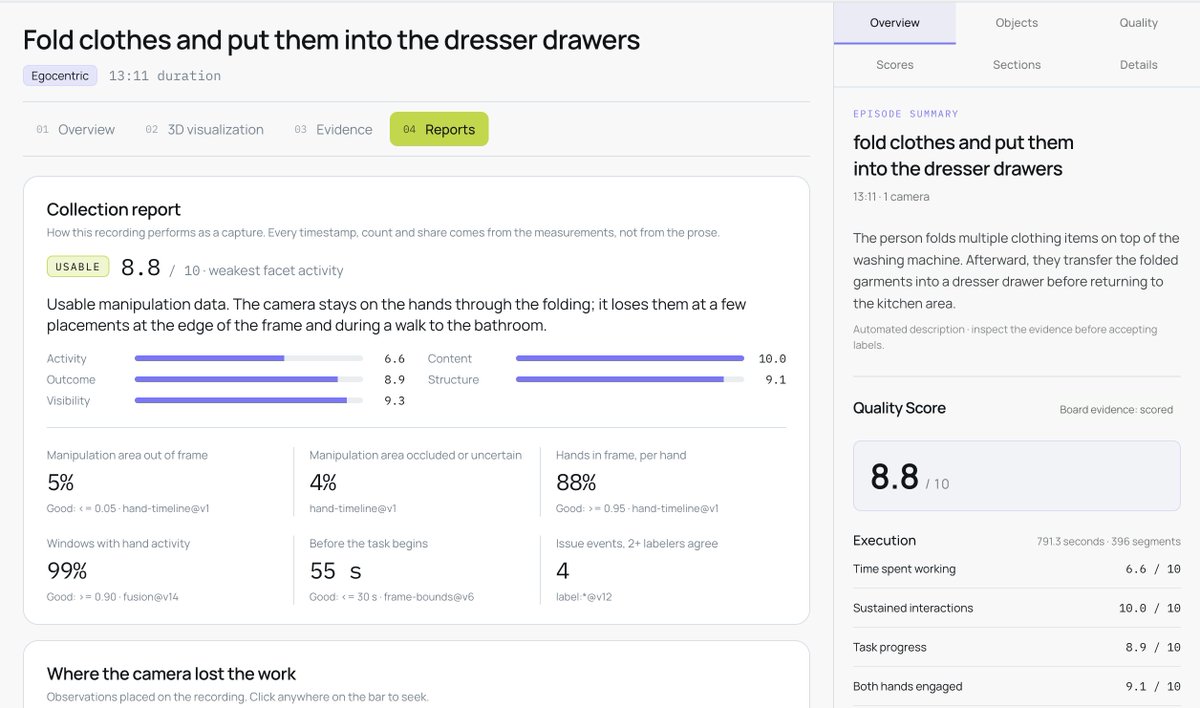
Scoring for egocentric data is now live in Munari!
No telemetry or kinematics required. Send us raw video, and we'll tell you what data is usable, what’s missing, and what to capture next.
pretty wild how much nuance there is in watching someone pick something up.
Just shipped 3D reconstruction for egocentric data in Munari!
For egocentric data, scoring quality can be much harder when the camera moves with the human. Viewpoints shift, hands disappear behind objects or out of frame, and motion alone doesn't tell you whether a task was done well.
We now visualize trajectories and pathways to help teams see which demonstrations are actually useful for teaching robots.
Introducing Munari: quality scoring for robotics data.
We’re now live helping collection teams assess data quality and improve collection. Reach out to schedule a demo!
Introducing Munari: data and operator quality scoring for robotics.
Robotics teams need training data, but collection operations often lack a consistent measure of the quality of their demonstrations. Thousands of paid operator hours, with limited feedback on how to make the next hour better.
We’re changing that with operator and episode quality scoring. Munari lets you:
➤ Evaluate every human demonstration against your definition of good
➤ Turn those scores into actionable feedback that improves how operators collect data
➤ Measure progress across sessions and track quality fluctuations over time
This creates a feedback loop that compounds: collect, score, coach, and measure what improves. Operators learn from each session, teams refine their collection process, and the same human hours produce more usable training data.
This measurement layer is the first step toward training models for reliable deployment. Making sure data teams understand what good looks like and how to consistently produce it.
Our longer-term vision is to help teams benchmark and collect the right data for a specific job, environment, and robot. Knowing what you want to deploy can guide what you collect and how you evaluate it.
Better data collection. Better robots.
We’re already live with early partners and now opening a few more spots for pilot customers.
If you’re collecting data or deploying robots, we’d love to chat!
just shipped 3D visualization of robot trajectories, optimal paths, and historical traces in @MunariAI , making it easier to inspect teleoperation data and catch quality issues before training new policies and models
hmu if you are collecting data at scale and want to try this and our automatic data and human operator QC
Robots learn from human demonstrations. The quality of those demonstrations start with the operator.
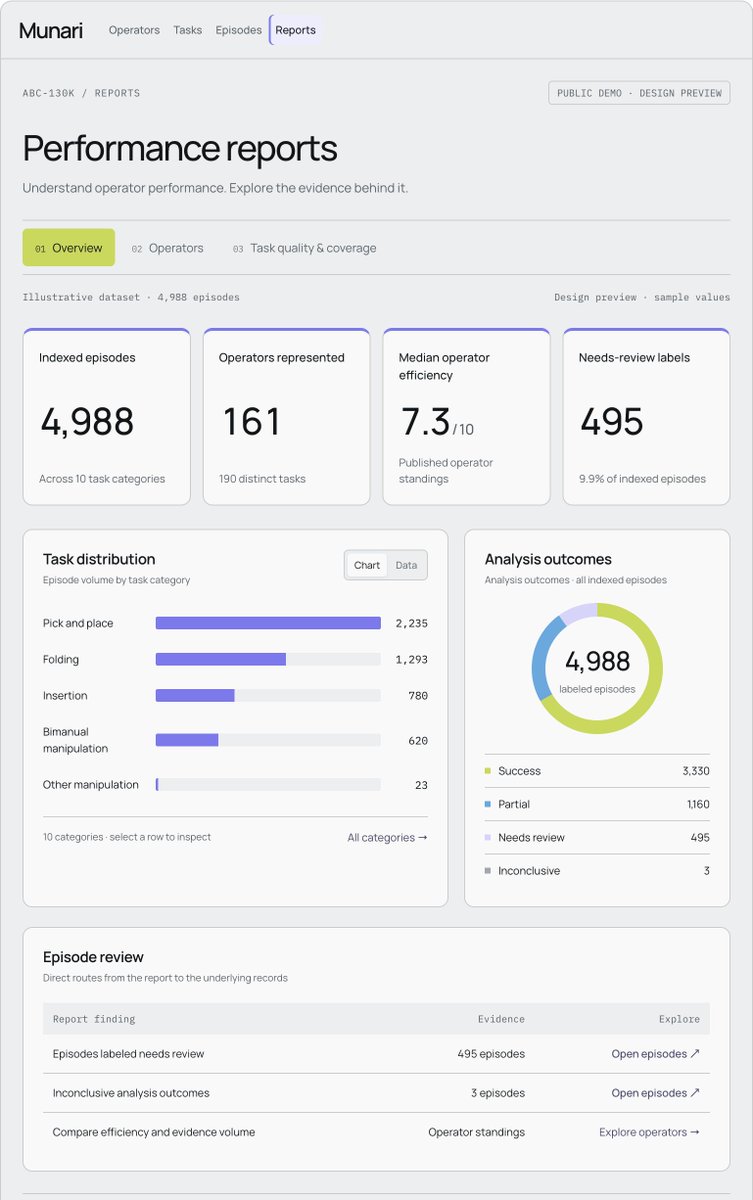
Here's a preview of @MunariAI: compare operator performance, inspect data quality by task, and explore the episodes behind every score.
@Polymarket "You're absolutely right to push back on that! I'll be sure to bring enough food and water next time! Why don't we give that another go?" - Gemini, probably
EARLY: @munariai - 6 followers (Robotics)
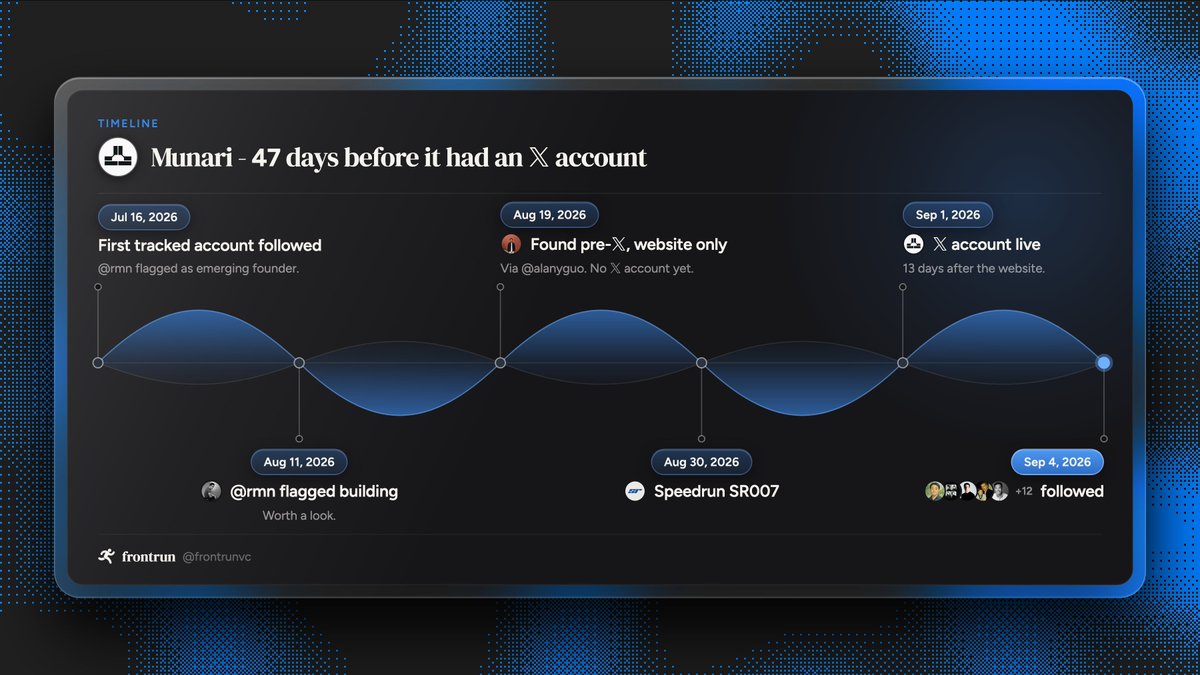
Munari just launched. Operator scoring for robot training data. On @frontrunvc, the story started 47 days before the X account went live.
jul 16: a tracked account follows @rmn. flagged.
aug 11: flagged building.
aug 19: website found. no x account yet.
aug 30: a16z @speedrun SR007.
sep 1: @munariai goes live.
sep 4: 17 tracked accounts following the founders.
a whole company, before it had a handle.
this is timeline. coming soon to every company card on @frontrunvc.
ABC-130K has operator IDs on ~130k episodes. The paper uses them for style. I haven’t seen anyone ask if those operators were actually any good.
We scored kinematics on each episode. Same task, people come out all over a 0-10, and you often can’t tell watching at normal speed. Then we train on the whole pile anyway.
Pass / fail is lossy in both directions. A rejected episode can't go back to the operator as feedback, and an accepted one enters the training set at the same weight whether it barely cleared the bar or was clean. A score keeps that information in both cases.
And the comparison basis matters more than the metric. Score every episode against a dataset-wide mean and you're mostly measuring which operator drew the harder tasks. We compare each episode against other episodes of the same task in the same session. That's what makes an operator score about the operator.
These are exactly the kind of problems we are thinking about at Munari. Check out the demo in the thread!
Every robotics company says data quality matters, but very few objectively evaluate the human operators responsible for collecting that data.
Behind every training set are a LOT of humans working to collect enough episodes. Each with different speed, smoothness, precision, hesitation, and recovery ability. All of it flows straight into the model through a single gate, pass or fail. But operator quality isn't binary, and someone had to put a score on it.
So we did.
Today we’re launching a demo of what we've been building at Munari. We score episodes on the kinematics that separate a “good” demonstration from a “bad” one, roll them up to a 0-10 score per episode and per operator, and put it in a easily queryable view to analyze findings.
Our demo looks at ABC-130K, XDOF's open bimanual teleop dataset: roughly 130,000 episodes that ship with anonymized operator IDs nobody has published a look at. The paper reports scale, task diversity, and policy results. Nothing about the people who made it.
What's interesting is how two episodes of the same task, in a clean dataset, can still sit far apart on the scale. At normal playback speed you often can't tell which is which. But when you drill in, you can uncover significant variance. And it’s clear that certain operators are better equipped at these tasks than others.
For us, kinematic quality is a starting point, not the final rubric for what makes good training data. That answer is different for every company and every policy, which is why we built our scoring to be adapted, reweighted, and validated against what data actually improves your policy.
And of course, please reach out if you want to connect or share feedback! Demo linked below.