Cool bundle tech from @justinbebis.
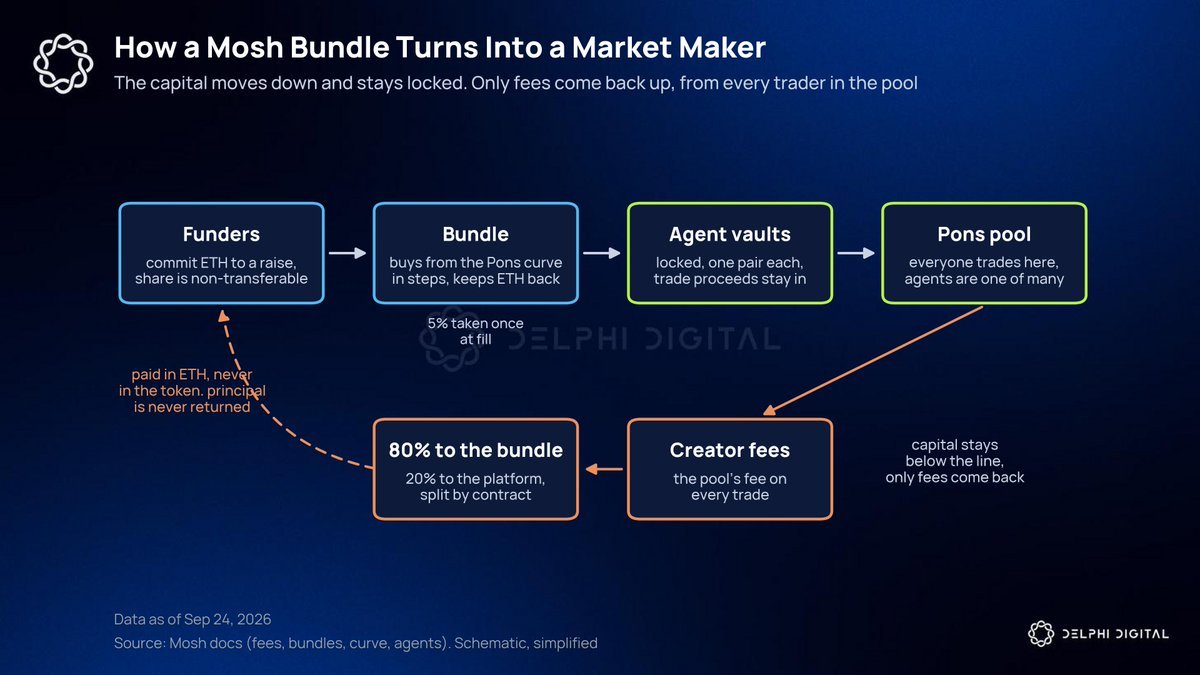
Funding a bundle doesn't buy you the token. Your contribution is locked, never redeemed and can't be transferred. What you own is a pro-rata claim on the bundle's fee income for as long as the token trades. A launch can name a team that takes 5% to 25% of the bundle's share, fixed before the raise opens.
The fees come from every trade in the pool by every trader. The agents are only one participant of many. Funders are paid in ETH, the fee asset on Pons, never in the launched token. Accrual is a running total with no claim window. The contract reads no price or oracle, so nobody can trade against it to move what you're owed. It behaves more like a perpetual fee-bearing bond than a token position.
The fee math is simple. Every trade in a Pons pool pays a 1% base fee and Pons keeps 30% of it. Each Mosh launch can also add a creator fee on a slider, from 0% up to Pons' 10% cap. Pons takes no cut of that. The remaining base fee plus the creator fee form the bundle's fee income. Mosh takes 20% and funders get 80%.
I'm sure you've seen Bundle Cat on the Pons home page recently.
Believe it or not, there's some incredible tech under the hood.
Learn about Mosh and our plans for $BUN in this article: https://t.co/DpCTIV2zNE
One square per stock. The closer its best route gets to clearing its pool fees, the darker the square, and full ink means open. The chip on top counts how many are open right now.
It reads the chain live, so the squares change as the pools move.
https://t.co/fCWJJtBOp2
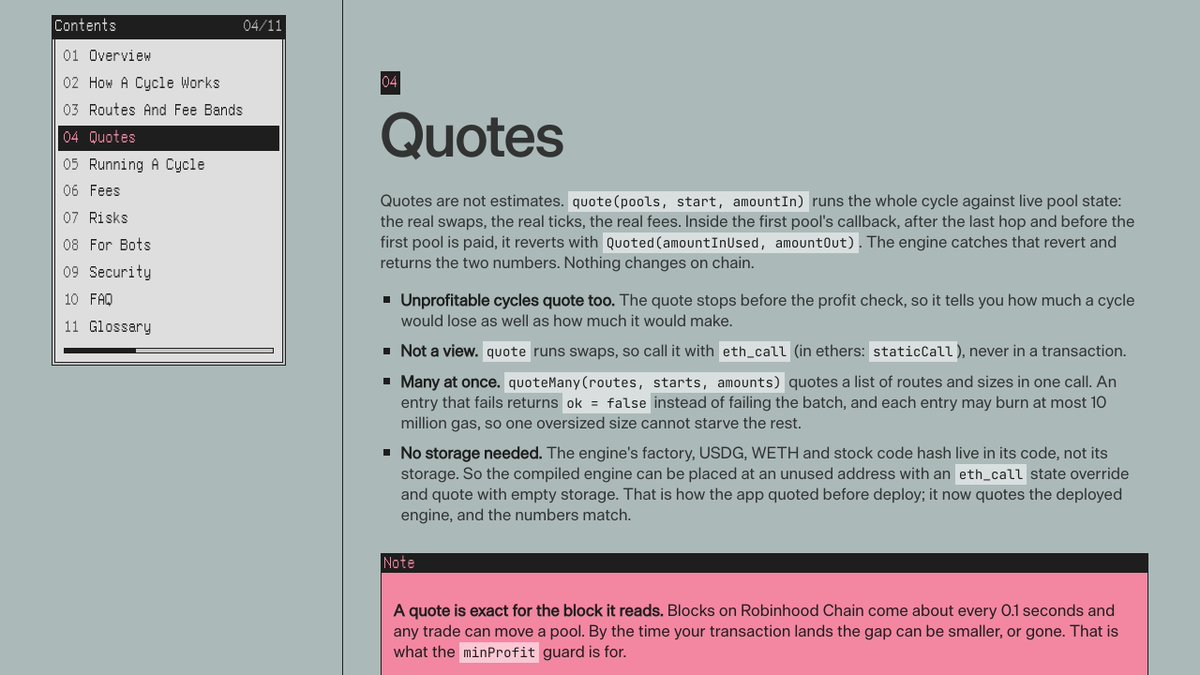
Negative quotes are useful too.
The engine's quote stops before the profit check, so it shows what a cycle would lose as well as what it would make. And quoteMany prices a list of routes and sizes in one call, where a failing entry cannot sink the rest.
https://t.co/8YeyyGFYmL
Our desk's method, in four short paragraphs: the engine does the work, in public, and every cycle is a transaction anyone can read. We read every pool every few seconds and show all of it, gaps that do not pay included. And exact beats fast.
https://t.co/RBYQjyNTY1
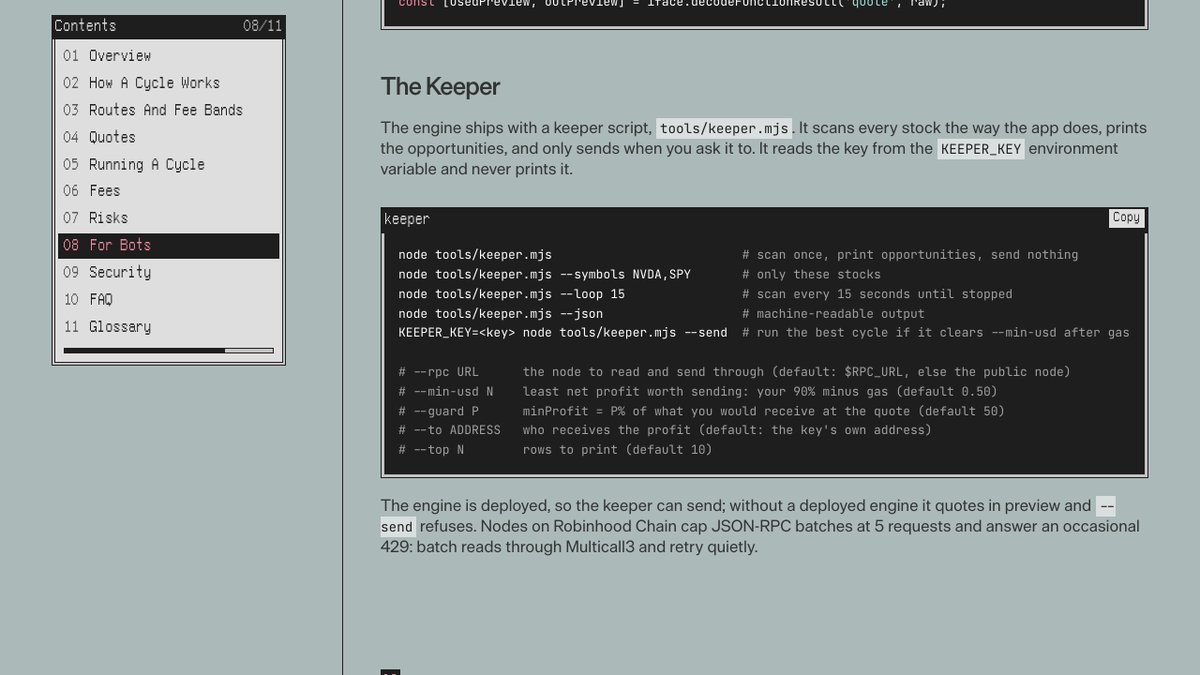
The app is one way to call the engine. The keeper script is another: it scans every stock the way the app does, prints what it finds and sends nothing unless you ask it to. It reads its key from KEEPER_KEY and never prints it.
https://t.co/8YeyyGFYmL
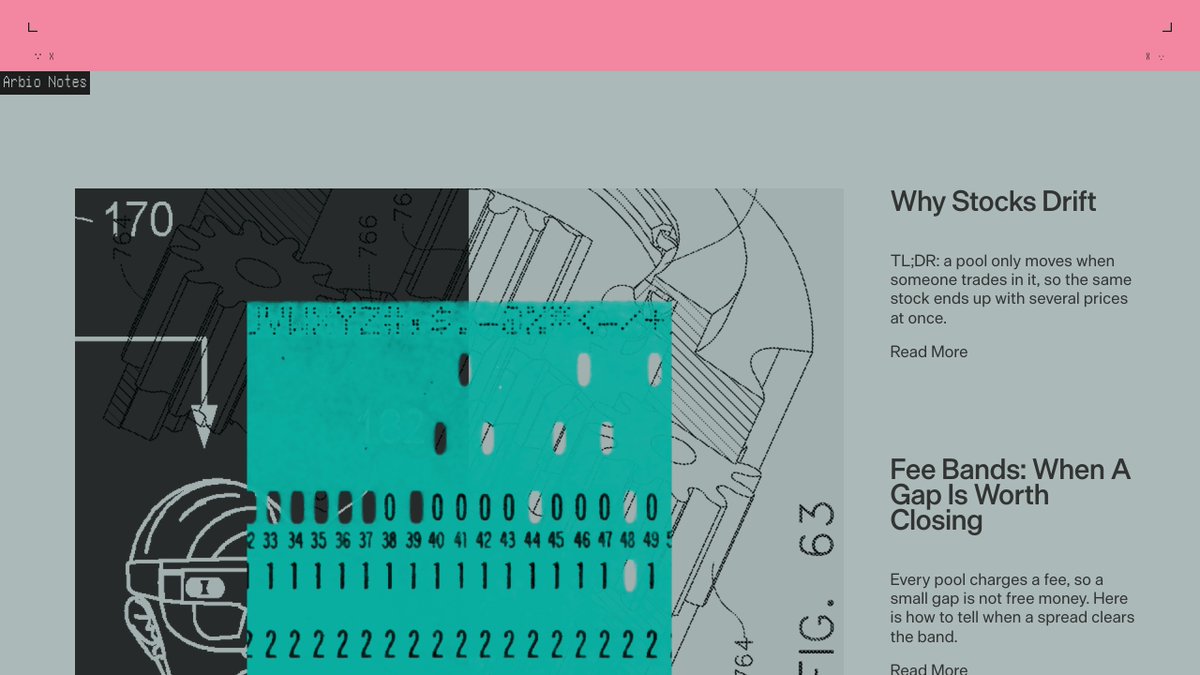
Three notes from launch day, a few minutes each: why we built a public engine, why one stock ends up with several prices at once, and how to tell when a gap is worth closing.
https://t.co/fCWJJtBgzu
Row by row: every pool of every stock against that stock's consensus price, in basis points, widest spreads first. Cells marked thin are pools too shallow to count in the mid.
Live readings, so they move while you watch.
https://t.co/rmi01vpKha
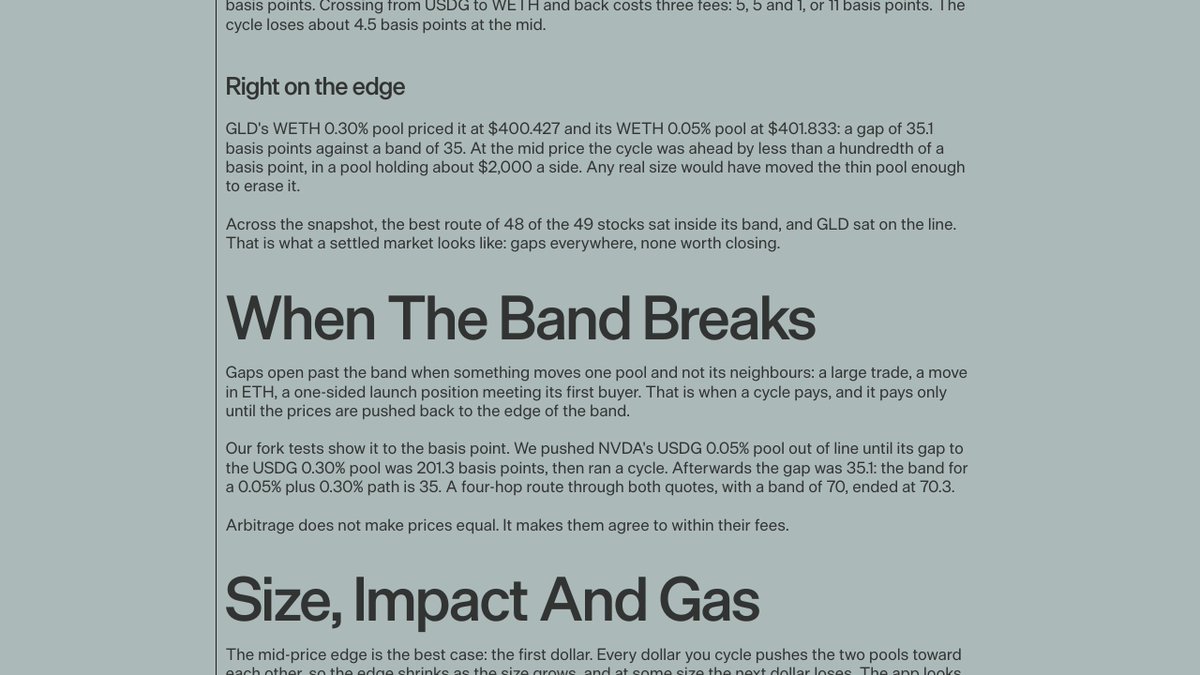
GLD sat right on the line in the Sep 18 snapshot: a 35.1 bps gap against a 35 bps fee band, in a pool holding about $2,000 a side. Any real size would have erased it.
48 of the 49 stocks sat inside their band.
https://t.co/GreZ7vNurU
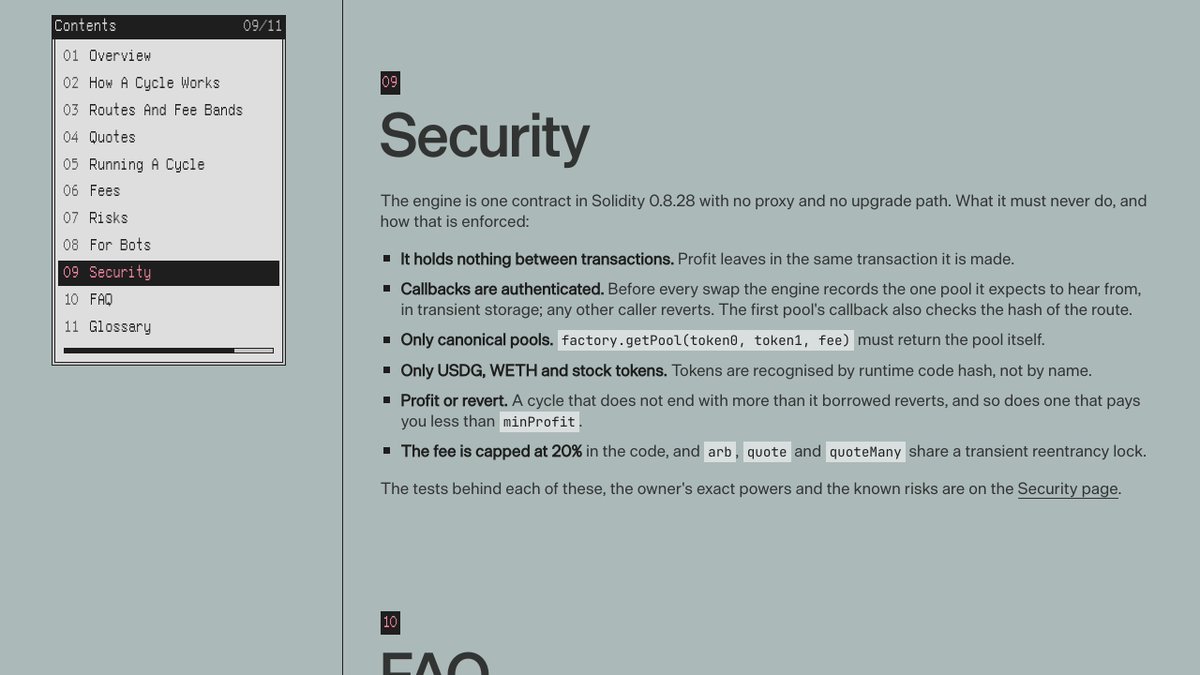
Only one address may call the engine back mid cycle: the pool it just swapped with. Before every swap the engine writes that pool into transient storage, and any other caller reverts. The first callback also checks the hash of the whole route.
https://t.co/8YeyyGFqxd
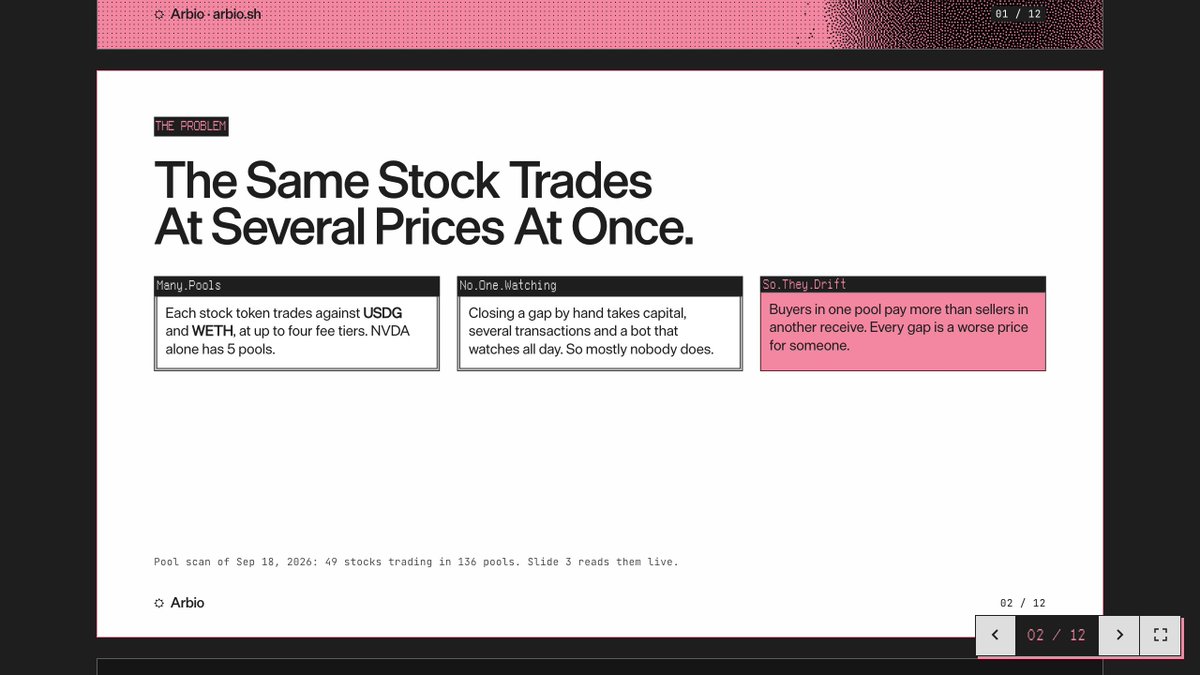
Every gap is a worse price for someone.
When one stock trades at several prices at once, buyers in one pool pay more than sellers in another receive. That is slide 2 of the deck, and the reason Arbio exists.
https://t.co/6nUZmZVNy4
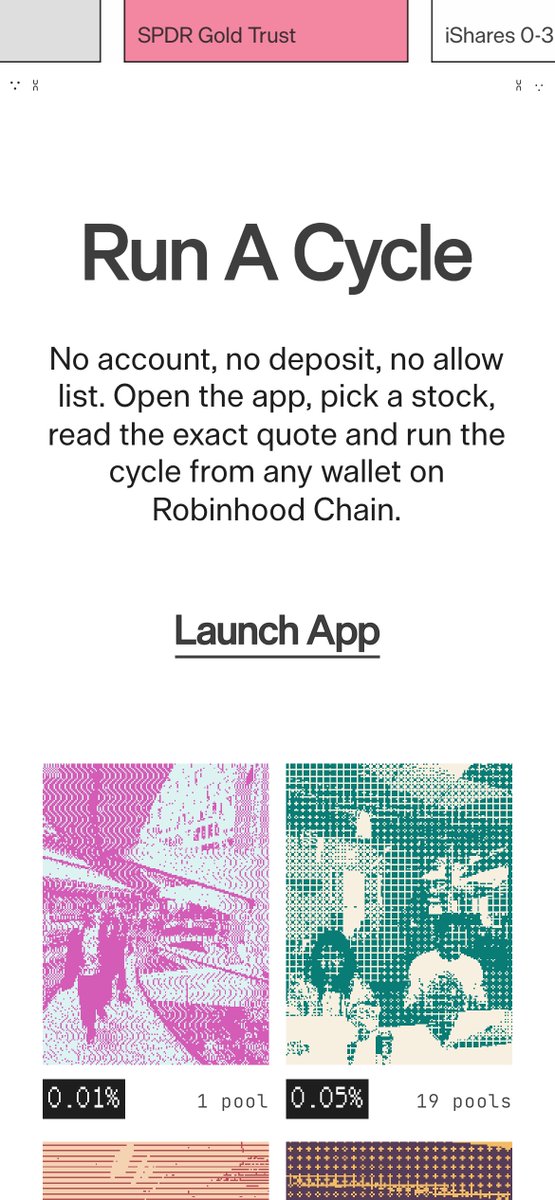
Nothing to sign up for. No account, no deposit, no allow list.
Open the app, pick a stock, read the exact quote, run the cycle from any wallet on Robinhood Chain. If the gap is gone before it lands, it reverts and costs only gas.
https://t.co/J3jlAiFjAP
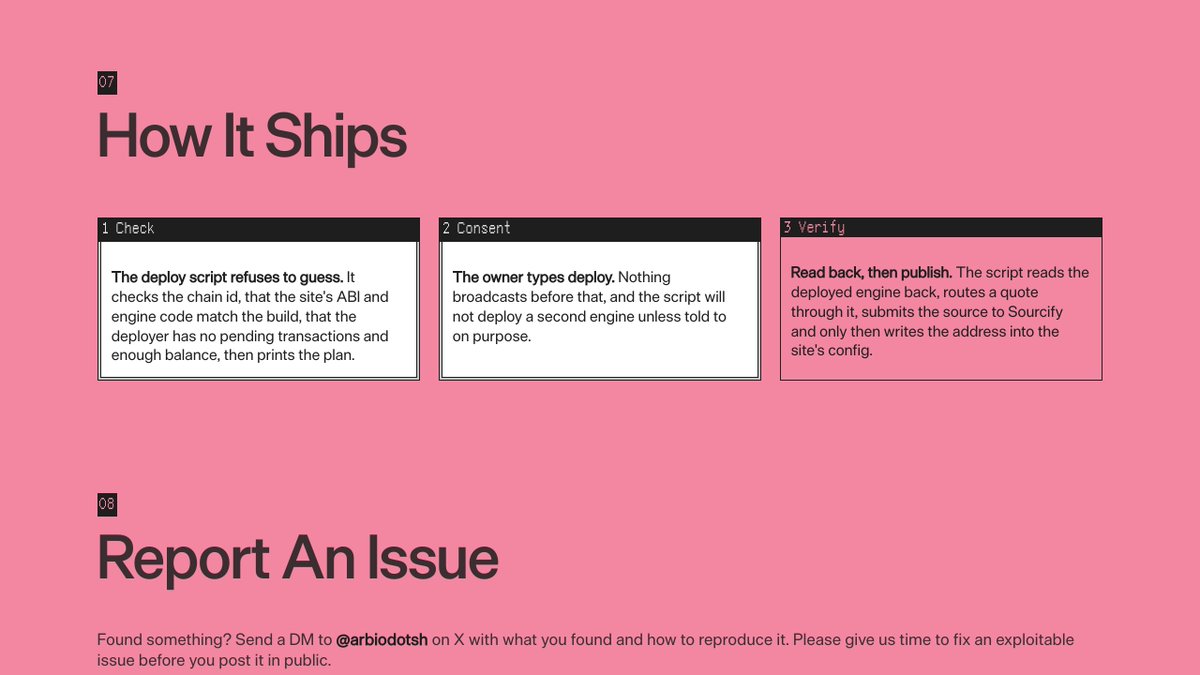
Found something wrong in the engine? DM us here with what you found and how to reproduce it. If it is exploitable, please give us time to fix it before you post it in public.
https://t.co/bNryLdk9zm
Can't sleep? Ten questions, short answers: do you need capital, is profit guaranteed (no), how quotes are made, what Arbio charges, who holds the funds.
All on the home page, just above the footer.
https://t.co/fCWJJtBgzu
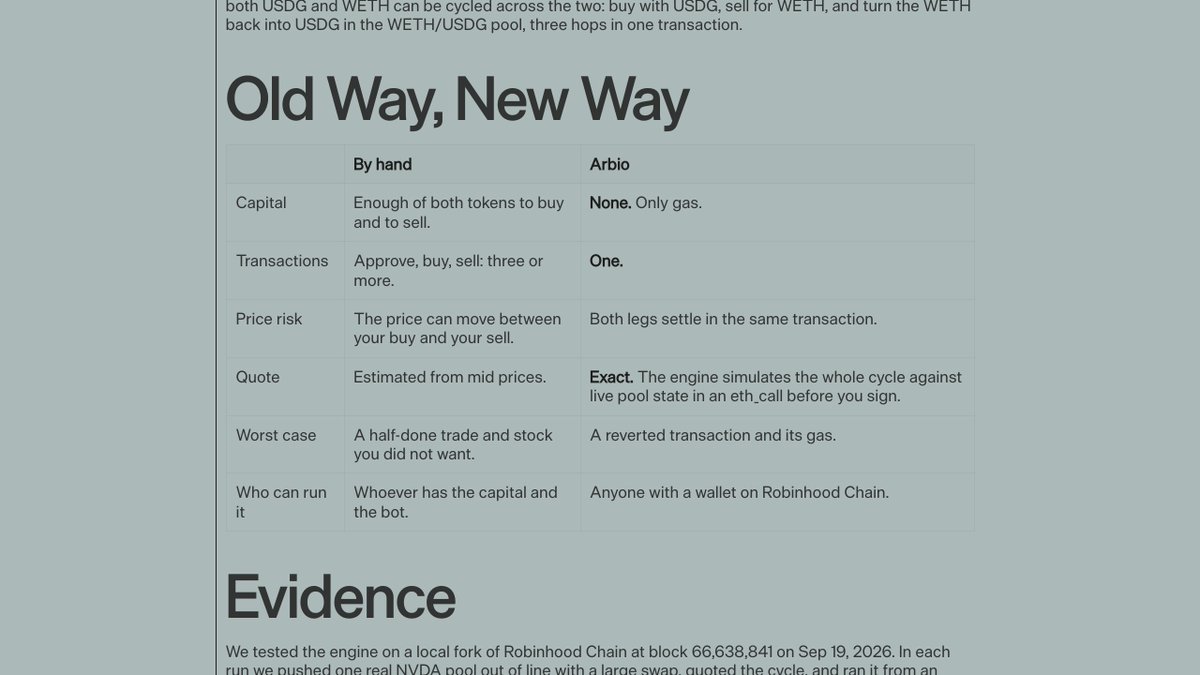
What happens to the price between your buy and your sell? By hand, it can move against you.
In a flash cycle there is no in between: both legs settle in the same transaction.
https://t.co/RUteEJoMLA
One share of NVDA, five prices on Sep 18. The two deep pools agreed within two basis points. The thin ones wandered, and nobody had a reason to walk them back.
https://t.co/TkGAndNoZa
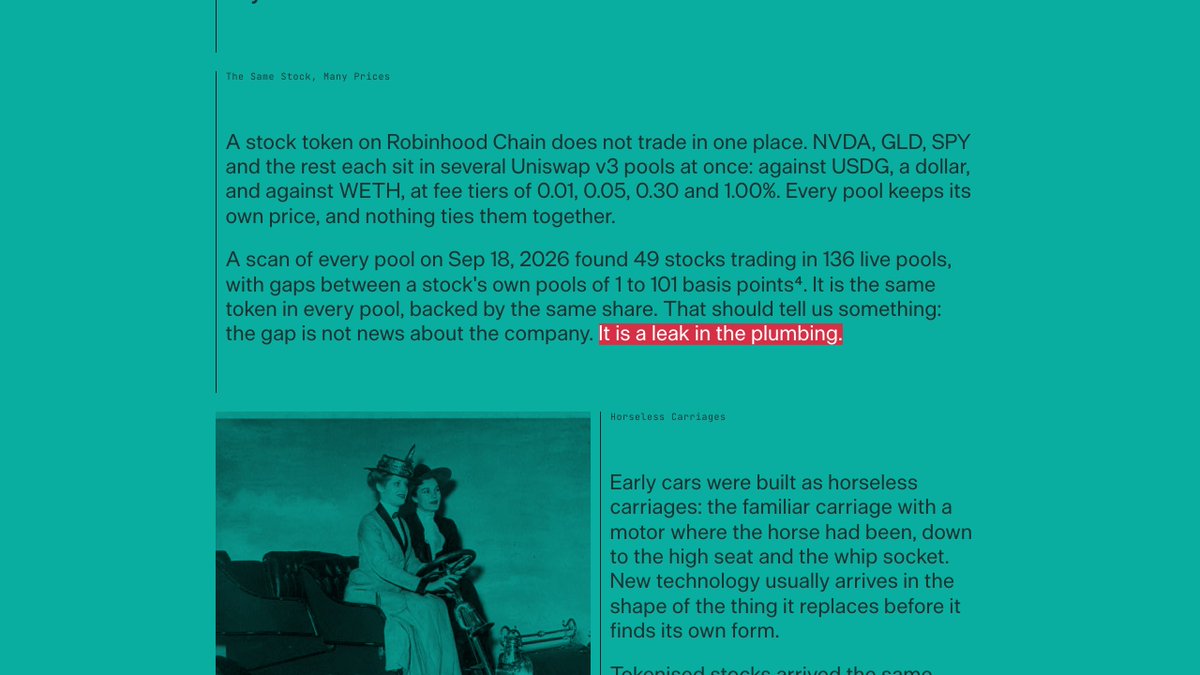
Same token in every pool, same share behind it. So when one pool prices a stock above another, that gap is not news about the company.
It only means nobody has traded the pools back together yet.
https://t.co/g2uyyi5aD0
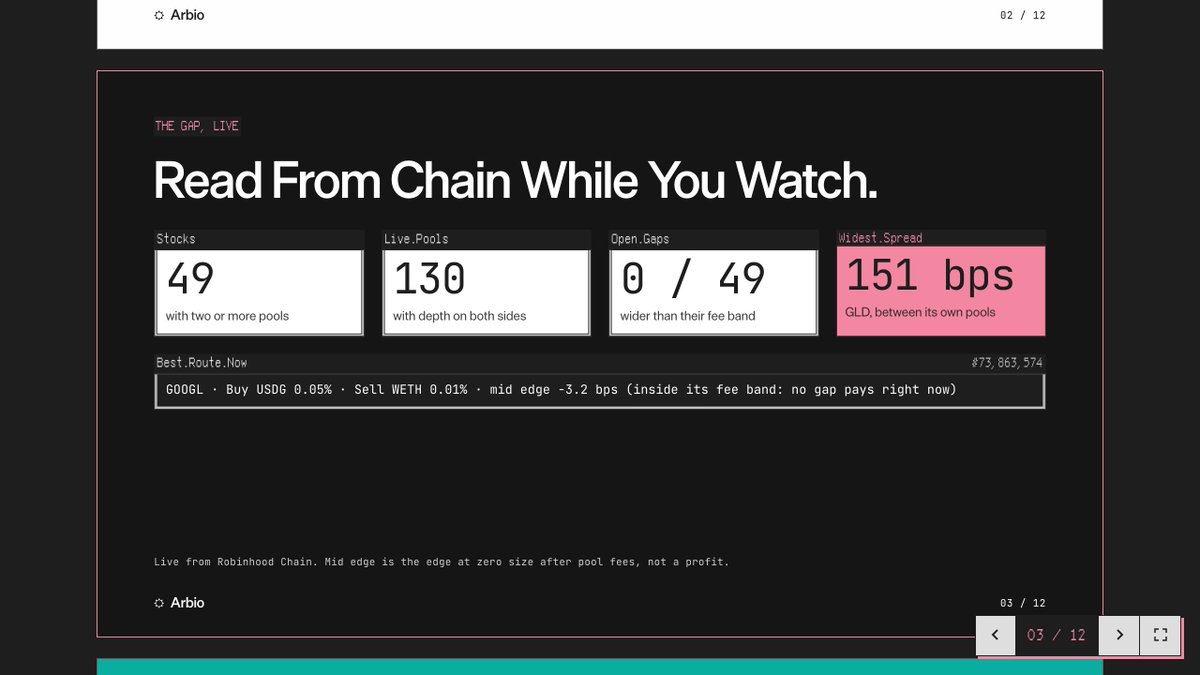
Last one for today. Deck slide 3 reads the chain live: stocks, live pools, open gaps past their fee band, the widest spread and the best route now. Its mid edge is the edge at zero size after fees, not a profit. Arbio runs on the bundle agent from @uv.
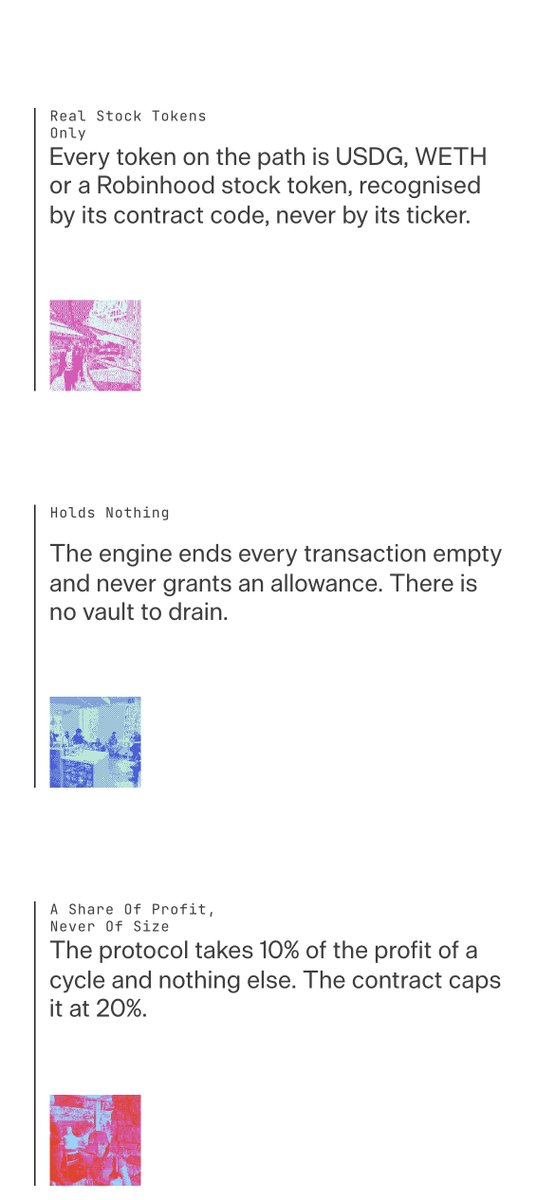
How does Arbio know a token is a real Robinhood stock? Never by its ticker, which anyone can copy. The engine checks the contract code every stock token shares. A deployed copy of that code would still pass, so the app and keeper only route through the stock list in the config.
A few words behind Arbio. Fee band: the sum of pool fees on a route. Mid edge: what a tiny cycle would earn after those fees. minProfit: the least you accept, or the cycle reverts. Canonical pool: one the Uniswap v3 factory itself returns. The rest: https://t.co/8YeyyGFYmL
How the engine shipped. The deploy script checks the chain id, the build and the deployer. Nothing broadcasts until the owner types deploy. Then it reads the engine back, routes a quote through it, submits the source to Sourcify and only then writes the address into the site.