World Flaneur @ global equities, cross markets. Connoisseur boom/bust. Ex-head global prop trading. Just memo to myself, not investment advice @uchicagoalumni
This week, two people asked me to borrow money. One was extended family and the other a friend.
My dad taught me a great two-part framework for these situations that has served me well over the years:
1) Never loan money to family and friends. Instead, make it a gift. It will help them more, and it keeps you from being in the collections business (and potentially screwing up your relationship). Equally importantly, it just feels better. If they choose to pay you back, that’s gravy.
2) Make it clear that it’s a one-time thing. You can always reconsider that in the future based on circumstances, but you should set the expectation that the answer will be no next time.
"The only way to gain an edge is through long and hard work. Do what you love to do, so you just naturally do it or think about it all the time, even if you are relaxing... Over time, you can accumulate a huge advantage if it comes naturally to you like this."
— Li Lu
David Lynch's Diagram for Transcendental Consciousness.
One of the greatest, easiest to understand explanations for how our reality is made of MIND first, MATTER second.
I promise this is genuinely worth your time.
The Russian scientists like Kozyrev and Kaznacheyev had some astounding insights and ran successful experiments that most westerners have never even heard of.
I can’t overstate how excited I am to see what’s in Brians trove of information. 🤔🤩
Nassim Taleb breaks down the Black-Scholes formula - and the story he tells starts with a forgotten man.
Louis Bachelier priced options 73 years before Black-Scholes - and modeled Brownian motion 5 years before Einstein.
it was 1900. a 30-year-old Frenchman defends a thesis under Henri Poincaré that quietly invents two fields at once: the math of random markets, and the first real formula for pricing options.
his reward? the committee marks it down - "too much finance." no top grade, no patron, no career. he spends his life applying for jobs one rank below what his work deserved, and dies forgotten in 1946.
then 1973: Black, Scholes & Merton publish the option-pricing formula. it reshapes Wall Street and wins the 1997 Nobel - for two of them (Black had died, so missed it). almost nobody remembers the Frenchman who got there first.
and here's Taleb's twist: traders never actually use Black-Scholes. what the market runs on is a version of Bachelier's original. the Nobel, he argues, wasn't even for the pricing - it was for dressing it up to fit the economic theory of the day.
~15-min lecture, free. the man who built modern finance — and watched the credit go to everyone but him ↓
Mark Spitznagel - founder of Universa, the "black swan" fund Nassim Taleb advises - on the most counterintuitive idea in investing:
add a 3% sliver of crash insurance to a stock portfolio. give that insurance a 0% expected return - it makes nothing over time.
it still raises the portfolio's long-run compound return - by roughly what you'd get from putting that same 3% into an asset returning 20%+ a year.
how? by killing the deep drawdowns that quietly destroy compounding. but the insurance has to actually fire in a crash. one that only sometimes pays out is "like a parachute that only sometimes deploys - you're better off not wearing one."
most "safe havens" - gold, the dollar, hedge funds, even a Picasso - fail that test.
~13-min talk, free. the man who made ~4,000% in the 2020 crash, on what actually protects you ↓
Andrew Huberman says these 5 things make every single health issue better, and their absence makes everything worse.
1. Solid sleep
2. Morning sunlight
3. Regular movement (whatever you actually enjoy)
4. Eat mostly real food that would spoil if left out, keep ultra-processed stuff under 25%
5. Real human connection (cut toxic ones)
No fancy protocol, no supplement stack, no biohacking kit. Just the non-negotiable foundations. Everything else is secondary.
Which of the five is hardest for you right now?
"Gebakken lucht, verse gebakken lucht, 333gulden per aandeel en het stijgt en wie weet wat het waard is over een half jaar, ja mensen gebakken lucht, kom der bij" De k/w waardering is nog schever dan ttv World Online die zich óók op kleine beleggers richtte. Nina zelf verkocht.
🔥 "Demystifying Managed Futures" Sharpe ratio de 1,8 con una estrategia que entendés en 5 minutos
Hurst, Ooi y Pedersen (AQR) lo publicaron en el Journal of Investment Management 2013 y se metieron con algo grande: los fondos CTA mueven USD 320.000 millones, cobran fees carísimos y operan como cajas negras. El paper demostró que atrás de todo eso hay una sola cosa, seguir la tendencia
La estrategia que usaron es de las más simples que vas a ver:
- Si el activo venía subiendo, te ponés long
- Si venía bajando, te ponés short
- Lo hacés sobre 58 mercados distintos
- Mirás la tendencia en 3 ventanas de tiempo: 1 mes, 3 meses y 12 meses
Lo que rinde la estrategia diversificada:
- Sharpe de 1,8
- Casi sin relación con el SP500 (correlación de -0,02)
- Su mejor momento es cuando el mercado se va a los extremos, para arriba o para abajo
Acá viene la parte más brutal del paper: agarraron esta regla simple y la compararon contra los CTAs más grandes y exitosos del mundo
- La regla simple explica entre el 36% y el 64% de lo que hacen esos fondos
- Se mueven casi igual (correlaciones de 0,66 a 0,78)
- Y cuando descontás lo que aporta la tendencia, el famoso alpha de la mayoría de esos managers se va a cero o queda negativo
O sea, una industria entera replicada con una regla que entendés en un café. ¿Y la diferencia entre el 1,8 del paper y lo que termina ganando el cliente del fondo? Los fees. Estos fondos suelen cobrar una parte fija más un porcentaje de las ganancias, y entre las dos cosas se llevan alrededor de un 6% por año, más los costos de operar
Mi conclusión: es de los papers que más te empoderan como inversor. Te muestra que el motor de un producto carísimo es algo simple, replicable y que podés entender. Si la idea es seguir tendencias, no hace falta pagarle fees gigantes a un fondo para acceder a eso
Link al paper en el primer comentario
The most predictable object in physics becomes completely unpredictable the moment you add a second joint.
A double pendulum.
It is two rods connected end to end, free to swing in any direction.
You release it from any starting position and the motion that follows looks completely random. The bob traces wild loops and figure eights, jerking suddenly in unexpected directions, switching between smooth arcs and violent whips with no apparent pattern.
The equations that govern its motion are perfectly known. Newton figured them out 300 years ago. Every force, every angle, every velocity can be calculated exactly using classical mechanics. The math contains no randomness, no quantum uncertainty, no hidden variables. Pure determinism.
Yet no computer on Earth can tell you where the pendulum will be in five minutes.
The reason exposes something unsettling about the nature of knowledge itself.
The double pendulum exhibits what mathematicians call sensitive dependence on initial conditions. Change the starting angle by one millionth of a degree and after a few swings, the entire trajectory diverges completely. The pendulum that was heading left suddenly rockets right. The smooth motion becomes chaotic. The predictable becomes impossible.
This sensitivity compounds exponentially. Every passing second doubles the uncertainty. After ten seconds, your prediction error has grown by a factor of a thousand. After twenty seconds, a million. The mathematics are relentless.
To predict the pendulum's position with perfect accuracy, you would need to know its initial state with infinite precision. You would need to measure the starting angle to infinitely many decimal places. The position of every atom in the rod. The gravitational influence of every planet in the solar system. The quantum fluctuations in the vacuum around it.
Perfect measurement is physically impossible. Quantum mechanics guarantees that measurement introduces uncertainty. The Heisenberg principle puts a hard limit on how precisely you can know both position and momentum simultaneously. Even in principle, complete information about any physical system remains forever beyond reach.
What makes this philosophically devastating is that the double pendulum follows completely deterministic laws. Nothing about its motion violates causation. Nothing happens without a cause. If you could rewind the universe to exactly the same state and let it play forward again, the pendulum would trace exactly the same path. The motion is absolutely determined by the laws of physics.
But determinism and predictability turn out to be completely different concepts.
The universe can be a clockwork mechanism where every outcome follows inevitably from the previous state, while simultaneously being impossible to forecast beyond a few moments. Deterministic and unpredictable. Lawful and chaotic. Both at once.
This paradox shows up everywhere once you know what to look for.
Weather systems follow the same mathematics as the double pendulum. The atmosphere obeys precise fluid dynamics equations. Every air molecule moves according to known physical laws. Yet weather forecasts become meaningless after about two weeks because small measurement errors explode into massive uncertainty.
The three body problem in astronomy works the same way. Computing the precise orbit of three gravitating objects is mathematically impossible for the same reason predicting the double pendulum fails. The motion is deterministic but the sensitivity to initial conditions makes long term prediction hopeless.
Stock markets, population dynamics, neural networks in the brain, the formation of turbulence, the dripping of a faucet... all governed by deterministic equations, all fundamentally unpredictable.
Chaos theory emerged from recognizing this pattern. Systems that should be predictable often contain an inherent unpredictability that no amount of computational power can overcome. The randomness emerges from the deterministic rules themselves.
The double pendulum demonstrates something stranger still. Its motion is confined to what mathematicians call a strange attractor. Despite the apparent randomness, the pendulum never strays outside a particular region of possibility. The chaotic trajectory traces out an invisible geometric structure in phase space, never repeating exactly but never escaping the bounds of its attractor.
Order hidden inside chaos. Structure within randomness. Constraints that operate even when prediction fails completely.
Watching a double pendulum swing forces you to confront the limits of human knowledge in real time. Every physicist knows the equations. Every physicist can run the simulation. Every physicist watches their predictions dissolve into uncertainty within minutes.
The pendulum keeps swinging according to laws we understand perfectly while following a path we cannot foresee.
Some philosophers argue that chaos theory provides space for free will in a deterministic universe. If even simple mechanical systems cannot be predicted despite following strict causal laws, perhaps human behavior operates in the same gap between determinism and predictability. The future could be fixed by the laws of physics while remaining genuinely open from our perspective.
Others see chaos as proof that reductionism has limits. Knowing the fundamental equations does not automatically grant understanding of emergent behavior. The whole becomes more than the sum of its parts when sensitive dependence amplifies tiny differences into massive changes.
The double pendulum swings in laboratories around the world, reminding every observer that the universe keeps secrets even when it follows rules we know by heart.
Physical law and predictive power are not the same thing.
The equations are perfect. The future remains dark.
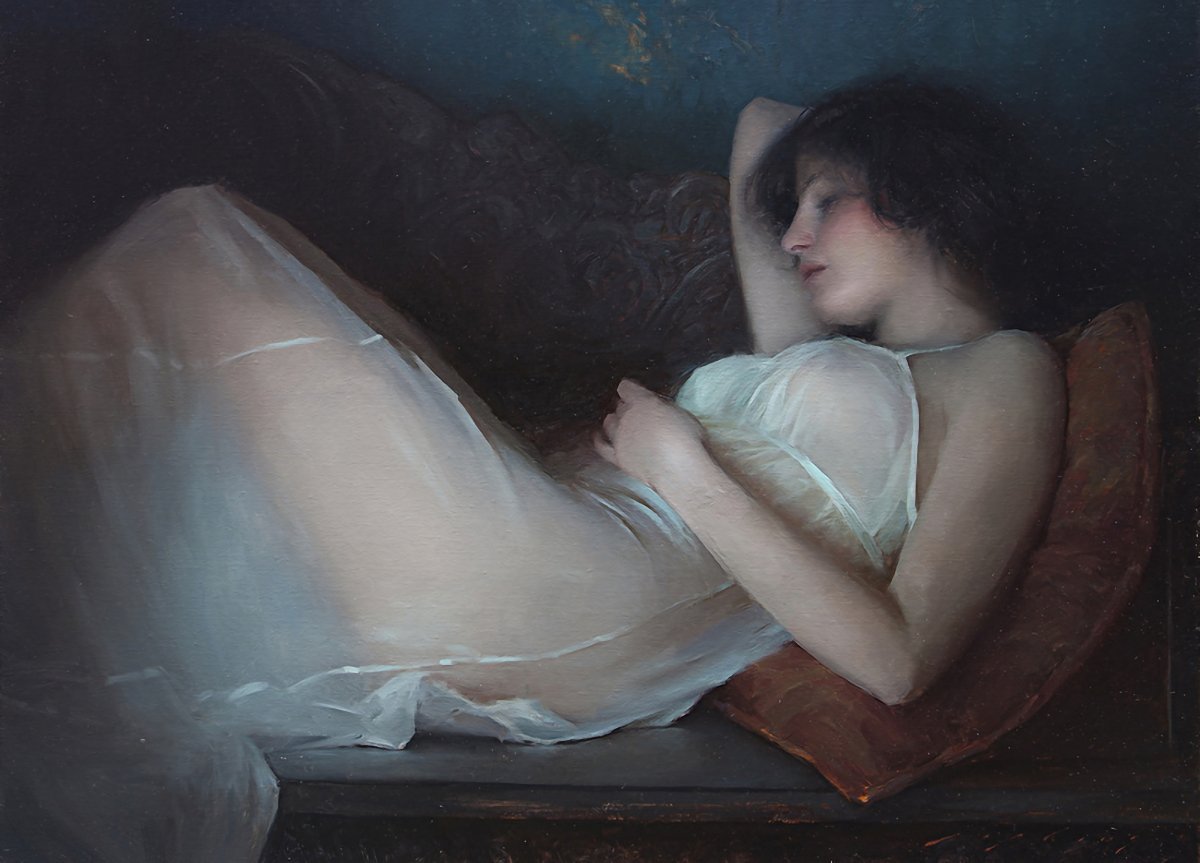
Lipking painted Reclining in White in 2004, early in his career, when he was really perfecting that soft, natural light he’s known for.
It’s from the phase where he was still mostly working indoors, keeping things quiet and intimate.
Just a model, a bit of fabric, and that calm, diffused light he handles so well.
Nicolai Tangen has interviewed all the most important CEOs and investors in the world (that's what $2T AUM buy you: lots of access). He has also interviewed a fair number of HF managers. Here are my favorites. Even so, it's almost 4 hrs. But I recommend actually listening, over the gemini summary.
Chris Hohn: https://t.co/5CdNm3fHI6
Paul Singer: https://t.co/DLq2U0atoa
Marc Rowan (not a HF, still interesting): https://t.co/k2BHwbPJFv
Stan Druckenmiller: https://t.co/H4sOAC1mU4
Ken Griffin: https://t.co/iepjcVwGOZ