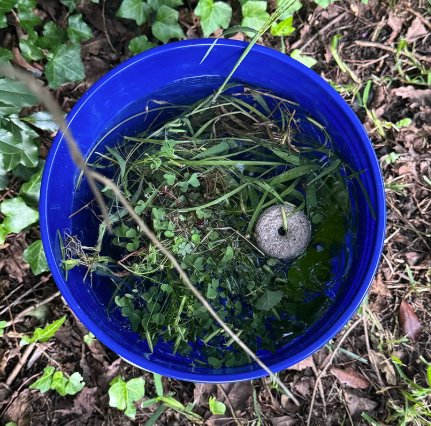
You can crash your yard's mosquito population without spraying a single chemical with a Mosquito Bucket of Doom.
Fill a 5-gallon bucket about two-thirds with water. Drop in a handful of grass clippings, leaves, or hay. Let it sit for a day, then drop in a Bti dunk (also called Bacillus thuringiensis israelensis, sold at any hardware store as "mosquito dunks," about $10 for six).
Mosquitoes are powerfully attracted to fermenting water and will lay their eggs in your bucket. Bti is a naturally occurring soil bacterium that produces a toxin that kills mosquito, blackfly, and fungus gnat larvae only.
This method doesn't harm bees, butterflies, fireflies, fish, frogs, birds, pets, or people. BTI dunks are EPA-approved for organic use and safe in animal water troughs and birdbaths.
One dunk lasts about 30 days. Top off the water as it evaporates. Cover with 1/2-in Mesh Hardware Cloth to prevent animals from getting trapped and put the bucket somewhere shady where pets and kids won't get into it.
The bucket becomes a mosquito magnet and a dead end. Compare that to fogging the entire yard with pyrethroids, which kills every insect in it, including the predators that eat mosquitoes.
Doug Tallamy's Homegrown National Park has been running the "Mosquito Bucket Challenge" since 2021. The more buckets in a neighborhood, the bigger the dent. One bucket per yard is a great start.
If a separatist group wants to fight this in court, they can pay for their own appeal. It is not the responsibility of Alberta taxpayers to subsidize a political project the government claims it does not even support.
https://t.co/vVQJpxwi88
🇯🇵A Japanese developer built an app that puts a fat cat on your screen and forces you to take a break
Silicon Valley spent billions on wellness platforms, mindfulness subscriptions, and digital detox retreats
A guy in Japan said: fat cat, problem solved
West of Edmonton is one of the biggest sundials in North America. It stands at a height of 6.4 metres and weighs 40 tons with its marker stones. Each of the stones, deposited by retreating glaciers, were gathered from the surrounding area for the sundial.
“May your troubles be less, and your blessings be more, and nothing but happiness come through your door.”
— Traditional Irish blessing
Green flowers, symbolising good health and good fortune, to wish the Emerald Isle a happy St. Patrick’s Day. #StPatricksDay#LaFeilePadraig
Did you know that the composer of the famous Game of Thrones soundtrack is Iranian?
This is a cover of the iconic piece on the Iranian Daf, arranged by Reza Sajjadi and the original composer of this music is Ramin Djawadi 🔥
Notice who is playing it?
The Art Of Losing It. Aka I’m so sick of politics I feel like our entire lives revolve around them now. You can’t stop engaging but sometimes you just need to take a lil break. Lyrics by me. Tools #Midjourney And #VEO3#Suno . #ai#aiart#aivideo#music
fear is my new all-time favorite program due to all the context, imagine being a 21 year old boy and performing such a profound and meaningful message on the biggest stage in the world after spending two weeks receiving tons of hate
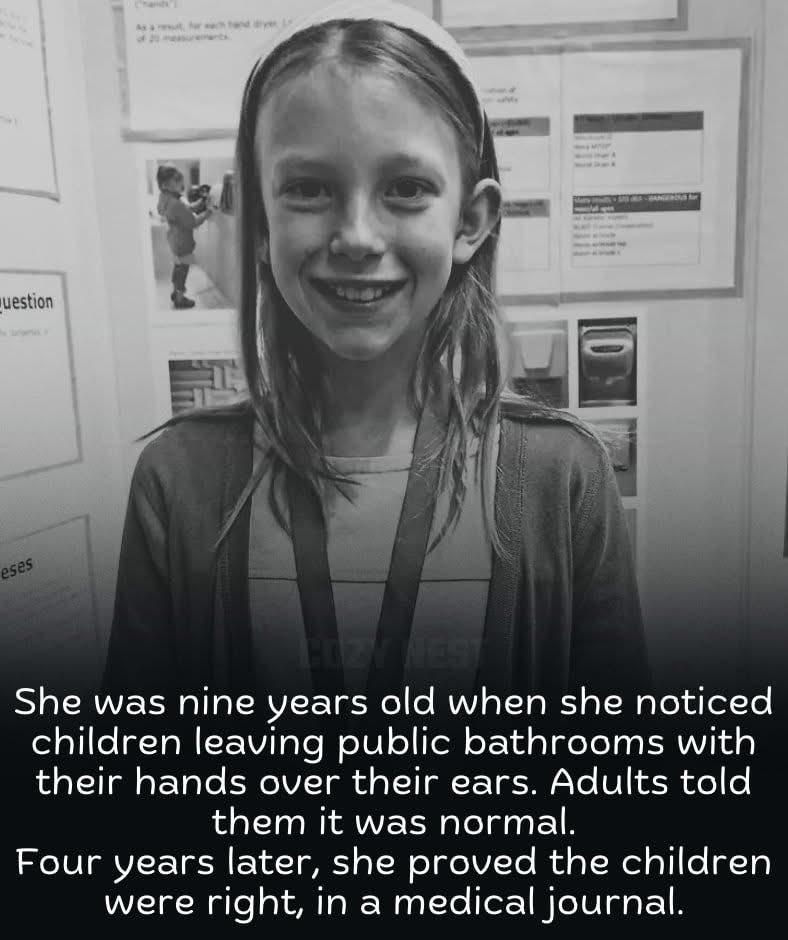
Nora Keegan was not trying to change public health policy. She was just paying attention.
In elementary school in Calgary, she noticed something adults kept dismissing. Children rushing out of public restrooms. Hands clamped over their ears. Faces tense. Complaints whispered between friends. It hurts my ears.
She felt it too. After using hand dryers, her ears rang. The sound lingered. Adults brushed it off. They are just loud. That is what machines do.
But Nora kept wondering why children reacted so strongly. And more importantly, why no one was measuring it.
In fifth grade, she decided to find out.
With the help of her parents, both physicians, she turned curiosity into research. She borrowed professional sound equipment. She designed an experiment. And then she went where the problem lived.
Public bathrooms.
Over two years, she visited forty four restrooms across Alberta. Libraries. Restaurants. Schools. She took eight hundred and eighty measurements. She measured at adult height. Then she crouched to measure at child height. She tested distance. Position. Airflow. Again and again.
What she found was impossible to ignore.
Many high speed hand dryers exceeded one hundred decibels at a child’s ear level. Some reached levels comparable to emergency sirens. Levels that medical authorities already prohibit in children’s toys because of the risk of hearing damage.
Children were not imagining the pain. They were standing closer to the source. Their ears were smaller. And the sound hitting them was stronger than what adults experienced.
Manufacturers claimed their machines were safe. Nora’s data showed real world conditions told a different story.
And she did not stop there.
Still in middle school, she began designing a noise reduction filter. A simple modification that lowered sound output by more than ten decibels. Proof that the problem was not inevitable.
Then she did something most adults never do. She wrote a scientific paper.
Her first submission was rejected. So she revised. She corrected. She tried again.
In June 2019, Paediatrics and Child Health published her study. Its title was direct and impossible to dismiss. Children who say hand dryers hurt my ears are correct.
She was thirteen years old.
Health professionals paid attention. Researchers cited her work. Parents shared it. Manufacturers requested meetings. All because a child trusted her own experience enough to test it.
Nora did not raise her voice. She measured. She documented. She proved.
And in doing so, she reminded the world of something simple and easily forgotten.
Sometimes the smallest voices are describing the biggest problems. You just have to listen.
“A fundamental Canadian value is that people should be able to be whoever they want to be, to love whoever they want to love,” Mr. Carney said to roaring applause.