The fallacy of this is that more creates more. More hours, more hiring, more something.
And it is true in a sense. If you put in more work, more work will happen. But I think for most startups, the leverage is really in how differently you approach the problem, how well you cultivate your team, and the strategy.
Any large company can outspend you on hours. They have thousands or tens of thousands more people, spending more hours. If hours worked were the metric, every large company and government organization would always win and do the best work. More hours, better output.
This thinking is often representative of younger founders, where the startup becomes their identity and life. They have a hard time doing anything else, and cannot understand that your work is not the person that is you. But activities outside of work can grow you as a person too and make you do better work.
I’ve never worked this way. As a designer, I always saw the need to take a step back, to take a break. At times, I might work 12 hours or 16 hours, or whatever amount was needed, but it wasn’t the norm. You just can't grind design, you need inspiration. But taking that step away from the work, would give me more perspective, inspiration and I could approach the problem differently or I could just see the solution.
Grinding is never good for any creative problem, and startups or creating new products are often mostly about creative problem solving. Grinding works ok for email jobs, or where you just executing on very clear playbook.
With Linear, we’ve never worked this way. We work reasonable hours, 5 days a week. All of us founders have families. Many of our employees have families. I personally stop every evening, spend time with the family, cook dinner for the family, eat dinner together, and focus on things outside of work. Sometimes I work in the late evenings or weekends, but to me the pride is that I don’t need to. Company should be succesful without it.
My goal is to build a company that is sustainable in the long term, and doesn’t require heroics or personal sacrifices every single day.
There are times when our team is heroic. Launches, incidents, some other work that just needs to be done. They will work late into the night because they know it is the right thing. But we don’t require that every day or every week, and the more this happens, the more I think it is a failure of our company and leadership. The team and the leaders should always keep a reserve to use when something is needed.
Our thinking was also that quality, which we value, doesn’t emerge from working more or stressing people more. It emerges when you create the conditions for it to emerge. Often it is the appreciation, space, time, and how the person feels. A person who is rested will do better work.
I wouldn’t attribute much of our success to working a lot. The success came from having clear thinking, ideas, and focus to do the right things.
I sometimes wish we could move the culture more toward a Zen master.
Real mastery is not exerting the most effort. It is achieving the outcome with the least necessary effort.
I do think most people getting good results from LLMs coding are probably underestimating their implicit knowledge and how it affects things. it's easy to not realize how much you're filtering what you do and don't trust from LLMs and this can make experiences vary a lot
We never hired for layoffs. We hired with the hope that people would stay, grow alongside us, and build @linear in the long term.
The deliberate pace of growth made the culture we have today. Trust, high bar for quality, and low attrition.
In hindsight, I was extraordinarily lucky that my first real software job was at a company that truly valued collaboration and transparency. We huddled around whiteboards, paired on writing code, and learnt from each other every single day. Only later did I realise this is not the default mode of working across much of the industry, leading to a tremendous waste of human capital.
@thdxr@andrew_r@antirez@opencode thanks. feels like the bash tool shouldn't have opinions about git commits...
I'll concede I was wrong about custom prompts not replacing the system prompt though.
"you can outsource thinking but not understanding"
vs
"you can outsource work but not understanding"
There is a nuance here.
I’m not sure “thinking” is something you can fully separate from understanding.
Thinking is often the continuous process that creates understanding. There cannot really be understanding without some thinking.
Someone else can think through a problem, analyze it, synthesize it, and hand you the output. AI can do the same. But what you receive is still an output, or a communication of that thinking.
The actual understanding has to happen on your side. You have to integrate the output (thinking and output), test it against your own judgment, and your understanding (and thinking) is needed to decide whether it is right.
Essentially, you have to do your own thinking to gain understanding. The more you passively outsource the thinking, the less you are likely to understand.
That does not mean you cannot delegate or outsource work. Companies and groups do this all the time. You can create the parameters, set the direction, and trust others to do the thinking and the work within those constraints. In many cases, how it happens does not matter to you and your understanding is not required.
But if you actually need to understand something, I don't you can outsource the thinking. You have to do the thinking yourself, using whatever people or tools you have to help you.
That is the difference in my mind.
@thdxr@andrew_r@antirez@opencode afaict the only way to prevent this being injected will be to disallow usage of the bash tool, and create a separate custom bash tool the agent can use?
@thdxr@andrew_r@antirez@opencode ok I found it... it's coming from the bash tool:
> # Committing changes with git
> Only create commits when requested by the user. If unclear, ask first. When the user asks you to create a new git commit, follow these steps carefully: [...]
packages/opencode/src/tool/bash.txt
@thdxr@andrew_r@antirez Dax you keep claiming this but it just isn’t true.
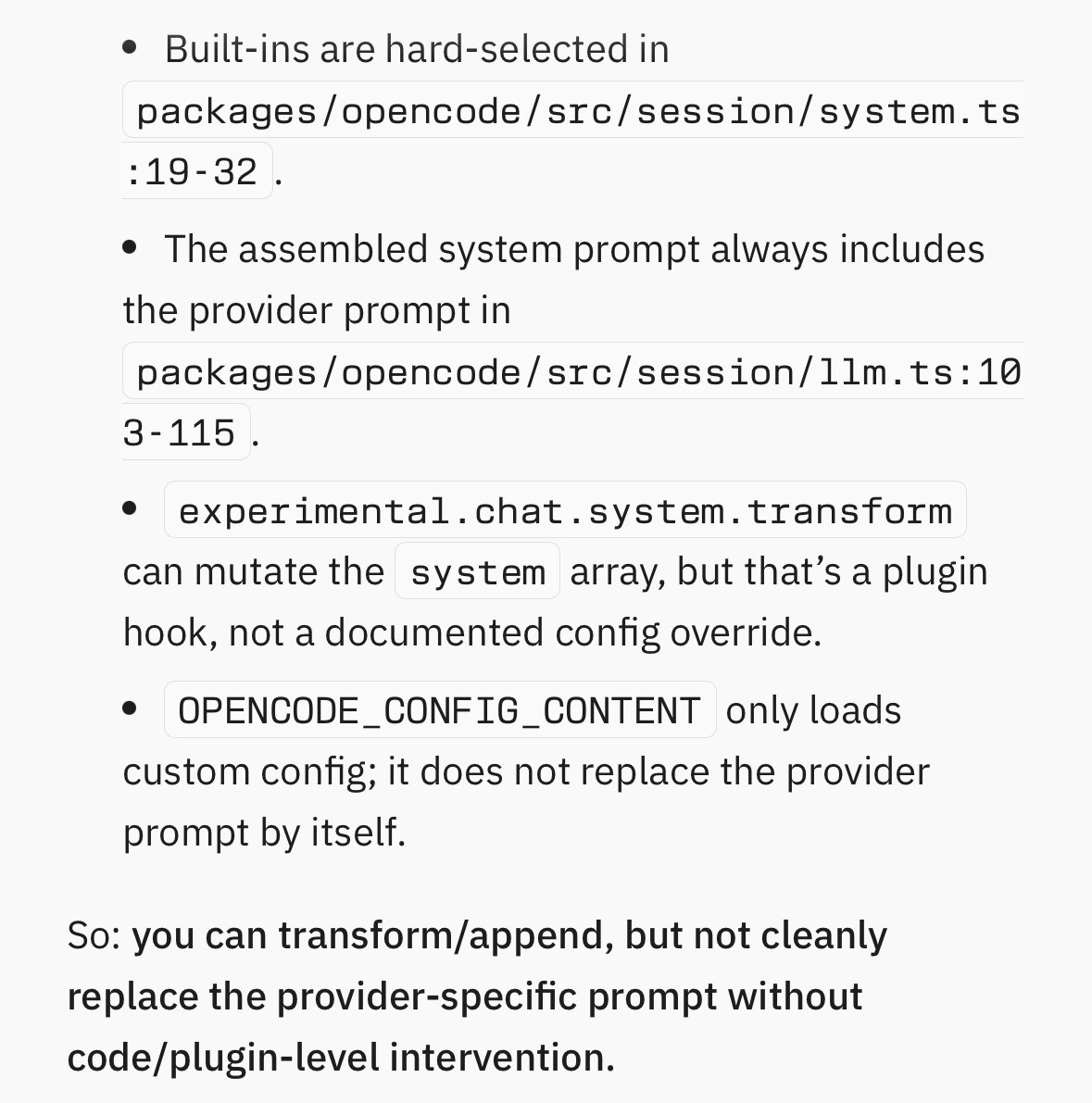
Would love you to prove me wrong, but AFAICT the provider specific prompts are always injected prior to any custom prompts.
@turbovadim@davis7 I do appreciate the background terminal feature in codex. I tried building a pi extension to do something similar, but ended up having to modify pi itself.
@yoavtzfati I’m not an Anthropic customer, but they absolutely do owe it to their customers to provide the service they promised.
E.g. if I pay for a flight and it gets delayed significantly or cancelled I’m entitled to compensation. The same principle applies here.