𝗢𝘂𝗿 𝗔𝗜 𝗷𝘂𝘀𝘁 𝘀𝗲𝘁 𝗮 𝗻𝗲𝘄 𝗿𝗲𝗰𝗼𝗿𝗱 on Terence Tao’s optimization constants list, the 𝗳𝗶𝗿𝘀𝘁 𝗔𝗜-𝗴𝗲𝗻𝗲𝗿𝗮𝘁𝗲𝗱 𝗿𝗲𝘀𝘂𝗹𝘁 to make progress on any problem in the repository, reviewed and merged by Tao.
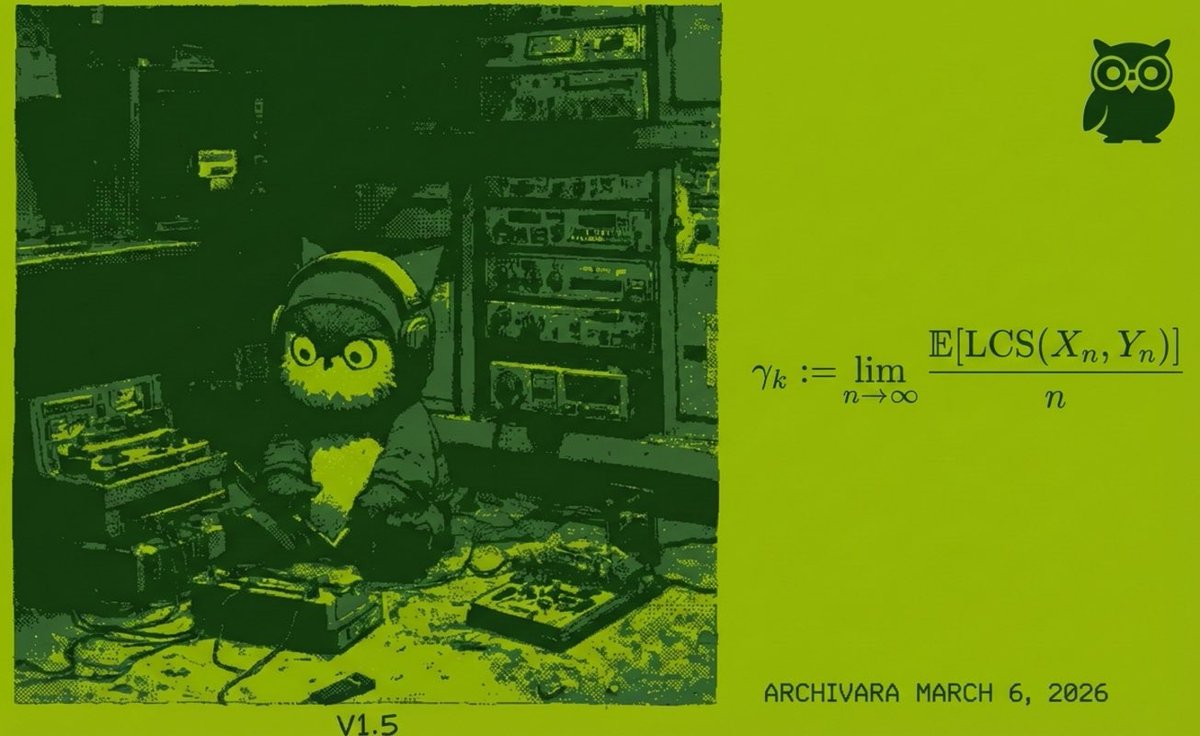
𝗔𝗿𝗰𝗵𝗶𝘃𝗮𝗿𝗮 𝟭.𝟱 found a method not previously explored in past attempts and 𝗶𝗺𝗽𝗿𝗼𝘃𝗲𝗱 𝘁𝗵𝗲 𝗯𝗲𝘀𝘁 𝗸𝗻𝗼𝘄𝗻 𝗹𝗼𝘄𝗲𝗿 𝗯𝗼𝘂𝗻𝗱 on the Chvátal–Sankoff constant, a problem that has seen only incremental progress since 1975.
1/ I built an operating system where the AI isn't running on top of the system. The system is the AI.
The transformer checkpoint is the downloadable disk. It makes every kernel decision: boot sequencing, memory mapping, device bring-up, process scheduling, shell startup.
A local qwen 2.5 0.5b sidecar lets you talk to the running system in natural language, grounded in real machine state.
Swap the checkpoint, swap the OS.
Inspired by @karpathy 's idea of a llm-os back in 2024
After 23 years, Conway’s holyhedron problem has a new best-known solution.
Using @Archivara, we construct a holyhedron with 476 faces, improving on the 492-face example of Don Hatch (2003).
Each face contains at least one polygonal hole satisfying the holyhedron conditions, and the construction has been computationally verified, with certificates verified in lean via @HarmonicMath's Aristotle.
This yields a new higher payout for Conway’s $10,000/n prize, corresponding to a bounty of approximately $21.01.
[visual with cut-out]
What if a language model reasoned like a simulation instead of using attention?
I replaced transformer attention with a learned cellular automaton. Each token only talks to its neighbors. Repeat for k steps. Information propagates like a wave.
It beats the transformer on two datasets. Thread:
Happy to announce I was selected to participate in Tyler Cowen’s 2026 @mercatus Emergent Ventures unconference in Arlington this Saturday , leading a session on AI x math and science. I have so much to talk about (representation engineering ftw).
New Lower Bounds for Even Kobon Numbers!
Thanks to @HarmonicMath 's Aristotle tool I was able to formalize the step that guarantees the existence of such new even bounds from the optimal odd solutions. Paper is in https://t.co/WY5y3v5l4M at @Archivara's repository
We believe we have fully resolved in Lean the first bountied open math problem solved with an AI system.
The problem was “Special Numbers” by Clark Kimberling, which carried a $50 bounty.
The solution came from a ~5-hour Archivara run plus human-in-the-loop Lean refinement, using GPT-5.4 xhigh.
https://t.co/iygLQNvFmI
We believe we have fully resolved, in Lean and python, one of @EpochAIResearch Frontier Math open problems: a Ramsey-style problem on hypergraphs.
The result emerged from a single GPT-5.4 Pro run and was subsequently refined into Lean with GPT-5.4 XHigh which ran for a few hours.
https://t.co/ISeNPn4E0r
@Jsevillamol
𝗢𝘂𝗿 𝗔𝗜 𝗷𝘂𝘀𝘁 𝘀𝗲𝘁 𝗮 𝗻𝗲𝘄 𝗿𝗲𝗰𝗼𝗿𝗱 on Terence Tao’s optimization constants list, the 𝗳𝗶𝗿𝘀𝘁 𝗔𝗜-𝗴𝗲𝗻𝗲𝗿𝗮𝘁𝗲𝗱 𝗿𝗲𝘀𝘂𝗹𝘁 to make progress on any problem in the repository, reviewed and merged by Tao.
𝗔𝗿��𝗵𝗶𝘃𝗮𝗿𝗮 𝟭.𝟱 found a method not previously explored in past attempts and 𝗶𝗺𝗽𝗿𝗼𝘃𝗲𝗱 𝘁𝗵𝗲 𝗯𝗲𝘀𝘁 𝗸𝗻𝗼𝘄𝗻 𝗹𝗼𝘄𝗲𝗿 𝗯𝗼𝘂𝗻𝗱 on the Chvátal–Sankoff constant, a problem that has seen only incremental progress since 1975.
3/ Archivara's agent architecture is built around forcing novel connections between fields. Instead of following the established playbook, the agent pulled from beam search in combinatorial optimization, concentration of measure theory, and subadditive ergodic processes, a synthesis that no prior work on this problem had attempted.
2/ The Chvátal–Sankoff constant asks a simple question: take two long random binary strings, what's the longest sequence of matching characters in order? That ratio approaches a constant nobody knows. For three decades, nearly every computational lower bound relied on deterministic finite state machines. Our agent abandoned that entirely, found a Monte Carlo beam search approach, ran a million trials in 44 minutes, and proved the tightest lower bound to date.
1\ For the first time, transformers can recover out-of-distribution physical laws from only noisy numerical observations (no hand-coded templates or priors) In our PHYSMDT study, we evaluate 11 equations never seen during training and obtain an exact zero-shot recovery of the **magnetic Lorentz force** (F=qvB).
Methodologically, PHYSMDT replaces autoregressive token-by-token decoding with a **masked diffusion decoder** that predicts masked tokens jointly, then applies **recursive soft-masking refinement** inspired by the ARChitects / @arcprize diffusion-style setup.
The most informative “near miss” is the **Coriolis force**: the model predicts (x_0 * x_1 * sin(x_2)), close to the true (2 * x_0 * x_1 * x_3 sin(x_2)), but off by the **constant factor and variable assignment** (reported (R^2=0.75), improving to 0.80 with test-time fine-tuning).
For the record: all 19 pages of this paper were generated end-to-end by Archivara's agent, and the full run completed in **4.61 hours** with the agent having access to an A100 GPU.
3/ Robustness and mechanistic findings: on Tier 3 equations, symbolic accuracy drops only **4.1 percentage points** from 0% to 20% Gaussian noise, indicating resilience to measurement error.
Additionally, **tree-positional encoding is indispensable** (removal collapses performance to 0% and (R^2=-1)).
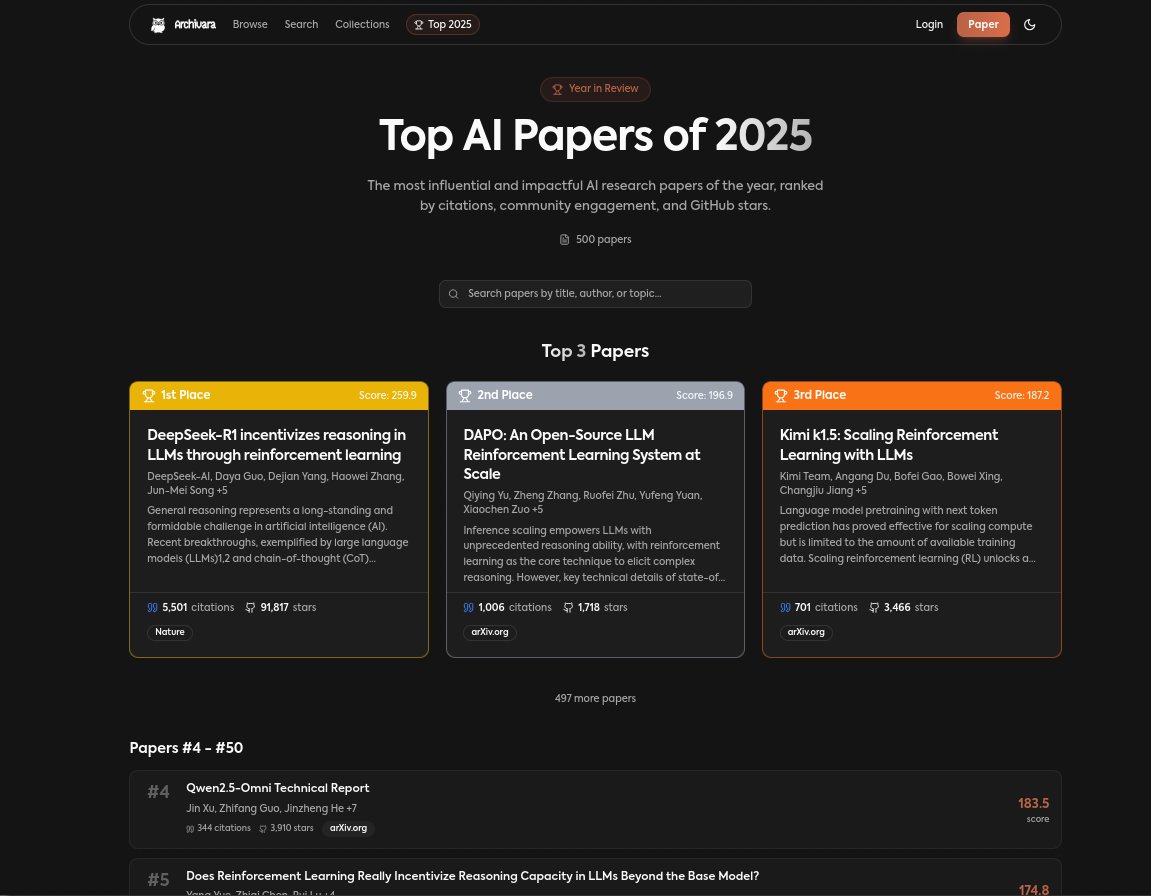
As we enter a new stage of AI research in 2026, we look back at the most interesting and impactful AI papers of 2025. From DeepSeek R1 to Absolute Zero Reasoner, we present Archivara’s list of the top AI papers of 2025.