@amirhusain_tx very much needed to know it Sir, young people have not seen
during this AI race, not everyone would have the confidence on their idea and determination to pull it off, these will also differentiate him from the crowd
I work with a lot of bright, young people who are characteristically worried about the future. How will they differentiate themselves? How will they compete? How will they keep up with AI?
A bit of healthy paranoia is a good thing, and I don't discourage it.
But after listening to them for a bit, I inevitably point out that in my career I have come across thousands of people who I've interviewed, worked with and gotten to know. Not everyone is pushed. Not everyone is interested.
Some people just don't want to... deeply engage. Work hard. Obsess. Be paranoid about self improvement. Worry about competition. Take responsibility.
If you are a bit obsessive, that is already your differentiator. It means you care about outcomes. You care about what value you will be capable of delivering. Now just turn that energy toward self improvement. Make a list of things you can learn. A list of skills you can acquire. A group of smart people with whom you can get together and discuss, learn collectively. A productive cause you can serve.
Turn paranoia toward action and nothing can stop you.
CAN INDIVIDUALS BOOTSTRAP INDUSTRIES?
One of the most amazing stories of the 20th century was the growth and innovation of the US aviation industry. How did these huge companies we look at in awe start? Government policies? Funds?
Surprisingly, the history of American aviation shows a clear trajectory where almost every major aerospace pioneer started out through private boot-strapping, personal risk, and organic market experimentation. To me, this is a very empowering fact and it means even two brothers running a bicycle shop have a shot at innovation. Let's look at the examples:
The Wright Brothers funded their wind-tunnel research and Kitty Hawk gliders entirely from the profits of their Dayton bicycle shop before landing their first U.S. Army Signal Corps contract in 1909. They already had a plane that flew with ZERO external support.
Bill Boeing self-funded his initial aircraft venture using personal timber profits.
The father of rockets, Robert Goddard built and launched the world's first liquid-fueled rocket using personal funds and small academic grants, long before military interest in rocketry materialized.
Loughead/Lockheed Brothers built their first seaplane in a rented garage and offered $10 joyrides at local fairs to generate capital.
Leroy Grumman started his engineering firm using capital from an auto-body repair business, developing retractable landing gear pontoons.
Jack Northrop developed his revolutionary all-metal, stress-skin designs through private commercial ventures well before securing military contracts for the P-61 night fighter and experimental Flying Wings.
Now apply this to developing nations like Pakistan. Here are just a few PRODUCT areas where private individuals and companies can innovate with no need to navigate government restrictions or look for government funding:
1. CubeSAT electronics, comms and control design
2. CubeSAT launch "one window" project management
3. Educational aviation kits
4. Educational rocketry kits (e.g. Estes)
5. Small model aircraft piston engines
6. API businesses such as data-feeds and intel services for sat tracking and other captured datasets
7. Flight controllers, ESCs
8. Autopilot and GCS software
9. Small test rigs
10. Simulators
11. High altitude balloon kits and payloads
12. Telemetry subsystems
None of these areas are particularly capital intensive. All of these products are exportable. Many of these are aviation software, thus easily exported.
There is always a way.
One of Pakistan’s leading universities, LUMS, was gracious in asking me to be their commencement speaker this year. I was honored to accept. A few days ago, I had the privilege of addressing one of the finest groups of young Pakistani minds, a class now setting out into the world to create positive change.
I am sharing my speech here in the event it is of interest, or might be helpful to young people who are at a similar stage in life.
VIDEO LINK: https://t.co/1BI8RG2YpB
Anthropic just dropped 5 workshops on building self-improving agentic systems from scratch:
00:00 - Ship your first Claude agent
36:44 - Build memory for Claude agents
1:05:06 - Make your agent autonomous
1:26:46 - Set up a proactive agent
2:03:35 - self-improving agents (tools,skills)
These 3-hours of free Claude workshops will replace 10 paid agentic courses.
Watch today, then read article below on how to build a self-improving agentic system with Fable 5.
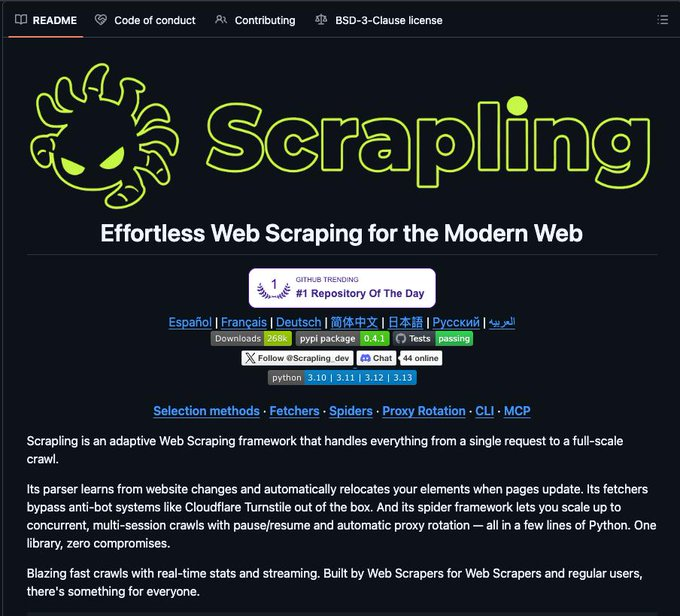
YOUR AI AGENT CAN FINALLY SCRAPE WEBSITES WITHOUT GETTING BLOCKED
- Zero bot detection
- Bypasses Cloudflare naturally
- 774 times faster than BeautifulSoup
- No need for selector maintenance
GitHub: https://t.co/4REiEjgaed
🚨Architects are going to hate this.
Someone just open sourced a full 3D building editor that runs entirely in your browser.
No AutoCAD. No Revit. No $5,000/year licenses.
It's called Pascal Editor.
Built with React Three Fiber and WebGPU -- meaning it renders directly on your GPU at near-native speed.
Here's what's inside this thing:
→ A full building/level/wall/zone hierarchy you can edit in real time
→ An ECS-style architecture where every object updates through GPU-powered systems
→ Zustand state management with full undo/redo built in
→ Next.js frontend so it deploys as a web app, not a desktop install
→ Dirty node tracking -- only re-renders what changed, not the whole scene
Here's the wildest part:
You can stack, explode, or solo individual building levels. Select a zone, drag a wall, reshape a slab -- all in 3D, all in the browser.
Architecture firms pay $50K+ per seat for BIM software that does this workflow.
This is free.
100% Open Source.
CONTRIBUTE TO YOUR NATION IN 15 EASY STEPS - ZERO GOV HELP NEEDED
1. Adopt solar. Cover canals w panels (free energy, fresh water saving)
2. Move to EVs - cars, scooters, motorbikes (free transport)
3. Plant trees EVERYWHERE you can (free clean air, free food)
4. Make ground water recharge, or infiltration tunnels (free clean water)
5. Move to drip irrigation (save 50% of fresh water)
6. Use high pressure bricks (solar energy->compacter->brick - zero pollution)
7. Adopt mesh radio networks (free wireless texting - infrastructure-less access)
8. Join LibreMesh (free community owned wifi networks https://t.co/C6WNAKeJXl
9. Keep honeybees (free pollination - ecosystem health)
10. Save 10% of your income and automatically invest it (e.g. PSX)
11. Keep public spaces clean. Don't litter. If you can, organize community trash collection. Teach everyone around you to respect public spaces.
12. Help animals and nature. (Bird houses, road bypass tunnels, save the habitat, be kind to animals, never release invasive species, donate to WWF.)
13. Donate to your local public school - books, toys, tools, money, computers, tablets, resources of any kind. Engage with them. Offer to speak to the kids once a year if you can help them.
14. Support an orphanage, a public hospital - even in a minimal way. It all adds up.
15. Start a "Little Free Library" https://t.co/GozflXZTsP
These are small things. Many of them are entirely free. We can do them today. The effect of many people doing these small things will be ENORMOUS. Just these things alone would transform your country... any country.
totally blown away by Google Gemini 3 + three.js..
just generated a 3D product interactive app with zero coding.. use hand gesture to rotate, scale, control xyz and lighting of 3D model
AI is taking over.. accept or not
tutorial with prompts & code below:
Austin Kleon reverse-engineered how every great artist actually works in his book "Steal Like An Artist"
I spent hours breaking down his principles and turned them into an AI system.
Nothing is original. Everything is a remix. Creativity is theft made elegant.
Here are 8 AI prompts that make you more creative, less blocked, and impossible to ignore:
Visualizing my re-designed living room in 3D
Nano banana -> World Labs -> WebAR (threejs)
Each of these gaussian splats are only 1.5 mb in size (.spz file type)